What Size Solar Panel to Charge a 12V Battery?
If you've ever hooked up a solar panel to a 12V battery and wondered why it never seems to fully charge, you're not alone. The real question is what size solar panel to charge a 12v battery, and the answer depends on a few key factors that most online guides skip.
For a typical 100Ah lead-acid battery used in an RV, you'll need roughly a 200W panel to fully recharge it each day, assuming 5 peak sun hours and a PWM charge controller. That number comes from real-world system losses and the battery's depth of discharge. Let's walk through how to get the exact number for your specific setup.

Image source: Wikimedia Commons / USDAgov
Quick Answer
A 100W to 200W solar panel is the standard range for a 12V battery. For a 50Ah battery, 100W works. For a 100Ah battery, aim for 200W.
These sizes assume 4 to 5 peak sun hours per day. A larger panel is needed for cloudy weather or higher daily usage.
Why Your Battery Is Probably Undercharged (And What To Do About It)
Most people pick a panel that's way too small. They see a 50W panel on sale, hook it up to their 100Ah battery, and wonder why the voltage never climbs above 12.3V. That's only about a 2.5 amp charge in full sun.
At that rate, it would take over 20 hours of perfect sun to fill a deeply drained battery.
The bigger problem is that most of us don't get 20 hours of full sun. Between clouds, early morning and late afternoon shading, and the angle of the panel, you're lucky to get 5 effective hours. A 50W panel on a 100Ah battery is a maintenance trickle at best, not a real charging solution.
Here's what actually happens. A 100Ah lead-acid battery discharges to 50% depth of discharge. That's 50Ah you need to replace.
A 50W panel puts out roughly 2.8 amps after wiring and charge controller losses. In 5 peak sun hours, you get 14Ah back. That leaves 36Ah still missing.
The battery slowly starves and sulfates over time.
The fix is simple but often missed. You need to match the panel size to the battery capacity and your daily energy use. That means doing the math once, upfront.
It takes three numbers and a very short formula.
If you're new to this, understanding the different types of solar panels is a good first step before sizing anything.
How Solar Charging Really Works: Voltage, Current, and Sun Hours
A solar panel doesn't just push power into a battery continuously. It only produces rated wattage under ideal conditions, and those conditions last only a few hours a day.
Here are the three numbers you actually need to care about.
What a 100W Panel Can Actually Deliver in Real Sun
A 100W panel is rated at 18V open circuit and about 5.5 amps at peak power. But that's in a lab with the panel perfectly perpendicular to the sun at midday. In real life, you get 70 to 85 percent of that once you account for wiring resistance, charge controller losses, and heat.
Heat alone can drop output by 10 to 15 percent on a hot roof.
On a clear day, a 100W panel will deliver around 400 to 450Wh of energy total. That's roughly 33 to 37Ah at 12V. That's enough for a 50Ah battery from 50% depth of discharge.
But for a 100Ah battery, you're falling short.

Image source: Wikimedia Commons / Trougnouf (CC BY)
The 3 Numbers That Matter: Ah, Wh, and Peak Sun Hours
The three numbers you need to know are:
- Battery capacity in amp-hours (Ah). That's how much electrical charge it holds.
- Watt-hours (Wh). Multiply Ah by system voltage. A 100Ah 12V battery holds 1200Wh.
- Peak sun hours (PSH) for your location. This is the average number of hours per day when sunlight intensity equals 1000W per square meter.
Do not guess peak sun hours. A map from the National Renewable Energy Laboratory (NREL) shows that the US ranges from about 3 hours in winter in the Pacific Northwest to 6 hours in the Southwest. That's a 2x difference, and it changes your panel size dramatically.
If you want to understand the full picture of how solar panels generate electricity, the physics behind voltage and current will make this sizing process click.
Step 1: The Battery Check — Capacity, Chemistry, and Depth of Discharge
The first question isn't "what size panel?" It's "what battery do you have?" Battery chemistry changes everything about sizing.
Lead-Acid vs Lithium: How It Changes Your Panel Size
Lead-acid and lithium batteries have very different depth of discharge numbers. This one number alone can double or halve your required panel size.
| Battery Chemistry | Safe Depth of Discharge | Usable Capacity from 100Ah | Recommended Panel Size Range |
|---|---|---|---|
| Flooded lead-acid | 50% | 50Ah | 200W to 300W |
| AGM | 50% | 50Ah | 200W to 300W |
| LiFePO4 | 80% to 100% | 80 to 100Ah | 100W to 200W |
A lithium battery lets you use nearly twice the usable capacity from the same size battery. That means you recharge more often, but each recharge cycle takes roughly the same amount of energy as a lead-acid battery that's half the size.
Here's the key thing. Lead-acid batteries also charge less efficiently. Around 85 percent of the energy going in actually gets stored.
Lithium batteries are closer to 95 percent efficient. That means a lithium system wastes less power as heat during charging.
AGM and flooded lead-acid also need an absorption phase at the end of charging. That phase can last 2 to 4 hours where the voltage is held steady, and current tapers down. That time counts toward your peak sun hours, but it's not putting full wattage into the battery.
This is why lead-acid setups often need a bigger panel to compress that absorption phase into a shorter window.
If you're comparing the pros and cons of each technology, see the full breakdown of advantages and disadvantages of solar panels for different battery chemistries.
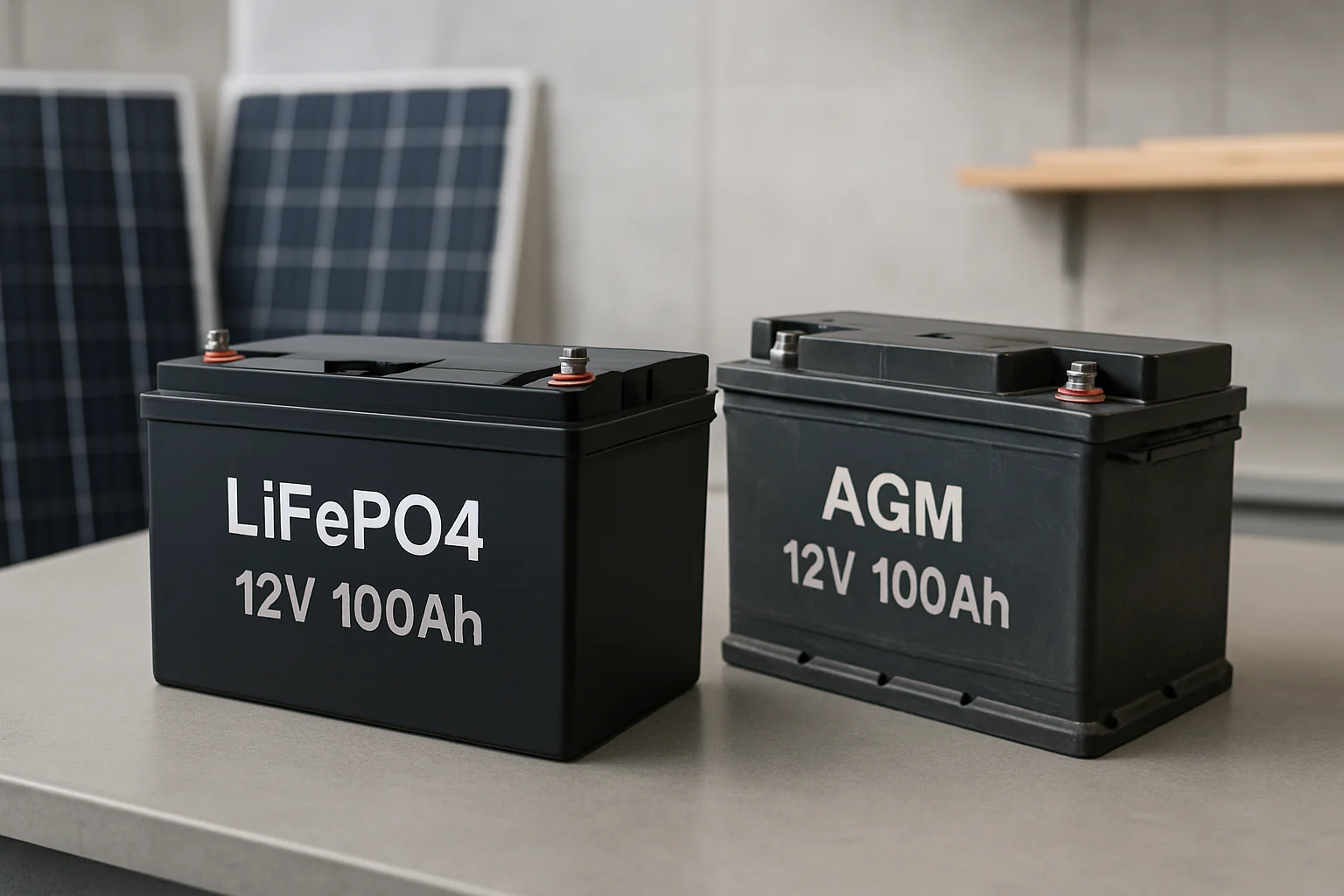
Image source: Bing (Web (fair-use with source credit))
Step 2: Figure Out Your Daily Energy Use
Now you need to know how much energy you're actually pulling from the battery each day. This is the number most people get wrong.
Occasional Top-Up vs Full Daily Recharge
There are two entirely different scenarios.
Scenario one: You use the battery lightly, maybe running a few LED lights and a small water pump for an hour each day. You draw 20Ah per day. That's a light load.
Your panel needs to replace 20Ah, not the full battery capacity.
Scenario two: You drain the battery completely every day and need it fully charged by morning. That means replacing the full usable capacity each day. For a 100Ah lead-acid battery at 50% depth of discharge, that's 50Ah.
The math for the light load scenario is straightforward.
- Daily energy use: 20Ah
- Convert to watt-hours: 20Ah × 12V = 240Wh
- Divide by peak sun hours: 240Wh / 5 hours = 48W
- Add system losses factor (25 percent): 48W × 1.25 = 60W
That's a 60W panel. Round up to 100W and you're safe.
The heavy use scenario changes things.
- Daily energy use: 50Ah
- Convert to watt-hours: 50Ah × 12V = 600Wh
- Divide by peak sun hours: 600Wh / 5 hours = 120W
- Add system losses factor: 120W × 1.25 = 150W
That's a 150W panel. Round up to 200W for buffer.
Here's a quick rule of thumb from our research: For every 100Ah of lead-acid battery, plan on 200W of solar for daily full recharge under decent sun. For lithium, half that, or 100W per 100Ah if you don't drain it fully every day.
If you're still deciding on panel type, our solar panel buying guide has the full comparison between monocrystalline and polycrystalline for different usage patterns.
The next step is finding your exact peak sun hours. That's covered in the next section.
Step 3: Find Your Peak Sun Hours (Don't Guess, Use Real Data)
Peak sun hours are the single most underestimated variable in solar sizing. A location in Phoenix gets roughly 6 peak sun hours year round. Seattle in winter gets 1.5.
That difference alone can triple your required panel size.
You can find your exact number using the NREL solar irradiance map. Look up your city or zip code and get the annual average daily total for a south facing panel at your latitude. The map is freely available from the National Renewable Energy Laboratory.
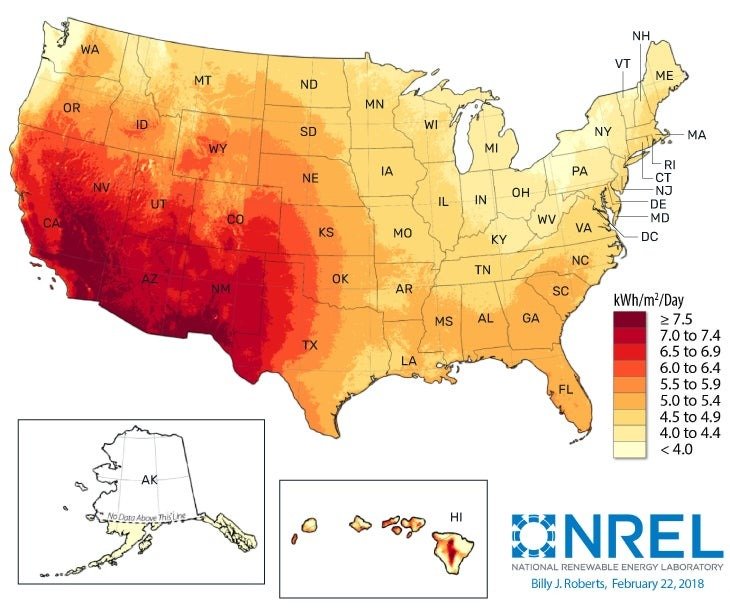
Image source: Bing (Web (fair-use with source credit))
Here is what different peak sun hour values mean for panel sizing.
| Peak Sun Hours | Panel Wattage for 100Ah Lead-Acid (50% DoD) | Panel Wattage for 100Ah Lithium (80% DoD) |
|---|---|---|
| 3 hours | 300W to 350W | 200W to 250W |
| 4 hours | 200W to 250W | 150W to 200W |
| 5 hours | 150W to 200W | 100W to 150W |
| 6 hours | 100W to 150W | 75W to 100W |
Notice how a drop from 5 to 3 peak sun hours nearly doubles the panel size. If you live in a northern climate or have winter shading, use your worst month average, not the annual average. That ensures your battery stays healthy year round.
One more thing: peak sun hours count only the hours when irradiance is at or above 800 W/m². That is typically a 4 to 5 hour window around solar noon. Panels produce very little in early morning or late afternoon.
Do not count those hours.
Step 4: The 4 Calculations That Give You Your Panel Size
Now we put everything together. You only need four calculations. I will walk through each one using a 100Ah lead-acid battery with 50 percent depth of discharge and 5 peak sun hours as an example.
The Formula: (Battery Wh × DoD) ÷ (Peak Sun Hours × System Efficiency)
Calculation 1: Find usable watt-hours.
100Ah × 12V = 1200Wh total. 50% DoD means 600Wh usable.
Calculation 2: Divide by peak sun hours.
600Wh ÷ 5 hours = 120W. This is the theoretical panel size with zero losses.
Calculation 3: Account for system efficiency.
Real world systems lose 15 to 25 percent. We use 0.75 for lead-acid with PWM. 120W ÷ 0.75 = 160W.
Calculation 4: Round up to a standard panel size.
Round 160W up to 200W. That is the recommended panel size for this setup.
Here is the same formula for a 100Ah lithium battery with 80% DoD.
- 100Ah × 12V = 1200Wh. 80% DoD = 960Wh usable.
- 960Wh ÷ 5 hours = 192W.
- With 0.85 efficiency for lithium and MPPT: 192W ÷ 0.85 = 226W.
- Round up to 250W.
You can see the lithium setup needs a larger panel because it uses more of the battery. But in practice, if you do not drain the battery fully, you can drop to a 200W panel.
For a 50Ah lead-acid battery with light use (20Ah per day), the math looks like this.
- 20Ah × 12V = 240Wh.
- 240Wh ÷ 5 hours = 48W.
- 48W ÷ 0.75 = 64W.
- A 100W panel covers it easily with buffer.
The Two Branches of the Decision Tree: PWM vs MPPT Systems
Your charge controller type changes everything about the panel size you can use. This is the biggest fork in the decision tree.
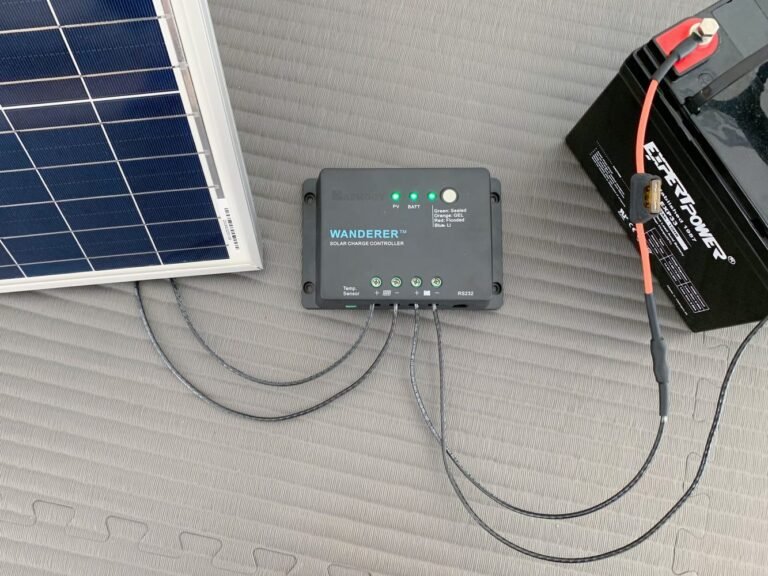
PWM stands for pulse width modulation. MPPT stands for maximum power point tracking. They work differently.
MPPT is more efficient, especially in cold weather or when your panel voltage is higher than the battery voltage.
When a 100W Panel on PWM Is Enough
PWM controllers simply connect the panel to the battery and pulse the connection to regulate voltage. They waste any voltage above the battery voltage. A 100W panel that outputs 18V into a 12V battery only uses about 12V worth of that current.
That is roughly 66 percent efficiency.
PWM works fine when the panel is roughly the same voltage as the battery. For small systems under 200W, PWM is cheap and adequate. Our research shows that a 100W panel on PWM will deliver about 5 amps in full sun.
That is enough for a 50Ah battery with light use.
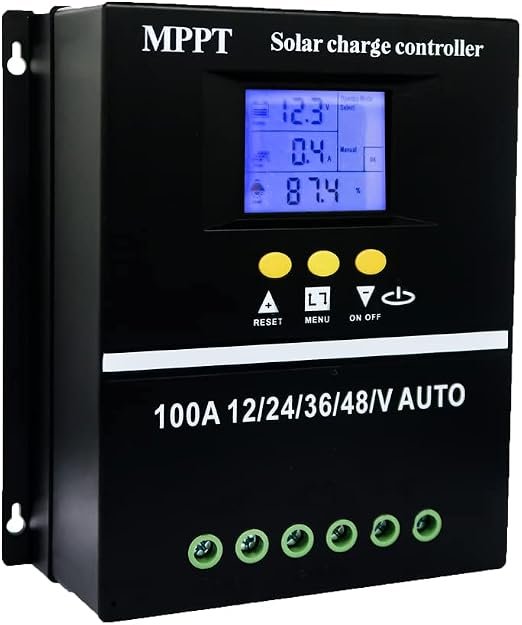
When You Need a Bigger Panel or an MPPT Controller
MPPT controllers convert excess voltage into additional current. They are typically 20 to 30 percent more efficient than PWM. That efficiency means you can use a smaller panel for the same result, or a larger panel for faster charging.
Here is the decision rule. If your panel voltage is more than 4V above the battery voltage, use MPPT. If you live in a cold climate where panel voltage rises, use MPPT.
If your system is over 200W, use MPPT.
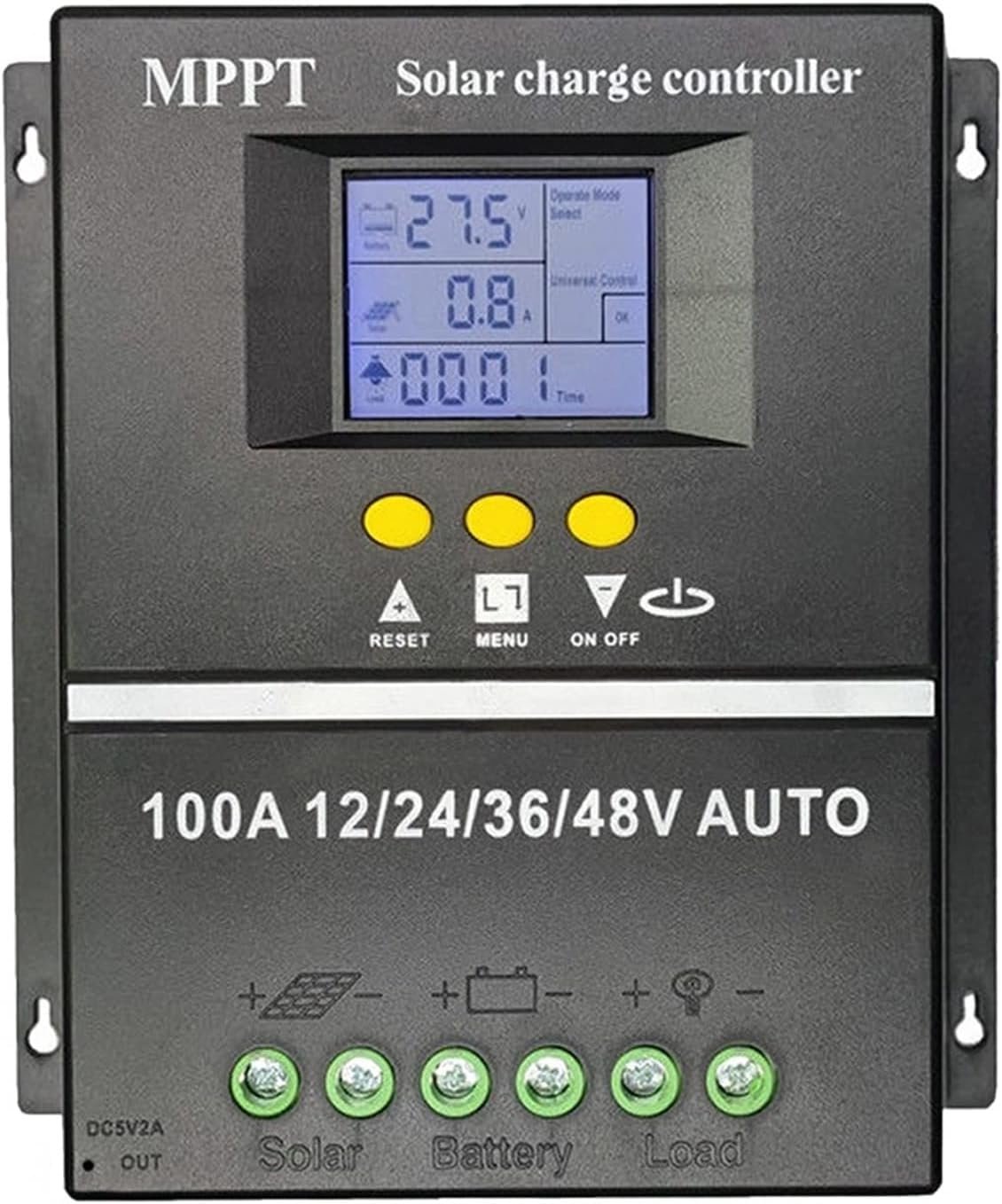
Image source: Bing (Web (fair-use with source credit))
MPPT also allows overpaneling. You can connect a 300W panel to a 20A MPPT controller charging a 12V battery. A 20A PWM controller would limit you to about 240W.
This flexibility matters if you plan to expand later.
5 Common Sizing Mistakes That Waste Your Money
These mistakes are incredibly common. Avoid them and your system will work reliably for years.
1. Ignoring system losses. People take the theoretical number and buy that exact panel size. They forget that wiring voltage drop, dust on panels, and controller inefficiency eat 20 to 30 percent.
Always multiply by 1.25 or 1.3.
2. Using the battery's total capacity instead of usable capacity. A 100Ah lead-acid battery is not a 100Ah usable battery. It is 50Ah usable.
Sizing for 100Ah will leave you with half the required power.
3. Guessing peak sun hours. Using an average of 5 hours for everyone is wrong. Check your local NREL data.
A mistake of 1 hour changes panel size by 20 percent.
4. Using a PWM controller with a high voltage panel. A 300W panel with 36V Voc into a 12V battery via PWM wastes more than half the power. MPPT is mandatory here.
5. Undersizing the charge controller. If you buy a 20A PWM controller for a 300W panel, the controller limits current. The panel never delivers its full wattage.
Always size the controller for the total panel wattage divided by battery voltage, times 1.25.
Real-World Examples: 50Ah, 100Ah, and 200Ah Battery Setups
Here are three complete examples using the formulas above. I include the charge controller recommendation for each.
50Ah lead-acid battery (AGM), occasional use, 2 peak sun hours (winter Pacific NW).
- Daily draw: 15Ah (lights, phone charging)
- Usable capacity: 25Ah (50% DoD)
- Watt-hours: 15Ah × 12V = 180Wh
- Panel wattage: 180Wh ÷ 2h ÷ 0.75 = 120W
- Round up to 150W. Use a 15A MPPT controller because panel voltage will be higher than battery in cold.
100Ah lead-acid battery, daily full recharge, 5 peak sun hours (southwest summer).
- Daily draw: 50Ah (50% DoD)
- Watt-hours: 600Wh
- Panel wattage: 600Wh ÷ 5h ÷ 0.75 = 160W
- Round up to 200W. Use a 20A MPPT controller. A 200W panel at 18V with MPPT will give about 11 to 12 amps, fully charging in about 5 hours.
200Ah lithium battery, daily full recharge, 4 peak sun hours (midwest spring/fall).
- Daily draw: 160Ah (80% DoD)
- Watt-hours: 160Ah × 12V = 1920Wh
- Panel wattage: 1920Wh ÷ 4h ÷ 0.85 = 565W
- Round up to 600W. Use a 60A MPPT controller. Two 300W panels in series to reduce voltage drop.
In all cases, verify your peak sun hours and adjust the efficiency factor for your specific equipment. If you want to understand the main components of a solar panel system, that knowledge will help you choose between series and parallel wiring for multiple panels.
The Charge Controller Decision: How It Affects Your Panel Choice
Your charge controller is the middleman. If it is undersized, your panel never delivers full power. If it is oversized, you waste money.
The rule is simple. Take your total panel wattage and divide by battery voltage. That gives you the controller amperage.
Then multiply by 1.25 for the safety margin. A 200W panel at 12V gives 200 ÷ 12 = 16.7A. Multiply by 1.25 and round up to 20A.
MPPT controllers also have a voltage limit. Check the maximum input voltage on the spec sheet. A 100V controller can handle two 36V panels in series, but not three.
Exceeding that voltage, especially on a cold day, destroys the controller instantly.
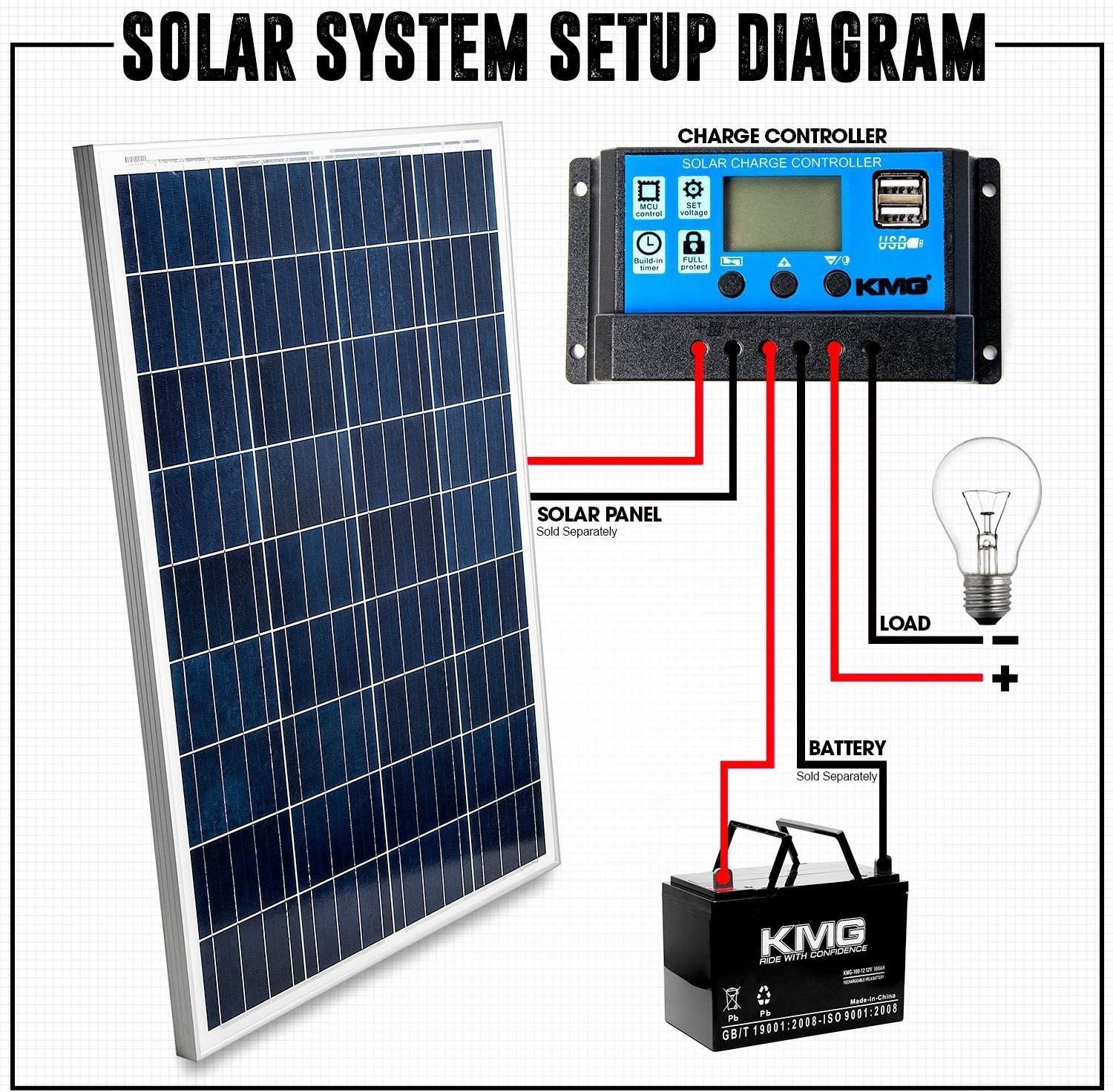
Image source: Bing (Web (fair-use with source credit))
For small systems under 200W, a 10A PWM controller is fine. For systems over 200W or with higher voltage panels, step up to MPPT. The extra cost pays for itself in faster charging and less wasted energy.
Frequently Asked Questions
Can I use a 50W panel to charge a 100Ah battery?
Yes, but only for maintenance. A 50W panel delivers about 2.5 amps under good sun. To fully recharge a 100Ah lead-acid battery from 50% depth of discharge, you would need roughly 20 hours of peak sun.
That is not practical for daily use.
What size charge controller do I need for 200W solar?
For 200W at 12V, use at least a 20A controller. The math is 200W ÷ 12V = 16.7A. A 20A controller with a 25% safety margin handles that comfortably.
If you plan to expand, go with a 30A MPPT controller.
Do I need an MPPT controller for a 100W panel?
Not typically. A 100W panel with a PWM controller will deliver about 5 to 6 amps into a 12V battery. That is usually enough for small setups.
MPPT adds cost and complexity that is not justified at 100W unless you have shading issues or cold weather.
How many peak sun hours do I need to charge a 12V battery?
You need at least 3 peak sun hours for a reliable daily charge with a moderately sized panel. Below 3 hours, you will need a significantly larger panel or multiple days to fully recharge. Check the NREL map for your specific location.
Can I connect two 100W panels in parallel to charge a 12V battery?
Yes, if both panels are the same voltage rating. Parallel wiring keeps the voltage at 12V and doubles the current. Use a combiner box or Y connectors and fuse each panel.
A 200W total from two 100W panels works perfectly with a 20A charge controller.
Your Final Decision Guide: A Simple 3-Step Plan
Step one: Know your battery. Write down the Ah rating and the chemistry. Decide how deeply you will discharge it each day.
That gives you your daily watt-hour target.
Step two: Look up your peak sun hours on the NREL map. Use the winter month average if you need year round reliability. Divide your daily watt-hour target by peak sun hours, then add 25 percent for losses.
Step three: Round up to the nearest standard panel size. Pick your charge controller based on total wattage and voltage. If your panel voltage is more than 4V above battery voltage, choose MPPT.
If not, PWM works fine.
That is the whole process. Measure once, do the math, buy the right size. Your battery will thank you.