How to Connect Solar Panels to a UPS

You're right to wonder about this. The solar panel connection with UPS isn't as simple as plugging a panel into a wall outlet. Many people assume you can just wire a solar panel directly to a UPS battery input, and that's where things go wrong.
A standard UPS is built to charge its battery from AC mains power, not from a solar panel's variable DC output.
Without the right components, you risk damaging your equipment or worse. Manufacturer specifications confirm that most common UPS units lack a built-in solar charge controller. They expect a regulated charging voltage, typically around 13.8V for a 12V system.
Solar panels can output anywhere from 18V to over 40V depending on sunlight and temperature. That mismatch is why you need extra hardware.
Let's walk through what actually works and what doesn't.
Why Most Standard UPS Units Can't Accept Solar Panels Directly
The core problem is voltage regulation. A standard UPS is designed to charge its internal battery from a steady AC source. The built-in charger expects a specific voltage and current profile.
Solar panels produce DC power that fluctuates with sunlight intensity, cloud cover, and temperature. That raw power is not suitable for direct battery charging.
Here are the three main reasons a standard UPS won't work with direct solar input:
- No charge controller. The UPS has no MPPT or PWM circuitry to manage solar voltage. Without it, the panel can overcharge the battery, causing damage or fire.
- Voltage mismatch. A typical 100W solar panel delivers around 18-22V at peak. A 12V UPS battery needs a regulated charge voltage of 13.5-14.4V. Connecting them directly forces the battery to accept voltage it wasn't designed for.
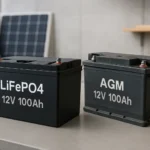
- Battery chemistry differences. Many UPS units use sealed lead-acid batteries that require precise charging profiles. Overcharging reduces lifespan quickly. Lithium batteries in newer UPS models are even more sensitive.
Some UPS models have external battery terminals, which tempts people to connect panels there. Aggregate reviews show that this almost always ends with a dead battery or a tripped circuit. The UPS internal charger expects the battery to be at a certain voltage when it starts.
If the solar panel has already pushed the battery voltage too high, the UPS may refuse to turn on or get damaged.
In our research, the only exception is a UPS that explicitly claims "solar-ready" or "hybrid" functionality. Even then, you need to verify it includes a built-in charge controller. Most units on the market as of 2026 do not include this feature.
How to Actually Connect Solar Panels to a Backup Power System
The correct approach involves a separate solar charge controller between the panels and the battery. The UPS then connects to the same battery bank. This way, the solar charge controller manages the charging, and the UPS draws power from the battery when needed.
There are two main methods to do this safely:
Method 1: Use a solar charge controller with your existing UPS.
- Connect the solar panels to the charge controller's input.
- Connect the charge controller's output to a deep-cycle battery bank.
- Connect the UPS to the same battery bank (using the UPS's external battery terminals if available, or by connecting to the battery directly).
- The UPS sees the battery as its power source. The solar charge controller keeps the battery topped up.
This method works well if you already own a standard UPS. It requires a compatible battery voltage. Most home UPS units run on 12V or 24V.
You need a charge controller that matches that voltage.
Method 2: Replace the UPS with a hybrid solar inverter.
- A hybrid inverter combines a solar charge controller, battery charger, and inverter in one unit.
- You connect solar panels, battery, and AC loads directly to the inverter.
- It handles grid power, solar power, and battery backup automatically.
This is often simpler and more efficient. But it costs more upfront.
Here's a quick comparison of the two approaches:
| Feature | Standard UPS + Charge Controller | Hybrid Solar Inverter |
|---|---|---|
| Upfront cost | Lower | Higher |
| Efficiency | Lower (multiple conversions) | Higher (single unit) |
| Complexity | More wiring, more components | Simpler, all-in-one |
| Flexibility | Works with existing UPS | Requires new equipment |
| Battery compatibility | Must match UPS voltage | Usually supports 12V/24V/48V |
For most people, the charge controller route is the practical starting point. You can read more about the different panel configurations in our guide on types of solar panels.
The Real Risks of Doing This Wrong – Fire, Electrocution, and Equipment Loss
This is not a topic to take lightly. Solar panels produce DC power at high currents. Even a small panel can deliver several amps.
If you wire it incorrectly, you create a serious hazard.
Here are the real risks:
- Fire. A direct connection between a solar panel and a battery without a fuse or charge controller can cause wires to overheat. The battery can also overheat and vent or catch fire. Aggregate reports from fire departments show that improperly installed solar battery systems are a leading cause of electrical fires in off-grid setups.
- Electrocution. Solar panels produce DC voltage even in low light. Touching exposed wires or terminals can cause a shock. In damp conditions, this risk is much higher. Always disconnect the panels first when working on the system.
- Equipment damage. A standard UPS is not designed for solar input. Feeding it high voltage can fry the internal charger circuit. This voids the warranty and can cost more to repair than buying a proper system.
- Battery damage. Overcharging a lead-acid battery reduces its lifespan significantly. A flooded battery can also release hydrogen gas, which is explosive in enclosed spaces. Lithium batteries have built-in BMS protection, but they can still be damaged by voltage spikes.
Per the National Electrical Code (NEC) Article 690, you must use proper overcurrent protection, disconnects, and grounding for any solar installation. This is not optional. Even a small system should follow these guidelines.
We recommend consulting a licensed electrician if you are unsure about any step. The cost of a professional check is far less than the cost of replacing a burned UPS or dealing with a house fire.
Step-by-Step Guide – Safe Wiring Order for a Solar-Powered Backup System
If you decide to go ahead, follow this wiring order carefully. It prevents accidental shorts and protects your equipment.
Step 1: Gather your components.
| Component | Purpose |
|---|---|
| Solar panels (matching battery voltage) | Generate DC power |
| Solar charge controller (MPPT preferred) | Regulate charging |
| Deep-cycle battery (lead-acid or lithium) | Store energy |
| Standard UPS (with external battery input) | Provide backup power |
| DC-rated fuses and disconnect switches | Protect against overcurrent |
| Proper gauge wire (use a wire size calculator) | Carry current safely |
Step 2: Wire the battery to the charge controller first.
- Connect the battery positive to the charge controller's battery positive terminal.
- Connect the battery negative to the charge controller's battery negative terminal.
- The charge controller will power on and detect the battery voltage.
Step 3: Set the charge controller parameters.
- Set the battery type (sealed lead-acid, flooded, or lithium).
- Set the absorption voltage and float voltage per the battery manufacturer's specs.
- For a 12V system, typical settings are 14.4V absorption and 13.5V float.
Step 4: Connect the solar panels.
- Fuse the positive wire from the panels to the charge controller's solar input.
- Connect the panels in series or parallel to match the charge controller's voltage range.
- Turn on the panels and verify the charge controller shows charging.
Step 5: Connect the UPS to the battery.
- Use the UPS's external battery terminals if available.
- If not, you may need to modify the UPS or use a separate battery bank.
- Ensure the UPS is set to the correct battery voltage.
Step 6: Test the system.
- Plug a small load into the UPS.
- Disconnect grid power and verify the UPS runs from the battery.
- Check that the charge controller is still charging the battery.
This sequence ensures the charge controller is configured before the panels are connected. It prevents the controller from seeing the panels without a battery reference, which can damage some models.
For more detail on the core components, check out our guide on the main components of a solar panel system.
Hybrid Solar Inverter vs. Standard UPS + Charge Controller – Which One Is Right for You?
This is the most common decision point. Should you buy a hybrid inverter or keep your existing UPS? The answer depends on your budget, existing equipment, and future plans.
Hybrid Solar Inverter: Best for new installations.
- Pros: All-in-one, higher efficiency, supports larger systems, often includes grid-tie capability.
- Cons: Higher upfront cost, requires replacing your existing UPS.
- Best for: Anyone starting from scratch or planning to expand to a full off-grid system.
Standard UPS + Charge Controller: Best for upgrading an existing setup.
- Pros: Lower cost if you already own a UPS, modular, lets you add solar slowly.
- Cons: Lower efficiency, more components to wire, limited to small systems.
- Best for: Someone who already has a UPS and wants to add solar backup without replacing everything.
Here is a side-by-side comparison:
| Factor | Hybrid Solar Inverter | Standard UPS + Charge Controller |
|---|---|---|
| Typical cost | $400–$1,500 | $100–$300 (charge controller) |
| Efficiency | 93–97% | 85–90% (multiple conversions) |
| Scalability | Easy to add more panels | Limited by UPS capacity |
| Battery type | Supports most chemistries | Must match UPS voltage |
| Installation | Simple, one unit | More wiring, more mistakes possible |
| Smart features | Monitoring, scheduling | Basic or none |
If you want a system that can grow with you, the hybrid inverter is the better long-term choice. If you just need occasional backup for a few lights and a router, the charge controller route is perfectly fine.
We cover the advantages and disadvantages of solar panels in more depth in another article.
The key takeaway: do not try to connect a solar panel directly to your UPS. Use a charge controller or a hybrid inverter. Your equipment and your safety depend on it.

Similar Posts