How Many Volts Does a Solar Panel Produce?

You have probably searched for it yourself: how many volts does a solar panel produce? It sounds like a simple question with a single number answer. But the reality is more layered than that.
A 12V nominal panel can put out anywhere from 18V to 22V depending on operating conditions.
Manufacturer specifications and Standard Test Conditions (STC) give us a clear baseline at 25°C and 1000 W/m² irradiance. Even then, the voltage changes with temperature, load, and panel design. That is what we will walk through so you can size your system correctly.
Why Everyone Gets This Wrong (And Why It Matters)
The most common mistake is confusing nominal voltage with actual voltage. A 12V panel does not output 12V. It outputs around 18V to 22V open-circuit.
The label just means it is designed to charge a 12V battery bank.
Why does this matter? Hook a 12V panel to a 12V battery without a controller, and the higher voltage will overcharge and damage it. Wire four panels in series, and the voltage adds up.
A system with four nominal 12V panels can reach 80V or more at the input. That number decides what controller and wire gauge you need.
The same applies to 24V and 48V systems. People buy equipment based on the nominal rating and wonder why things fail. The panel datasheet tells the real story.
There is also a seasonal trap. Panel voltage climbs as temperature drops. A panel rated for 40V Voc at 25°C can push 46V on a freezing morning.
If your charge controller is rated for 45V max, you just cooked it.
The Quick Answer (But Read On — It Changes)
A standard 60-cell residential panel produces about 38 to 40V open-circuit.
A 72-cell panel produces roughly 45 to 48V open-circuit.
A 12V nominal portable panel outputs 18 to 22V open-circuit.
These numbers drop under load.
Temperature and sunlight change the actual voltage.
Those numbers are a starting point. Your specific panel and climate shift the answer. The next section explains how voltage really works.
How Solar Panel Voltage Actually Works
A solar panel has three voltage ratings: Voc (open-circuit voltage), Vmp (maximum power voltage), and nominal voltage. Voc is the voltage with nothing connected. It is the highest voltage the panel can produce.
You use this to size your charge controller.
Vmp is the voltage at peak power. It is lower than Voc. A 60-cell panel has about 40V Voc and 33V Vmp.
Your system runs at Vmp under full sun.
Nominal voltage is a labeling convention. A 12V panel outputs 18V Voc and 15V Vmp. The label is for battery matching, not actual output.
Standard Test Conditions (STC) give a consistent baseline at 25°C and 1000 W/m². Manufacturers publish these numbers on the datasheet.
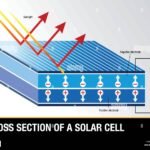
The number of cells drives voltage. Each cell produces 0.6V to 0.7V. A 60-cell panel gives 38-40V Voc.
A 72-cell panel gives 45-48V Voc. Commercial panels with 96 cells push past 60V. The various panel designs affect the exact range you get.
The voltage temperature coefficient is negative. Voltage drops as temperature rises. Voltage rises as temperature falls.
Per National Renewable Energy Laboratory testing standards, this matters most in winter.
The Decision Tree: What Voltage Is Your Panel Really Putting Out?
Your situation determines the real answer. Work through these questions.
If you have a portable camping panel, check the label. Most 100W panels are 12V nominal. They produce about 18-22V Voc.
That works well for charging a 12V battery with a PWM controller.
If you have a rooftop residential panel, it is likely 60 or 72 cells. A 60-cell panel gives about 40V Voc. You wire multiple panels in series to reach the 300-500V range that string inverters accept.
If you are building an off-grid system, the battery voltage decides the panel voltage. A 12V battery needs Vmp above 14V. A 24V battery needs Vmp above 28V.
A 48V battery needs Vmp above 50V.
If you are in a cold climate, your Voc will be higher than the datasheet says. Use the temperature coefficient to calculate the worst-case voltage. If that exceeds your equipment's max input, you need a different panel or controller.
If you are wiring in series, add up each panel's Voc. The total must stay under the controller's max input with a safety margin. If wiring in parallel, the voltage stays the same.
Mistakes to Avoid (Don't Fry Your Charge Controller)
The biggest mistake is ignoring cold weather voltage spikes. A panel producing 40V Voc at 25°C can hit 46V at -10°C. If your controller is rated for 45V max, that spike destroys it.
The second mistake is treating nominal voltage as actual voltage. A 24V panel does not output 24V. It outputs around 36-44V Voc.
Wire two in series and you get 72-88V. That matters for controller selection.
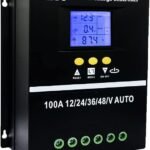
The third mistake is using a PWM controller when you should use MPPT. PWM works best when panel voltage is close to battery voltage. MPPT handles higher panel voltages efficiently.
If your panel's Vmp is well above your battery voltage, go with MPPT.
The fourth mistake is ignoring voltage drop over long wire runs. Thin wire and long distance cause voltage loss. The panel might produce 40V at the source but only 35V at the controller.
That wastes power. Use thicker wire or run a higher voltage string.
The fifth mistake is mixing panels with different voltages in the same string. A 60-cell and a 72-cell panel in series will drag each other down. Match the specs.
For a deeper look at the internal parts that affect this, read about the core components of a solar panel.
How to Measure Voltage Yourself (With a Multimeter)
You do not need to guess. A simple multimeter gives you the real number in seconds.
Set the multimeter to DC voltage. Choose a range higher than your expected Voc. 200V is a safe bet for most residential panels.
Disconnect the panel from any controller or battery. You want the open-circuit reading.
Touch the red probe to the positive MC4 connector and the black probe to the negative. Do this in full sun for the most accurate reading.
Compare that number to the Voc on the datasheet. They should be close. If they are far off, the panel could be damaged or shaded.
Now try it under load. Connect the panel to a charge controller and battery. Measure the voltage again at the controller input.
You will see Vmp, which is lower than Voc. That is normal.
A portable 100W panel might show 20V open-circuit and 15V under load. That 5V difference explains why a PWM controller wastes some energy but an MPPT one recovers it.
Do this test on a cold morning and again on a hot afternoon. The difference can be several volts. That is the temperature coefficient at work.
Understanding this process ties directly into the fundamental physics of how panels work, which we cover in our guide on how solar panels generate electricity.
FAQ: The 5 Questions People Ask Most
Does a 12V solar panel output 12 volts?
No. A 12V nominal panel outputs about 18-22V open-circuit and 15-18V under load. The 12V label means it is designed for a 12V battery system.
The actual operating voltage is higher.
What voltage does a 100W solar panel produce?
A typical 100W portable panel produces 18-22V open-circuit and 15-18V under load. The exact number depends on the cell count and quality. Check the datasheet for the specific Voc and Vmp.
How many volts do residential solar panels produce?
Most residential panels use 60 or 72 cells. A 60-cell panel produces about 38-40V Voc. A 72-cell panel produces about 45-48V Voc.
These are wired in series to reach 300-500V for the inverter.
Can solar panel voltage damage my equipment?
Yes, especially in cold weather. Rising voltage in low temperatures can exceed your charge controller or inverter's maximum input. Always calculate worst case Voc using the temperature coefficient.
Leave a 10-15% safety margin.
Does voltage drop when I plug in a device?
Yes. The panel voltage drops from Voc to Vmp under load. That is normal.
If the voltage drops far below Vmp, the load may be too large or the panel may be shaded.
Your Cheat Sheet: Quick Voltage Reference for Common Panels
| Panel Type | Cell Count | Voc (Typical) | Vmp (Typical) | Best For |
|---|---|---|---|---|
| 12V portable | 36 cells | 18-22V | 15-18V | RV, camping, 12V battery |
| Residential 60-cell | 60 cells | 38-40V | 30-33V | Grid-tied home systems |
| Residential 72-cell | 72 cells | 45-48V | 36-40V | Larger residential / small commercial |
| Commercial 96-cell | 96 cells | 58-64V | 48-54V | Commercial and utility scale |
| 24V nominal panel | 72 cells | 36-44V | 30-36V | 24V off-grid battery banks |
These numbers come from Standard Test Conditions (25°C, 1000 W/m²). Your actual voltage will vary with temperature and sunlight.
Keep this table handy when shopping for panels or designing a system. It saves you from the common mistake of buying a panel that does not match your controller or battery voltage. For more context on the different options available and how to pick the right one for your setup, check out our article on the types of solar panels.
Series vs. Parallel: How Wiring Changes Voltage
Wiring panels in series adds voltage. Wiring them in parallel keeps voltage the same.
Four 40V panels in series give you 160V Voc. Current stays the same. That higher voltage lets you use thinner wire over longer runs.
It is the standard approach for grid-tied systems.
Four 40V panels in parallel give you 40V Voc. Current multiplies by four. You need thicker wire and shorter runs.
Parallel works best for small off-grid systems with a 12V or 24V battery bank.
Mixed wiring is an option too. Two series strings of two panels each gives 80V at double the current. That is a common configuration for MPPT controllers.
The wrong choice wastes money or damages equipment. If your controller maxes out at 150V input, you can safely wire three 40V panels in series (120V). Wire four (160V) and the controller fails.
Check the controller specs first. For a broader understanding of how these electrical choices affect performance, look at the advantages and disadvantages of solar panels.
Matching Voltage to Your Equipment
Your charge controller has a maximum input voltage. Your inverter has an operating range. Your battery bank has a nominal voltage.
All three must match the panel string voltage.
An MPPT controller needs the panel Vmp to be higher than the battery voltage. How much higher? At least 5V to 10V for good efficiency.
A 40V panel Vmp charging a 12V battery works well. A 20V Vmp charging a 48V battery does not.
PWM controllers are simpler. They need the panel voltage to be close to the battery voltage. A 18V Voc panel charging a 12V battery works fine.
A 40V Voc panel charging a 12V battery wastes over half the power.
String inverters for grid-tied systems expect a specific voltage range. Most residential inverters work between 250V and 500V. That means 6 to 12 panels in series, depending on the panel Voc.
Mismatched voltages cause efficiency loss or equipment failure. Always check the datasheets before wiring. If you are shopping for a new system, the solar panel buying guide helps you match all the pieces correctly.
Real-World Voltage Examples
A typical 400W residential panel has a Voc around 49V and Vmp around 41V. That is a modern 72-cell panel. On a hot summer day, the Voc might drop to 45V.
On a freezing winter morning, it can hit 55V.
A 200W portable folding panel usually has 36 cells. Its Voc is about 22V. Its Vmp is about 18V.
In partial shade, the voltage drops below 15V. An MPPT controller handles that better than a PWM.
A 100W rigid panel for a shed is 36 cells. Its Voc is 22V. Under load in full sun, it sits at 18V.
That charges a 12V battery through a PWM controller with little loss.
A 450W commercial panel uses 96 cells. Its Voc is about 62V. Its Vmp is about 52V.
These are common on large installations. They need high-voltage MPPT controllers or string inverters.
These numbers shift with temperature. For every 1°C below 25°C, Voc increases by about 0.3%. At -20°C, that 49V panel becomes 55V.
Know your local climate before finalizing the string size. For the fundamentals that explain why these voltage changes happen, read about how do solar panels work.
Safety First: When to Get Help
High voltage solar systems can kill you. A string of panels producing 400V DC is as dangerous as a live power line. DC arcs do not self-extinguish.
They can burn through metal and start fires.
Never work on a live system. Disconnect the panels from the controller first. Cover the panels with an opaque cloth to stop generation.
Use insulated tools rated for the voltage.
If your string voltage exceeds 150V, consider hiring a licensed electrician. Most DIY off-grid systems run at 12V, 24V, or 48V. Those are safer but still require proper fusing and grounding.
Grid-tied systems with string inverters often run at 300V to 500V. Only qualified professionals should install or modify these. Many jurisdictions require permits and inspections.
Per the National Electrical Code Article 690, rapid shutdown and arc fault protection are mandatory for residential systems. These safety devices protect firefighters and first responders. Do not skip them.
Your local climate also matters. Snow, ice, and high winds create additional hazards. A damaged panel can expose live DC wiring.
Inspect your system after storms. If you spot damage, disconnect and call a pro.

Similar Posts