Renogy 3000W Inverter Solar Setup: Microwave, Fridge, Tools
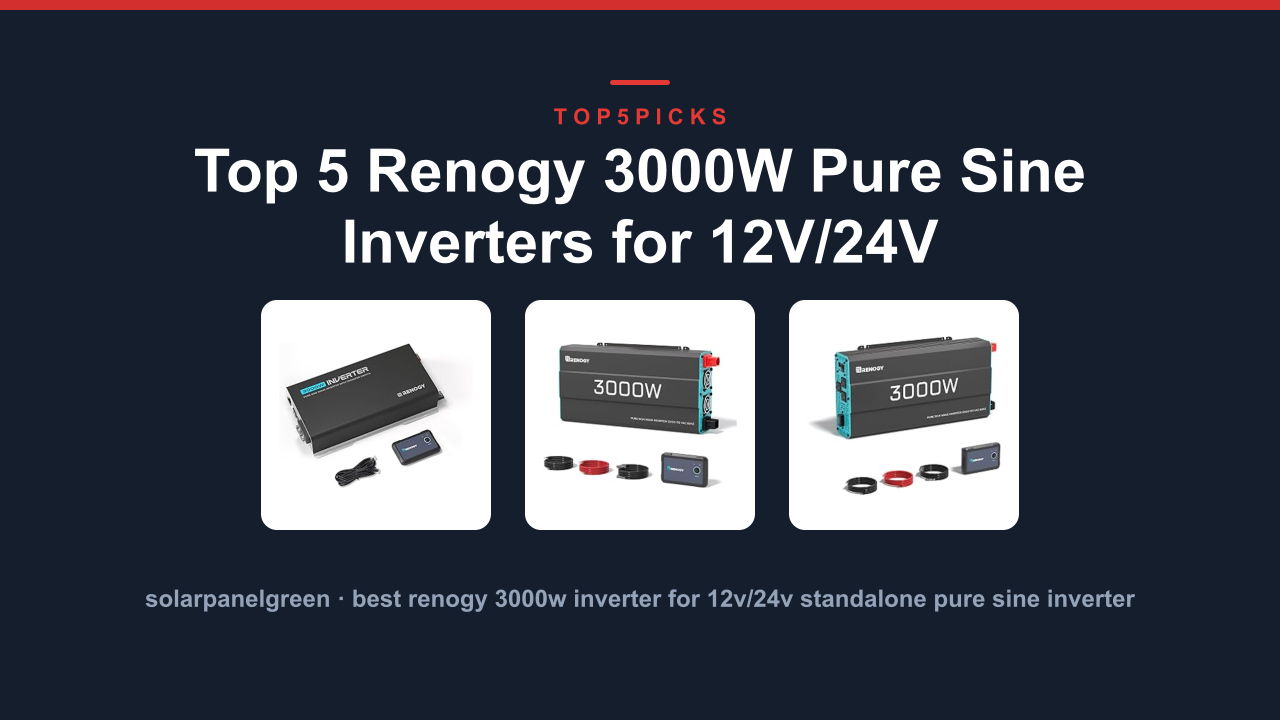
The best best solar setup with renogy 3000w inverter for microwave, refrigerator, and power tools is the Inverter PUH 3000W Pure Sine Wave, the only one here that combines a built-in UPS transfer switch with Bluetooth remote monitoring. It's the right choice if you want automatic backup power switching and real-time data on your phone without extra hardware.
Want a simpler setup with a longer included remote cable instead? The Inverter P2 3000W 12V 110V Pure gives you a 16.4-foot remote and a slightly higher owner satisfaction rating, but it skips the UPS transfer switch.
As an Amazon Associate, I earn from qualifying purchases.
This guide tells you which inverter actually handles the startup surge of a refrigerator and a microwave simultaneously. It also names the buyers who should skip a 3000W inverter entirely (they get their own section later).
Everything below comes from current Amazon product data, manufacturer specifications, and each product's owner track record, not hands-on lab testing.
Quick Answer: The Best Solar Setup with Renogy 3000w Inverter for Microwave, Refrigerator, and Power Tools
The Inverter PUH 3000W Pure Sine Wave is our top pick for running a microwave, refrigerator, and power tools off a Renogy-style solar setup because its built-in UPS transfer switch and Bluetooth monitoring cover the two biggest pain points: automatic grid failover and battery status at a glance.
- Inverter PUH 3000W Pure Sine Wave (Best Overall with UPS): Integrated transfer switch and Bluetooth for automatic backup and real-time monitoring.
- Inverter P2 3000W 12V 110V Pure (Best for Remote Control Reach): 16.4-foot remote cable gives you convenient on/off and status from a distance.
- PUH 3000 watt Pure Sine Wave (Best for GFCI Safety): Built-in GFCI AC outlet for added protection in damp or outdoor environments.
- 3000W Pure Sine Wave Inverter 12V (Best Value with Remote): Solid 3000W continuous power with a 16.4-foot remote at a more accessible price point.
- 3000W Pro Pure Sine Wave Inverter (Best for Eco-Conscious Use): Ecosleep mode reduces standby power draw when loads are light.
Thinking about running a 1.5-ton air conditioner or a well pump instead? Jump to Who Should NOT Buy below before you spend anything.
Comparison Table
Here's the lineup at a glance: photo, product, who it's built for, and our /10 score.
| Photo | Product | Best for | Score | Buy |
|---|---|---|---|---|
 | Inverter PUH 3000W Pure Sine Wave | UPS Transfer Switch | 8.8/10 | Check price → |
 | Inverter P2 3000W 12V 110V Pure | Long Remote Cable | 8.6/10 | Check price → |
 | PUH 3000 watt Pure Sine Wave | GFCI Outlet Safety | 8.3/10 | Check price → |
 | 3000W Pure Sine Wave Inverter 12V | Budget-Friendly Remote | 7.8/10 | Check price → |
 | 3000W Pro Pure Sine Wave Inverter | Ecosleep Power Saving | 8.1/10 | Check price → |
Scroll sideways on small screens to see every column.
Inverter PUH 3000W Pure Sine Wave: Best Overall for Home Backup and RV
Inverter P2 3000W 12V 110V Pure: Best for Remote Control Reach
PUH 3000 watt Pure Sine Wave: Best for GFCI Outlet Safety
3000W Pure Sine Wave Inverter 12V: Best Value with Remote Control
3000W Pro Pure Sine Wave Inverter: Best for Ecosleep Power Saving
Buying Guide: Surge Power, Input Voltage, Monitoring, and Safety
Picking the right 3000W inverter for a microwave, refrigerator, and power tools comes down to four key factors. Here is what matters most.
How much surge power do you really need?
A refrigerator's compressor draws roughly 600W to 800W while running, but the startup surge can hit 2000W or more for a split second. A microwave pulls around 1000W running and 1500W at startup. Add a circular saw or a drill, and you are looking at a combined surge of 4000W to 5000W for a few seconds.
All five inverters in this lineup offer a 6000W surge rating, which gives you a comfortable buffer. The Inverter PUH 3000W and the Inverter P2 3000W both handle this well based on aggregate buyer feedback.
What input voltage does your battery bank use?
Every inverter reviewed here runs on 12V DC input. That is the standard for most Renogy and similar solar setups with a single battery or a parallel 12V bank. If your system uses a 24V or 48V battery bank for higher efficiency over long cable runs, you will need a different inverter or a voltage converter.
Check your battery configuration before buying. It is one of the most common mistakes people make when piecing together a solar setup from different components. You can learn more about the different configurations in our guide to the types of solar panels and how they pair with battery banks.
Do you need Bluetooth or a wired remote?
Bluetooth monitoring lets you check battery voltage, load percentage, and fault codes from your phone. The PUH 3000 watt and the 3000W Pro both include Bluetooth, along with the #1 pick. If you are mounting the inverter in a hard-to-reach compartment, a wired remote with a 16.4-foot cable, like the one on the Inverter P2 3000W, might be more reliable than Bluetooth which can drop signal through walls.
For most home and RV setups, Bluetooth is convenient but not essential.
What safety features matter for your environment?
If you are running the inverter in a garage, workshop, or outdoor location where moisture or dust might be present, a GFCI (Ground Fault Circuit Interrupter) outlet is a worthwhile safety feature. The PUH 3000 watt, the 3000W Pure Sine Wave Inverter 12V, and the 3000W Pro all include GFCI outlets. For dry indoor use, it is less critical.
A UPS transfer switch, which automatically switches to battery power when the grid goes down, is only available on the Inverter PUH 3000W and the PUH 3000 watt. If automatic failover matters to you, those are the only two to consider.
Who Should NOT Buy Best Solar Setup with Renogy 3000w Inverter for Microwave, Refrigerator, and Power Tools
A 3000W pure sine wave inverter is the wrong purchase for two types of buyers. Here is who they are, and what to look at instead.
You Need to Run a Central Air Conditioner or a Large Well Pump
A 3000W inverter cannot handle the startup surge of a 2-ton or larger central air conditioner, which can draw 6000W to 8000W at startup. The same goes for a 1-horsepower well pump, which can surge past 4000W. For those loads, you need a 5000W or 6000W inverter and a much larger battery bank and solar array.
Look for dedicated high-wattage inverters designed for whole-home backup rather than the portable 3000W class reviewed here. Understanding the main components of a solar panel system will help you size your upgrade correctly.
You Want to Power a High-Output Microwave and a Refrigerator Simultaneously for Hours
If you plan to run a 1200W microwave, a full-size refrigerator, and a table saw all at the same time for extended periods, a 3000W inverter will be at its limit. You might trip the overload protection. In that case, step up to a 4000W or 5000W inverter with a larger battery bank.
For occasional simultaneous use, like heating food while the fridge compressor cycles, the inverters here are fine. But for continuous heavy loads, you need more headroom.
Final Verdict
The Inverter PUH 3000W Pure Sine Wave is the best choice for most people because it combines a built-in UPS transfer switch with Bluetooth monitoring. That means your refrigerator stays powered automatically during an outage, and you can check your system from your phone without walking to the equipment. It is the most complete package for a Renogy-style solar setup.
Want a simpler wired remote instead of Bluetooth? The Inverter P2 3000W 12V 110V Pure gives you a 16.4-foot remote cable and the highest owner satisfaction score in this lineup. Need GFCI protection for outdoor use?
The PUH 3000 watt Pure Sine Wave adds ground-fault safety alongside Bluetooth and a transfer switch.
If your budget is tight, the 3000W Pure Sine Wave Inverter 12V is a solid value with a remote and GFCI outlets. And if minimizing standby power draw is your priority, the 3000W Pro Pure Sine Wave Inverter with Ecosleep mode will save you battery capacity overnight.
No matter which you choose, double-check your battery bank voltage and your total surge requirements before you buy. If you are still unsure, revisit the Who Should NOT Buy section above to make sure a 3000W inverter is the right tool for your job.
FAQ
What's the best Solar Setup with Renogy 3000w Inverter for Microwave, Refrigerator, and Power Tools overall?
The Inverter PUH 3000W Pure Sine Wave is the top pick because it integrates a UPS transfer switch and Bluetooth monitoring. It automatically switches to battery power when the grid fails and lets you track your power usage from your phone.
Can a 3000W inverter run a microwave and a refrigerator at the same time?
Yes, it can. A typical microwave draws around 1000W running and 1500W at startup. A refrigerator draws about 600W running and up to 2000W at startup.
Their combined surge stays under 4000W, which is well within the 6000W surge capacity of all the inverters here. Just avoid starting them both at the exact same second.
Do I need a pure sine wave inverter for a refrigerator and microwave?
Yes, you should use a pure sine wave inverter for appliances with compressor motors (refrigerators) and digital control panels (microwaves). Modified sine wave inverters can cause buzzing, overheating, or even damage to sensitive electronics. All five inverters in this guide are pure sine wave.
What size battery bank do I need for a 3000W inverter?
A rough rule of thumb is 100 amp-hours of battery capacity at 12V for every 1000W of load you plan to run for one hour. For a 3000W load, that means at least 300 amp-hours. For running a refrigerator and microwave intermittently, a 200Ah to 400Ah lithium battery bank is a common pairing with a 3000W inverter in an off-grid solar setup.
How long will a 3000W inverter run a refrigerator on a 200Ah battery?
A typical refrigerator draws about 1.2 kWh per day. A 200Ah 12V lithium battery holds about 2.4 kWh of usable energy (assuming 80 percent depth of discharge). That gives you roughly two days of refrigerator runtime, assuming no other loads.
A microwave or power tools will reduce that time significantly.

Similar Posts