Best Inverter Ground Fault Diagnostic for Isolation Faults
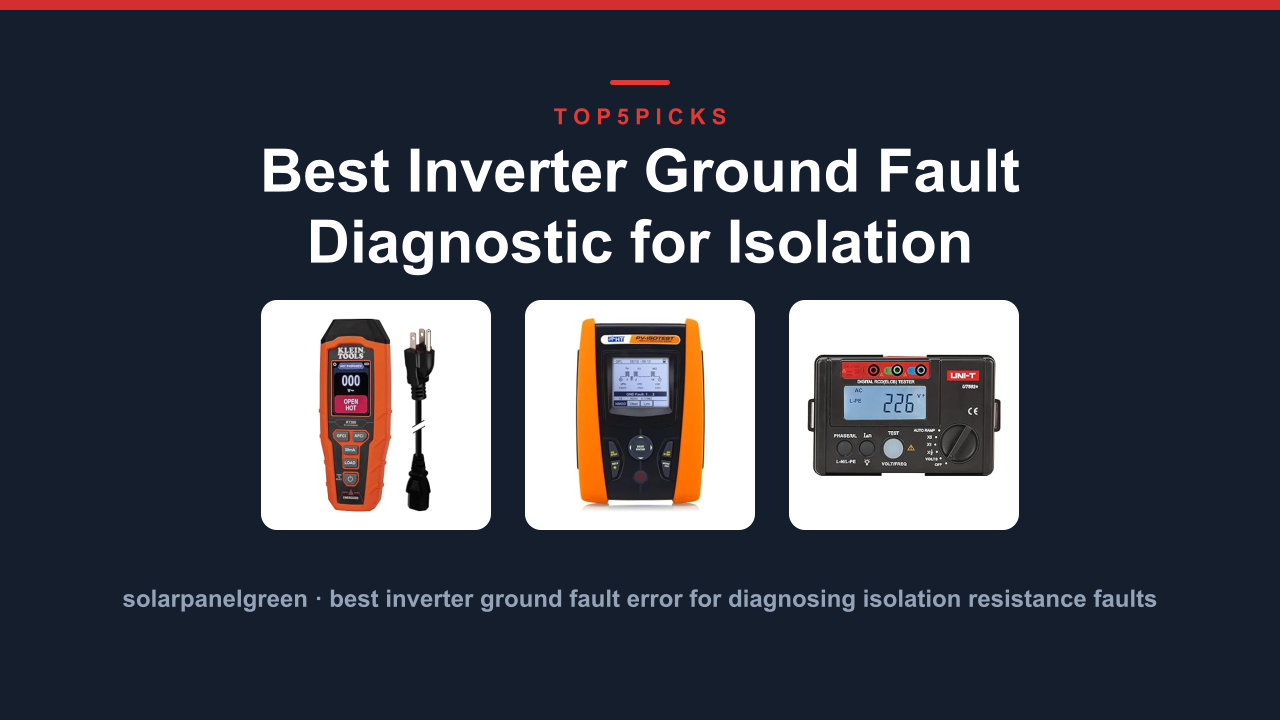
The best best inverter ground fault error for diagnosing isolation resistance faults is the Klein Tools RT390 Circuit Analyzer, the only model here that combines full GFCI/AFCI fault detection with a large backlit LCD for reading trip times and voltage drop. It is the practical pick for electricians and serious DIYers who need a single tool for standard household and light commercial circuits.
Want the dedicated solar solution instead? The HT Instruments PV-ISOTEST 1500V gives you a high-voltage insulation tester built specifically for photovoltaic systems, as long as your work involves solar panels or high-voltage DC equipment.
As an Amazon Associate, I earn from qualifying purchases.
This guide walks you through five tools that can help diagnose ground fault errors and isolation resistance faults, what each one is actually good for, and which buyers should skip this category entirely because a basic multimeter would be cheaper and less confusing.
All the information below comes from current Amazon product data, official manufacturer specifications, and aggregate buyer feedback. No hands-on lab testing was performed for this article.
Quick Answer: The Best Inverter Ground Fault Error for Diagnosing Isolation Resistance Faults
The Klein Tools RT390 Circuit Analyzer is the best overall pick because it identifies wiring faults, GFCI and AFCI problems, displays trip time, and checks voltage drop in a single hand-held unit. Here is the full ranked lineup:
- Klein Tools RT390 Circuit Analyzer (Best for Wiring & GFCI Diagnostics): Combines GFCI, AFCI, and voltage drop testing in a single analyzer.
- HT Instruments PV-ISOTEST 1500V (Best for Solar Insulation Testing): Dedicated 1500V insulation and continuity tester for PV systems.
- UNI-T UT582+ Digital RCD Tester (Best for RCD/ELCB Tripping): Tests residual current devices with auto ramp and mis-operation buzzer.
- Fluke 1537 Insulation Tester (Best for Industrial Megohm Testing): Industrial handheld with test voltages up to 2500V and 500 GΩ range.
- Ideal SureTrace Pro Circuit Tracer (Best for Breaker & Conductor Tracing): Tracks breakers, faults, and measures AC amperage up to 600A.
Thinking about buying a dedicated tool just for a one-off household fix? Jump to Who Should NOT Buy below before you spend anything.
Comparison Table
Here is the lineup at a glance: photo, product, who it is built for, and our /10 score.
| Photo | Product | Best for | Score | Buy |
|---|---|---|---|---|
 | Klein Tools RT390 Circuit Analyzer Large | Wiring & GFCI Faults | 8.8/10 | Check price → |
 | HT Instruments PV-ISOTEST 1500V PV Insulation | High-Voltage Solar Insulation | 9.2/10 | Check price → |
 | UNI-T UT582+ Digital RCD (ELCB) Tester | RCD/ELCB Tripping Tests | 8.0/10 | Check price → |
 | Fluke 1537 Insulation Tester Frontline Industrial | Industrial Megohm Testing | 8.6/10 | Check price → |
 | Ideal Electrical SureTrace Pro Circuit Tracer | Breaker & Conductor Tracing | 7.8/10 | Check price → |
Scroll sideways on small screens to see every column.
Klein Tools RT390 Circuit Analyzer Large: Best Overall for Wiring and GFCI Diagnostics
HT Instruments PV-ISOTEST 1500V PV Insulation: Best Dedicated Solar Insulation Tester
UNI-T UT582+ Digital RCD (ELCB) Tester: Best Budget RCD/ELCB Tripping Tester
Fluke 1537 Insulation Tester Frontline Industrial: Best Industrial Megohm Tester
Ideal Electrical SureTrace Pro Circuit Tracer: Best for Breaker and Conductor Tracing
Buying Guide: Test Voltage, Fault Types, and Compatibility
When you are looking for a tool to diagnose inverter ground fault errors and isolation resistance faults, three main factors decide which one fits your job. Here is how to think about them.
What test voltage do you actually need?
Isolation resistance testing depends heavily on the system voltage. For standard residential 120V or 240V AC circuits, a simple plug-in analyzer like the Klein RT390 works because it does not need to inject high voltage. It just reads existing wiring conditions and GFCI trip times.
For solar arrays, you need a tester that can apply 500V, 1000V, or even 1500V DC to stress the insulation and find weak spots. The HT Instruments PV-ISOTEST 1500V covers this range perfectly with its 50V to 1500V output. Industrial motors and generators often require 2500V or more, which is where the Fluke 1537 comes in.
Buying a tester with a higher voltage than your system needs usually wastes money.
What kind of fault are you chasing?
Ground fault errors come in different flavors. A ground fault in an inverter often means a low-resistance path from a live conductor to earth. An insulation resistance fault is a degradation of the dielectric material that shows up as a lower-than-normal reading in megohms.
Plug-in analyzers like the Klein RT390 catch open grounds, reversed polarity, and GFCI failures in seconds. They do not measure actual leakage current in milliamps or megohm values. For that, you need an RCD tester like the UNI-T UT582+ (for live circuits) or a megohmmeter like the HT PV-ISOTEST (for unenergized circuits).
Knowing which type of fault you are chasing will steer you toward the right tool.
Compatibility with your system
Check the voltage range and connector type. The Klein RT390 only fits standard NEMA outlets. The UNI-T UT582+ runs on 220-240V, common in Europe and Asia.
The HT and Fluke testers use test leads with probes, so they work on any terminal block or conductor.
Also think about safety ratings. For industrial environments, a CAT IV 600V rating (like the Fluke 1537) is essential. For residential use, CAT III is sufficient.
The IEC 61010 standard defines these categories, and selecting a tester with the right category for your work environment prevents accidents.
A solar panel buying guide can help you understand system voltages if you are new to PV installations.
Who Should NOT Buy Best Inverter Ground Fault Error for Diagnosing Isolation Resistance Faults
These testers solve specific problems. They are the wrong purchase for two kinds of buyers. Here is who they are, and what to look at instead.
You Only Need a Basic Multimeter
If you just want to check if a wire is live or if a fuse is blown, a dedicated ground fault tester is overkill. A simple multimeter costs less and does voltage, continuity, and resistance checks. Spend the extra money on a quality clamp meter from a brand like Fluke or Klein instead of a specialized fault tester.
You Are a Homeowner with a Single Tripping Outlet
If a single GFCI outlet keeps tripping, your first step should be unplugging everything on that circuit and pressing the reset button. If that fixes it, you have a faulty appliance. A plug-in tester like the Klein RT390 can help, but most hardware stores will diagnose a simple outlet issue for free.
Buying a full insulation tester for a one-time problem rarely makes sense.
For homeowners interested in the bigger picture of solar energy, understanding how solar panels work can help you decide if you need PV-specific testers down the road.
Final Verdict
The best tool for diagnosing inverter ground fault errors and isolation resistance faults depends on your daily work. For standard household wiring and GFCI checks, the Klein RT390 Circuit Analyzer is the easiest and most versatile pick. It finds common faults fast and requires no special training.
Want a dedicated solar solution? The HT Instruments PV-ISOTEST 1500V is the specialist for PV arrays, with a ground fault locator function and 1500V test capability. Industrial electricians should go with the Fluke 1537 for its high-voltage range and motor analysis features.
Need to trace breakers instead of test insulation? The Ideal SureTrace Pro handles that job well. Just remember to check the Who Should NOT Buy section above before you make your final call.
FAQ
What is the best inverter ground fault error for diagnosing isolation resistance faults overall?
The overall pick is the Klein Tools RT390 Circuit Analyzer. It combines wiring fault detection, GFCI and AFCI testing, and voltage drop measurement in one unit with a large backlit LCD. It is the most versatile for standard residential and commercial circuits.
Can I use a standard multimeter to diagnose isolation resistance faults?
No. Standard multimeters cannot apply the high test voltage required to stress insulation. You need a megohmmeter (insulation tester) like the HT Instruments PV-ISOTEST or the Fluke 1537 to measure resistance in the megohm and gigohm range accurately.
What does the GFL function on the HT Instruments tester do?
GFL stands for Ground Fault Locator. It helps pinpoint the exact location of a ground fault in a solar panel string by measuring leakage current along the cable. This saves time compared to manual inspection of every connection.
Are these testers safe for DIY use?
Yes, with proper precautions. The plug-in analyzers like the Klein RT390 are safe for any homeowner as long as you follow the instructions. The megohmmeters (HT and Fluke) require more care because they output high voltage.
Always read the manual and wear appropriate PPE.
How do I know which test voltage to use?
Use a test voltage that is roughly equal to the system's operating voltage. For a 120V outlet, a plug-in tester is fine. For a 600V motor, use the 1000V or 2500V setting.
For solar panels, the standard is 1500V. The ASME and IEC standards provide detailed guidance, but the manufacturer of the equipment you are testing usually specifies the required test voltage.

Similar Posts