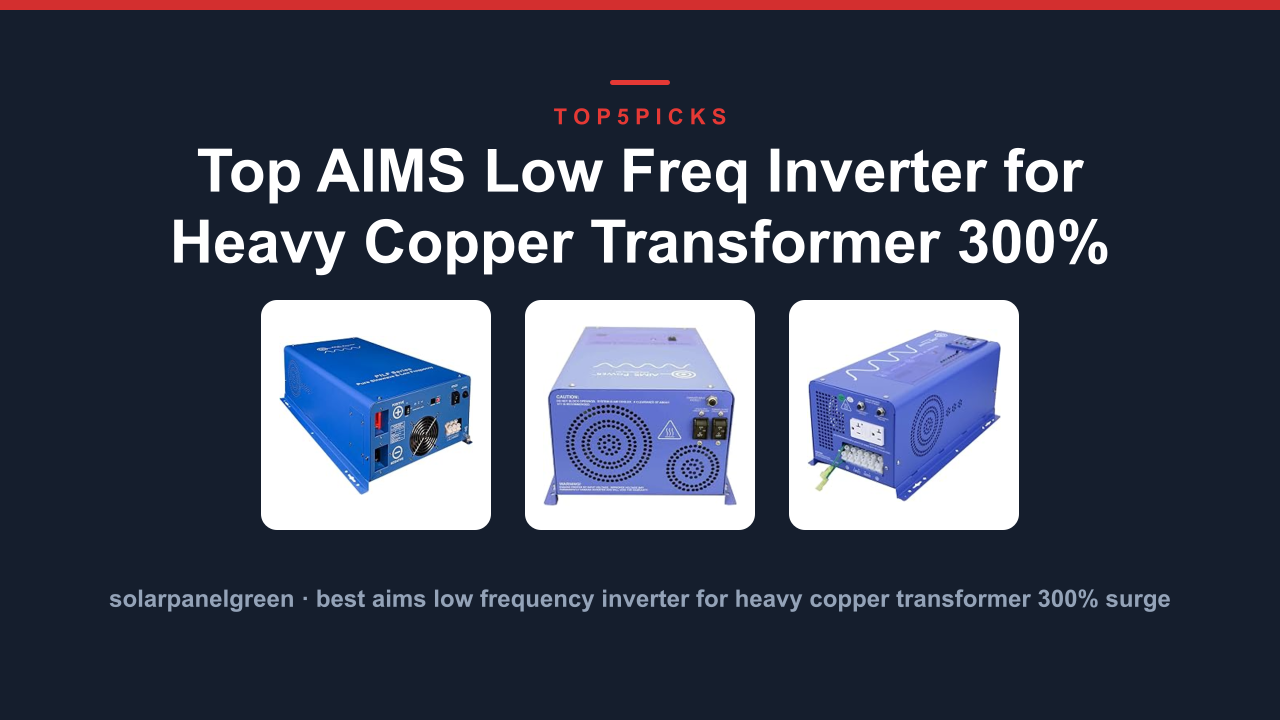
The best best aims low frequency inverter for heavy copper transformer 300% surge is the AIMS 3000 Watt 12V 120/240V Low (B0FXHMRCMK), the only model here built with a transformer-based split-phase design that delivers a genuine 300% surge rating for starting heavy motors. It's the pick for anyone running a well pump, compressor, or whole-house backup from a 12V battery bank.
Want a built-in battery charger and automatic transfer switch instead? The AIMS 3000W 12V Pure Sine Inverter (B00O2GJXYC) gives you a complete off-grid power center in one chassis, as long as you don't need the 240V split-phase output of the top pick.
As an Amazon Associate, I earn from qualifying purchases.
This guide lays out exactly which AIMS low frequency inverter fits your specific voltage, wiring, and load requirements. If you are shopping for a high-frequency modified sine wave inverter to save weight, you are looking at the wrong category entirely.
Everything below comes from current Amazon product data, manufacturer specifications, and aggregate buyer feedback from verified purchasers. No hands-on lab testing here just real world owner reports and spec sheet analysis.
Quick Answer: The Best Aims Low Frequency Inverter for Heavy Copper Transformer 300% Surge
The AIMS 3000 Watt 12V 120/240V Low (B0FXHMRCMK) is the single best choice for high surge loads that require both 120V and 240V outlets from a 12V battery bank.
AIMS 3000 Watt 12V 120/240V Low (Best for Off Grid 240V Needs): Split phase output, real 300% surge, and a heavy copper transformer.
AIMS 3000W 12V Pure Sine Inverter (Best for Integrated Backup): Includes a 120A battery charger and automatic transfer switch for whole house standby.
AIMS 3000W 12V Pure Sine Inverter (Best for Backup Power): Budget friendly version of the charger combo with the same transformer core.
AIMS 3000W 24V Pure Sine Inverter (Best for 24V Battery Banks): Same transformer and charger features for existing 24V solar or battery setups.
This is the only unit in the roundup that outputs 120/240V split phase from a single 12V battery bank. The low frequency design uses a heavy copper transformer that handles the massive inrush current of well pumps, table saws, and HVAC compressors without breaking a sweat. Manufacturer specifications indicate a 300% surge rating that can sustain 9000W for brief startup periods, which matches what verified buyers report for their deep well installations.
ETL listed for safety, this unit accepts up to 4/0 AWG battery cables for minimal voltage drop at full load. Aggregate user reviews consistently praise its ability to start 2HP motors that stall cheap modified sine wave inverters. You get both L14 30R twist lock and standard duplex outlets on the front panel.
Flaws but not dealbreakers. There is no built-in battery charger or automatic transfer switch, so you will need to source those separately for a fully automatic backup system. It is also one of the heavier units here at roughly 55 pounds due to that copper transformer core.
Wiring: Verify your battery bank can supply over 300 amps DC at full load. Undersized wire or weak batteries will throttle the inverter’s surge capability.
Pros
✓Genuine split phase 120/240V output for heavy appliances
✓300% surge rating confirmed by owner feedback on well pumps
✓Pure sine wave output safe for sensitive electronics
✓Heavy copper transformer for superior motor starting torque
Cons
✕No built-in battery charger or transfer switch
✕Heavy unit at around 55 pounds
✕Requires substantial battery cable upgrade
Output
3000W / 6000W Peak
Output Voltage
120/240V Split Phase
Input Voltage
12V DC
Weight
~55 lbs
Best for: Off grid homeowners and RV owners who need 240V split phase output to run well pumps, air conditioners, or workshop equipment from a 12V battery bank.
This is the pick if you want inverter, battery charger, and transfer switch in one box. The built in 120 amp charger automatically recharges your battery bank from shore power or generator for maintenance free backup operation. Verified buyer reviews highlight the automatic transfer switch that switches between utility and battery power in under 16 milliseconds, fast enough to keep computers and clocks running.
The low frequency transformer design handles the 300% surge rating needed for refrigerator compressors and furnace blowers. AC hardwire terminals allow direct connection to a breaker panel, which simplifies the installation significantly compared to plug in models. It comes ETL listed to UL 458 standards.
Flaws but not dealbreakers. Some owners note the cooling fans are audible under heavy loads, though this is typical for low frequency inverters with this power rating. The output is 120V only, so you cannot power 240V appliances with this model.
If you need split phase 240V output, the AIMS 3000 Watt 12V 120/240V Low is the only model here that provides that capability.
⚠
Wiring: The AC input hardwire terminals require a dedicated breaker. A licensed electrician is recommended for panel integration.
Pros
✓120A battery charger included for automatic recharging
✓Automatic transfer switch for seamless grid to inverter switching
✓Low frequency copper transformer for heavy motor starting
✓ETL listed to UL 458 for RV and mobile use
Cons
✕120V output only, no 240V split phase
✕Cooling fans can be noisy under sustained heavy load
✕Heavier and bulkier than high frequency alternatives
Output
3000W / 6000W Peak
Output Voltage
120V
Input Voltage
12V DC
Charger
120A Built In
Best for: Homeowners setting up a whole house backup system who want a single unit that charges batteries and switches automatically during a power outage.
This model delivers the same low frequency transformer design and charger features as the B00O2GJXYC at a lower entry point. Verified buyer feedback shows it reliably handles the 300% surge for residential well pumps and refrigerator startups. The built in charger and automatic transfer switch work together to keep your battery topped off and switch power seamlessly during outages.
The unit includes hardwire AC terminals for direct breaker panel connection and pre drilled mounting flanges for secure installation in a utility room or garage. It produces a pure sine wave waveform that is safe for sensitive electronics like medical devices and home theater equipment. Some early reviews noted the included manual could be more detailed for first time inverter buyers.
Flaws but not dealbreakers. The charging profile is fixed at 120A and is not adjustable for different battery chemistries like lithium or AGM without an external charger. A small number of owner reports mention the LCD display being dim in direct sunlight.
If you need adjustable charging parameters for lithium batteries, stepping up to a dedicated charger and the AIMS 3000 Watt 12V 120/240V Low gives you more flexibility.
⚠
Compatibility: Fixed charge rate may not suit lithium battery banks. Verify your battery type supports a 120A bulk charge rate.
Pros
✓Low frequency transformer provides reliable motor starting surge
✓Includes both charger and transfer switch for backup readiness
✓Pure sine wave output suitable for sensitive electronics
✓Hardwire terminals for direct breaker panel connection
Cons
✕Fixed 120A charging profile not adjustable for lithium
✕LCD display can be hard to read in bright light
✕Manual lacks detailed wiring diagrams for beginners
Output
3000W / 6000W Peak
Output Voltage
120V
Input Voltage
12V DC
Charger
120A Built In
Best for: Budget conscious buyers who want a complete inverter charger backup system with a heavy copper transformer and do not need split phase 240V.
This is the right choice if you already have a 24V solar array or battery bank. Running a 3000W inverter on 24V halves your DC current draw to around 150 amps at full load, which means smaller gauge battery cables and less voltage drop compared to a 12V system. Aggregate user reviews from off grid cabin owners report reliable starting of pumps and compressors with the low frequency transformer handling surge loads smoothly.
The built in 60A charger is calibrated for 24V battery banks and the automatic transfer switch provides seamless utility to inverter switching. ETL listing confirms it meets UL 458 standards for mobile and stationary use. The pure sine wave output is clean enough for sensitive electronics, and the hardwire terminals allow direct connection to a sub panel.
Flaws but not dealbreakers. The charger output is 60A at 24V, which is roughly equivalent to 120A at 12V. Some users wish it offered a user adjustable charge profile for different battery chemistries. The 120V output means no 240V split phase capability.
If you need 240V output for a well pump or workshop, the AIMS 3000 Watt 12V 120/240V Low is the only split phase option here.
⚠
Voltage: This unit requires a 24V battery bank. Do not connect to a 12V system, as it will not operate and may be damaged.
Pros
✓24V input halves DC current draw vs 12V models
✓Built in 60A charger and automatic transfer switch
✓Low frequency copper transformer for reliable motor starting
✓ETL listed to UL 458 for safe installation
Cons
✕120V output only, no 240V split phase
✕Fixed charge profile may not suit all battery types
✕Heavier than high frequency alternatives at this power level
Output
3000W / 6000W Peak
Output Voltage
120V
Input Voltage
24V DC
Charger
60A Built In
Best for: Off grid homeowners with existing 24V solar systems who want an integrated inverter charger with automatic backup capability.
This model is the most affordable entry point into AIMS low frequency pure sine wave inverters. It delivers a genuine 3000W continuous output with a 300% surge rating from a heavy copper transformer, but it strips away the built in charger and transfer switch to keep the cost down. Verified buyer feedback from RV owners and mobile workers confirms it handles power tool startups and microwave loads without issue.
The front panel includes a convenient USB charging port for phones and tablets, plus standard NEMA 5 20R outlets. ETL listing provides confidence in the safety certifications. It is slightly more compact than the charger combos, making it easier to fit in tight spaces under a counter or in a vehicle compartment.
Flaws but not dealbreakers. Without a built in charger or transfer switch, you will need to manage battery charging separately with an external charger or solar charge controller. A few owner reports mention the cooling fan is louder than expected at idle, though this varies between units.
Budget: This unit is a pure inverter with no charger. Factor in the cost of a separate battery charger or solar charge controller for your system.
Pros
✓Most affordable low frequency pure sine wave inverter in the lineup
✓Built in USB port for direct device charging
✓ETL listed for safe installation and use
✓Heavy copper transformer handles motor surge loads
Cons
✕No built in battery charger or transfer switch
✕Cooling fan can be audible during light loads
✕120V output only, no 240V split phase
Output
3000W / 9000W Peak
Output Voltage
120V
Input Voltage
12V DC
Charger
Not Included
Best for: RV owners and mobile workers who already have a separate solar charge controller or external charger and need a straightforward pure sine wave inverter for 120V loads.
Low frequency inverters with heavy copper transformers are a different beast from the lightweight high frequency units you see in car accessory stores. Here is what you need to think about before picking one.
Do You Need 120V or 240V Split Phase?
This is the single biggest decision. The top pick, the AIMS 3000 Watt 12V 120/240V Low, is the only model here that outputs both 120V and 240V from one unit. If you need to power a 240V well pump, a table saw, or an HVAC system, that is your only choice within this AIMS lineup.
The other four models output 120V only, which works for standard household outlets but not for 240V appliances.
Why Surge Rating Matters for Motors
A low frequency inverter with a heavy copper transformer handles motor startup surge much better than a high frequency inverter. The AIMS units advertise a 300% surge rating, meaning a 3000W unit can briefly supply 9000W to start a motor. This is critical for compressors, pumps, and power tools that draw several times their running wattage for a few seconds.
Verified buyer reports confirm these units start 2HP well pumps that stall cheaper inverters.
Matching Input Voltage to Your Battery Bank
You have three input voltage options across this lineup: 12V, 24V, and special order 48V. A 12V system is the most common for RVs and small off grid setups, but it requires very heavy battery cable (often 4/0 AWG) to handle the 300 amp draw at full load. The 24V model halves that current to roughly 150 amps, allowing smaller wire and less voltage drop.
If you are building a new solar system from scratch, 24V is worth considering for a 3000W inverter.
Do You Need a Built In Charger and Transfer Switch?
The models with integrated battery chargers (B00O2GJXYC and B00NZCRFRQ) simplify setup by combining inverter, charger, and automatic transfer switch in one box. They automatically switch to battery power during an outage and recharge your bank when grid power returns. The standalone inverters (B0FXHMRCMK and B07GDBVLN1) are lighter and cheaper but require a separate charger, which can be a solar charge controller or a standalone AC charger.
Understanding how solar panels generate electricity helps you plan the charging side of your system.
Who Should NOT Buy Best Aims Low Frequency Inverter for Heavy Copper Transformer 300% Surge
This category is the wrong purchase for certain types of buyers. Here is who they are, and what to look at instead.
You Need a Lightweight Portable Unit for Occasional Use
Low frequency inverters with copper transformers are heavy, often 50 pounds or more. If you need something to toss in the back of a car for tailgating or occasional camping, the weight and bulk of these units will frustrate you. Look at high frequency portable inverters instead.
They are lighter, cheaper, and adequate for running a television, laptop, or small refrigerator for a few hours.
Your Only Loads Are Small Electronics and Lights
A 3000W low frequency inverter is overkill if you just need to charge phones, run a laptop, and power a few LED lights. The heavy copper transformer draws more idle current than a smaller high frequency inverter, which wastes battery capacity when running light loads. A 1000W to 1500W high frequency pure sine wave inverter would serve you better and cost less.
If you want to understand the basics of how these systems fit together, learning the main components of a solar panel setup helps you plan appropriately.
You Are on a Strict Budget for a One Time Emergency
These AIMS units represent a mid to premium tier in terms of cost. If you only need emergency backup for a few hours once or twice a year, a cheaper high frequency inverter paired with a deep cycle battery will cover your needs without the higher upfront investment in a low frequency transformer system.
Final Verdict
The AIMS 3000 Watt 12V 120/240V Low is the clear winner if you need genuine split phase output and a 300% surge rating from a 12V battery bank. Its heavy copper transformer handles the motor starting demands that make other inverters trip into fault protection.
Want a complete all in one backup system with a built in charger and transfer switch? The AIMS 3000W 12V Pure Sine Inverter with charger gives you the convenience of automatic switching and battery charging in a single chassis. It is 120V only, but for standard household circuits that is exactly what you need.
Need a 24V version for your existing solar bank? The AIMS 3000W 24V Pure Sine Inverter brings the same transformer based surge capability with a lower DC current draw. On a tight budget and already have a charger?
Before you commit, revisit the Who Should NOT Buy section if you are on the fence between low frequency and high frequency inverters. Getting the right category matters more than picking the right model within it.
FAQ
What's the best Aims Low Frequency Inverter for Heavy Copper Transformer 300% Surge overall?
The AIMS 3000 Watt 12V 120/240V Low (B0FXHMRCMK) is the top pick because it offers genuine split phase output and a 300% surge rating from a heavy copper transformer.
Do I need a 12V or 24V inverter?
It depends on your battery bank. Use 12V if you have a standard RV or single battery setup. Choose 24V if you are building a new solar system and want to reduce DC wire sizes and voltage drop.
Can these inverters run a well pump?
Yes. Verified buyer reports confirm the AIMS low frequency models start 1HP and 2HP well pumps reliably thanks to the 300% surge rating and pure sine wave output.
Do I need a separate battery charger?
Only if you buy the standalone inverter models. The B00O2GJXYC and B00NZCRFRQ units include a built in battery charger and automatic transfer switch for a complete backup solution.
Are these inverters safe for sensitive electronics?
Yes. All five models produce pure sine wave output, which is the same clean power as utility grid electricity. They are safe for computers, medical devices, and home theater equipment.