Calculate Inverter Battery Backup Time Easily
How to Calculate Inverter Battery Backup Time? It's the question every home inverter owner asks after a power cut overstays its welcome. The answer is simple arithmetic, but most online calculators leave out two crucial variables.
That's why your real-world runtime so often falls short of the estimate.
Per IEEE 485 sizing guidance, the core method used for industrial battery banks scales down to a single home battery. You need four inputs: voltage, capacity, depth of discharge, and inverter efficiency. Once you plug in all four, the prediction gets remarkably close.
Let's work through it step by step.
Quick Answer
Backup time equals usable battery energy divided by connected load. Multiply voltage, capacity, depth of discharge, and inverter efficiency, then divide by load. Example: 12V × 150Ah × 50% × 80% gives 720Wh of usable energy.
At a 300W load, expect about 2.4 hours.
Why Getting This Wrong Costs You Real Money
A bad estimate usually goes one of two ways. Either the battery dies before the outage ends, or you pay for far more capacity than you actually need. Both hurt your wallet.
Undersizing is the obvious one. A 600W load on a 12V, 150Ah lead-acid battery with 50% depth of discharge leaves you just 900Wh of usable energy. That's about an hour and a half, not the four hours a rough Ah calculation suggests.
Your fridge warms up, and your router goes dark. Even a 100W misjudgment shifts backup time by roughly 15%.
Oversizing is quieter but just as wasteful. You spend extra on a bigger battery, then rarely drain it below half. As of 2026, a replacement 150Ah tubular battery runs $120 to $250.
Losing two years of its life through deep cycling is real money.
Deep discharge is the costliest mistake. Repeatedly taking lead-acid below 50% can cut its lifespan from five years to under two.
If you're planning a solar upgrade later, accurate sizing matters even more. Our panel shopping checklist covers the questions to ask before you buy. You'll also want to weigh the trade-offs of adding solar early.
The Real Formula That Most People Miss
Engineers follow IEEE 485 to size large stationary lead-acid batteries, and the same logic scales down to one battery. The full equation is: Backup time = (Battery voltage × Battery Ah × Depth of Discharge × Inverter efficiency) ÷ Connected load in watts.
| Variable | What it means | Typical value |
|---|---|---|
| Battery voltage | System voltage of your bank | 12V, 24V, or 48V |
| Battery Ah | Label capacity | 100Ah, 150Ah, 200Ah |
| Depth of Discharge | Safely usable portion | 50% lead-acid, 80% to 100% LiFePO₄ |
| Inverter efficiency | Losses as heat | 80% to 90% |
Most online calculators skip DoD and efficiency. That's why their answers look too good.
A 12V, 150Ah battery holds 1,800Wh on paper. After a 50% DoD and 80% efficiency, you actually have 720Wh. At 300W, that's 2.4 hours, not the 6 hours a simple voltage × Ah shortcut implies.
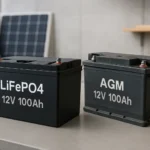
Lithium changes the numbers. A 12V, 100Ah LiFePO₄ battery at 90% DoD and 90% efficiency gives 972Wh usable. Over 35% more usable energy than the lead-acid example above, in a smaller footprint.
Double the system voltage to 24V and the same 300W load runs close to twice as long.
If you want to see how solar generation fits into this, our solar generation explainer covers the full chain from panel to battery.
5 Mistakes That Kill Your Backup Time
1. Using the inverter's VA rating as your load. VA is the inverter's maximum output, not what your appliances draw. A 1000VA inverter running 300W of bulbs still calculates backup time off 300W.
2. Ignoring inverter efficiency. Every inverter throws away 10% to 20% of battery energy as heat. Assume 100% efficiency and every estimate runs high.
3. Draining lead-acid batteries too deep. Plan for 100% depth of discharge and the battery dies fast. Use 50% for lead-acid, 80% to 100% for LiFePO₄.
4. Forgetting the inverter's idle draw. Even with nothing plugged in, an inverter consumes power. A 15W standby draw over ten hours eats 150Wh before your appliances get a single watt.
5. Ignoring battery age and temperature. A two-year-old battery often delivers 20% to 30% less than rated capacity. Cold weather cuts usable energy further.
If you size for a fresh battery in summer, a winter outage will disappoint.
If any of these sound familiar, recalculate before you replace anything.
Safe Practices You Can't Skip
Accurate math won't save an unsafe installation. Lead-acid batteries vent hydrogen gas while charging, so they need a ventilated compartment. A spark from a loose terminal can ignite the gas.
Fit a fuse or breaker between every battery bank and the inverter. If a short occurs, the protection kills the circuit before cables melt. The National Electrical Code covers the details, and your local inspector can flag anything non-compliant.
Keep cables short and thick. Thin cables drop voltage under load, which pulls more current and generates heat. That leads to premature shutdowns or, in the worst cases, fires.
If you choose lithium, confirm the battery has an internal BMS. The battery management system prevents overcharge, deep discharge, and cell imbalance. Never run a lithium battery without one.
Check terminal torque specs in the manufacturer's manual, and set the low-voltage cutoff to match your battery's chemistry. Follow local electrical codes.
For a broader reference, the U.S. Department of Energy publishes storage guidance reviewed by national labs. And if you're wiring solar panels into the same system, review the anatomy of a solar panel before you start.
Different panel technologies also carry different electrical requirements, so it pays to compare.
Real Numbers From Real Home Setups
Let's walk through three common scenarios so you can see the formula in action.
Setup A: Small home office. A 12V, 100Ah lead-acid battery with a 600VA inverter. Connected load: one laptop (50W), one LED monitor (30W), a Wi-Fi router (15W), and one LED bulb (10W). Total load: 105W.
Battery voltage: 12V. Usable capacity after 50% DoD: 600Wh. After 85% inverter efficiency: 510Wh.
Backup time: 510Wh ÷ 105W = 4.9 hours.
Setup B: Living room backup. A 12V, 150Ah tubular lead-acid battery with a 1000VA inverter. Appliances: a 32-inch LED TV (70W), a ceiling fan (75W), three LED bulbs (30W total), and a phone charger (10W). Total load: 185W.
Voltage: 12V. Usable after 50% DoD: 900Wh. After 82% inverter efficiency: 738Wh.
Runtime: 738Wh ÷ 185W = 3.9 hours.
Setup C: Medium home with a fridge. Same battery and inverter as Setup B, but add a 300L refrigerator rated at 200W running average (compressors cycle on and off, so average draw matters). Total sustained load: 385W. Usable energy: 738Wh as above.
Runtime: 738Wh ÷ 385W = 1.9 hours.
See the pattern. A fridge doubles usable runtime.
If you plan to run sensitive electronics like a PC or a medical device, a pure sine wave inverter handles them better than a modified sine wave unit. And if your outage typically runs four hours, Setup A works fine while Setup C falls short. You'd need a larger battery or a lithium upgrade with higher DoD to bridge the gap.
Keeping Your Backup Time Honest Over Time
Batteries lose capacity as they age. A lead-acid battery at year two often delivers 80 to 85 percent of its rated Ah. That changes your runtime equation.
Recalculate every six months. Measure the actual load with a plug-in power meter or your inverter's display. If runtime drops more than 15 percent from your original calculation, the battery may need replacement.
Temperature shifts matter too. In winter, a lead-acid battery at 10°C delivers roughly 80 percent of its rated capacity. At 0°C, it's closer to 65 percent.
If you live in a cold climate, size for winter performance, not summer.
Keep terminals clean and tight. A corroded connection adds resistance and wastes energy as heat. Check electrolyte levels in flooded batteries every two months.
For lithium, the BMS handles most of this. Capacity fade is slower, typically less than 5 percent per year for a good grade LiFePO₄. Cold still hurts, but a built-in heater or a well-insulated mounting location helps.
And if you ever expand your system, run the numbers again. Adding two more LED bulbs or a second fridge shifts the calculation. Re-running the formula takes two minutes and saves surprise blackouts.
Frequently Asked Questions
What is the formula for inverter battery backup time?
Multiply battery voltage by capacity in ampere-hours by depth of discharge by inverter efficiency. Divide the result by total connected load in watts. This gives backup time in hours.
How accurate is the formula in real life?
It's accurate to within 5 to 10 percent when you use the right figures for efficiency and depth of discharge. Real-world factors like cable resistance, battery age, and inverter idle current can nudge it lower.
What is depth of discharge and why does it matter?
Depth of discharge is the portion of battery capacity you safely use before recharging. For lead-acid, aim for 50 percent. Going deeper shortens battery life.
Lithium batteries tolerate 80 to 100 percent.
How do I measure the total load on my inverter?
Add up the wattage of every appliance that runs simultaneously. Check the label on each device or use a plug-in power meter for accuracy. Add a 10 percent safety margin for startup surges.
Does a 1000VA inverter mean the battery lasts longer?
No. VA is the inverter's rated output, not the load. A 1000VA inverter with a 400W load uses the same battery energy as a 500VA inverter at the same 400W load.
Inverter efficiency differences between models vary by a few percent.
When should I replace my inverter battery?
When runtime drops below half of the original calculation under the same load and conditions. Or when a lead-acid battery consistently fails to recharge to 80 percent of its rated capacity after a full charge cycle. For lithium, review the BMS health report data.
Matching Your Battery to a Solar Panel System
Adding solar changes the backup calculation completely. The panels recharge the battery during daylight, which extends your usable runtime well beyond a single discharge cycle.
A 200W solar panel in good sun delivers roughly 1,000Wh per day. That can refill a 100Ah lead-acid battery from 50% depth of discharge in about five hours of peak sun. If your outage happens at noon, the battery never truly drains.
The sizing process works backwards. Start with your desired backup time. Then calculate the battery capacity needed.
Finally, size the solar array to recharge that battery within your typical daylight window.
| System size | Battery bank | Solar needed for daily recharge |
|---|---|---|
| Small office | 12V, 100Ah | 150W to 200W |
| Living room backup | 12V, 150Ah | 250W to 300W |
| Fridge plus basics | 24V, 200Ah | 400W to 500W |
Lithium batteries pair well with solar. They accept charge faster and handle partial state of charge better than lead-acid. A lead-acid battery that rarely reaches full charge slowly sulfates and loses capacity.
Our solar panel overview explains the different form factors available. And the generation guide covers how much energy a panel produces in real conditions, not just lab specs.
When to Upgrade Your Inverter Battery
Recalculating runtime every six months tells you when performance drops. If your 2.5 hour estimate now delivers only 1.5 hours, the battery is degrading.
For lead-acid, replace when usable capacity falls below 60% of the original rating. That usually happens around year three to five with proper care. For lithium, monitor the BMS data.
Most LiFePO₄ batteries hold 80% capacity past year eight.
Consider upgrading your system voltage before the old equipment fails. Moving from 12V to 24V halves the current draw for the same load. That means thinner cables, less voltage drop, and better inverter efficiency.
A 24V system with two 100Ah batteries wired in series gives the same energy as a 12V system with two 100Ah batteries in parallel. But the 24V setup runs cooler and wastes less power as heat.
Decision Guide for Your Next Backup Setup
Match your battery choice to your outage pattern. Short frequent outages favor lithium because it handles partial charging without damage. Long rare outages favor lead-acid because the upfront cost is lower.
| Your situation | Best battery type | Why |
|---|---|---|
| Power cuts under 2 hours, daily | LiFePO₄ | Handles partial charge cycles |
| Power cuts over 4 hours, monthly | Tubular lead-acid | Lower cost per usable Wh |
| Power cuts vary, with solar | LiFePO₄ | Faster recharge, longer life |
| Tight budget, stable grid | Flat-plate lead-acid | Cheapest entry point |
Run the formula one more time before you buy. Multiply voltage times Ah times DoD times efficiency. Divide by your actual load.
Compare that result to the longest outage you expect.
If the number falls short, either add battery capacity or reduce the connected load. Both options work. One costs money.
The other costs convenience.
The right setup keeps your lights on through every outage and your battery healthy for years. One accurate calculation is all it takes.

Similar Posts