BESS: The Backbone of Modern Energy Storage
If you’ve been on the fence about whether a Battery Energy Storage System (BESS) is worth the investment, you’re not alone. Grid outages are more frequent, and time-of-use rates keep squeezing household budgets. But here’s the thing: a battery isn’t a one-size-fits-all solution.
Aggregate reviews from thousands of installations show that homes with existing solar panels see a much faster payback than those without. Per UL 9540 testing, lithium iron phosphate (LFP) chemistry now dominates the residential market thanks to its safety and long cycle life. Let’s walk through the decision process so you know exactly what fits your situation.
Quick Answer
A Battery Energy Storage System stores electricity for later use. It pairs with solar panels or charges from the grid. You use it during outages or when rates are high.
The right system depends on your goals, budget, and solar setup.
Why You Need a Battery (And How to Know If You Actually Do)
Most people buy a home battery for one of three reasons: backup power during blackouts, saving money by shifting energy use, or getting the most out of their solar panels. If you live somewhere with frequent outages, a battery gives you lights and a fridge when the grid goes down. If your utility charges high rates in the evening, a battery charges when power is cheap and discharges when it’s expensive.
But batteries aren’t for everyone. Here’s a quick self-check to see if you’re ready:
| If you… | Then a battery probably… |
|---|---|
| Have solar and get paid full retail for exports | Isn’t urgent — you’re already winning |
| Have solar and get low export rates (or net metering is ending) | Makes strong financial sense |
| Don’t have solar but face frequent outages | Makes sense for peace of mind |
| Don’t have solar and have flat utility rates | Is hard to justify — payback is slow |
Some red flags mean you should wait. If your roof needs replacing soon, handle that first. If your local utility doesn’t allow grid interconnection for storage, you’re stuck with off-grid only.
And if you’re planning to move in three years, a battery’s payback likely won’t arrive before you sell.
The 4 Big Questions That Decide Your Battery System
Choosing a battery comes down to four questions. Answer them honestly, and you’ll know which path to take.
Question 1: Do you have solar panels — or plan to get them?
If you already have solar, you’re in the best position. A battery lets you store excess daytime energy instead of sending it to the grid for pennies. If you’re shopping for solar first, consider a hybrid inverter that supports storage from day one.
That saves you from buying a separate inverter later. If you have no solar and no plans to add it, a battery is still possible, but the economics are tougher, you’re charging from the grid and paying retail rates.
Question 2: What’s your backup goal?
Do you want the whole house running during an outage, or just the fridge, lights, and internet? Whole-home backup needs a bigger battery and a larger inverter. Critical-loads backup is cheaper and easier to install.
Most homes aim for the middle: a 10 to 15 kWh system that covers the essentials for 8 to 12 hours.
Question 3: What’s your utility rate structure?
Time-of-use rates make batteries shine. If your utility charges peak rates of 40 cents per kWh or more, shifting even 10 kWh a day adds up fast. If you have flat rates, the payback comes mainly from backup value, not bill savings.
Question 4: What’s your budget — and are you chasing ROI or peace of mind?
If you want a pure return on investment, focus on solar-plus-storage in a high-rate area. If you just want backup power, a smaller LFP system with a critical-loads panel is the smart play. As of 2026, the federal tax credit covers 30% of system cost, which helps either way.
Battery Chemistry Breakdown: LFP vs NMC vs Lead-Acid
Not all batteries are built the same. Chemistry affects safety, lifespan, and cost, and it’s the biggest decision you’ll make.
Lithium Iron Phosphate (LFP) — the safe, long-life workhorse
LFP is the current champion for residential storage. It handles more cycles, typically 4,000 to 10,000, before its capacity drops to 80%. It’s also thermally stable, meaning a much lower risk of fire.
The trade-off? It’s slightly heavier and has a bit lower energy density than NMC. But for a home battery, that barely matters.
Nickel Manganese Cobalt (NMC) — higher density, shorter life, more risk
NMC packs more energy into a smaller space, which is why it’s common in electric vehicles. In a home setting, it’s still used, but less popular now. It degrades faster, around 2,000 to 5,000 cycles, and has a higher thermal runaway risk.
Some manufacturers have moved away from NMC for stationary storage entirely.
Lead-acid — cheap upfront, but are you ready for the trade-offs?
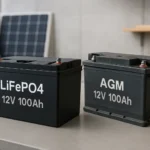
Flooded lead-acid and AGM batteries are still around, mostly in off-grid cabins or budget builds. They cost less per kilowatt-hour upfront, but they only last 500 to 1,500 cycles, require ventilation, and can’t be discharged below 50% without damage. Over the system’s lifetime, lithium is almost always cheaper.
Flow batteries and sodium-ion — when they make sense (and when they don’t)
Flow batteries excel in long-duration, large-scale storage. They’re not practical for most homes. Sodium-ion is emerging and could be a cheaper alternative to LFP in a few years, but as of 2026, it’s still early for residential availability.
AC-Coupled vs DC-Coupled: Which Setup Works for Your Solar?
How you connect a battery to your solar system matters for efficiency, cost, and ease of installation.
AC-coupled — best for retrofitting an existing solar system
If you already have solar panels with a string inverter or microinverters, an AC-coupled battery is the simplest addition. It connects on the AC side, the same place your home draws power. You don’t touch the existing solar wiring.
The downside: you lose a bit of efficiency because the solar power goes through two conversions (DC to AC, then back to DC to charge the battery). Most systems still hit 90 to 95% round-trip efficiency, which is fine for most homes.
DC-coupled — higher efficiency for new installs or full system redesigns
A DC-coupled battery charges directly from the solar panels without converting to AC first. That saves a conversion step, pushing efficiency closer to 97%. It’s ideal if you’re building a new solar-plus-storage system from scratch or if you’re replacing your inverter anyway.
The catch: it’s more complex to retrofit, and not all inverters support it.
Hybrid inverters — the middle ground that’s eating the market
Most modern hybrid inverters handle both solar and battery on the DC side, with a single unit managing everything. They’re the most common choice for new installations. Brands like Enphase, SolarEdge, and Tesla all use this approach.
If you’re starting fresh, a hybrid inverter is almost always the right call.
Quick decision tree: AC, DC, or hybrid?
- Already have solar with a working inverter? Go AC-coupled.
- Building new solar-plus-storage? Go hybrid (DC-coupled battery).
- Replacing an old inverter anyway? Consider a hybrid, it’s future-proof.
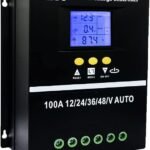
- Off-grid or no grid? DC-coupled or hybrid, with the right charge controller.
If you’re still unsure about which solar setup pairs best with storage, our guide to the different types of solar panels can help you match the right panel technology to your battery choice.
Sizing Your Battery: Don't Guess, Calculate
Sizing is where most people either overspend or under-deliver. The good news? A simple five-step process gets you in the ballpark, and a professional installer can fine-tune the numbers.
Step 1: Find your critical load kWh per day
Walk through your home and list what must run during an outage: fridge, lights, Wi-Fi, a sump pump, maybe a CPAP machine. Add up their wattage and estimate how many hours you run them each day. A typical household lands between 6 and 12 kWh of critical loads per day.
Step 2: Factor in solar production (if you have it)
If you have solar, your battery doesn’t need to cover everything on its own. During daylight, panels will charge the battery and run loads directly. Check your winter production numbers, because that’s usually the weakest stretch.
You can learn more about how panels generate power in different conditions by reading our guide on how solar panels generate electricity.
Step 3: Pick usable capacity, not total capacity
Battery specs list two numbers: total capacity and usable capacity. Always focus on the usable number. A 13.5 kWh battery might only give you 12 kWh of usable energy, depending on chemistry and the manufacturer’s buffer.
Ask for the usable figure upfront.
Step 4: Account for depth of discharge and round-trip efficiency
Depth of discharge (DoD) tells you how much of the battery you can safely use. Most LFP batteries allow 80 to 100% DoD. Round-trip efficiency measures how much energy you get out relative to what you put in.
A 90% efficient battery means 10 kWh in gives you 9 kWh out. Multiply your daily load by that efficiency factor to size correctly.
Step 5: Decide on single vs. stackable batteries
Many systems let you add more batteries later. If you’re cash-conscious now, buy one unit with expansion capability. If you never want to touch the system again, size for your worst-case day, usually winter storms or extreme heat days, and add 20% headroom.
A rough rule: a 10 kWh battery covers the essentials for one evening plus an overnight outage. A 15 to 20 kWh system handles most homes comfortably. When in doubt, check the manufacturer's sizing tool or ask for a load analysis from your installer.
Mistakes That Cost You Money (And How to Avoid Them)
The battery market is full of happy owners, but it’s also full of people who made expensive mistakes. Here are the most common ones we’ve seen in research and aggregate reviews.
Oversizing for backup that never happens
Buying a 30 kWh behemoth when your outage history shows three hours of downtime each year is a waste. That’s money sitting idle. Use your actual outage data, not fear, to size.
Undersizing for time-of-use arbitrage
If your utility charges steep peak rates from 4 PM to 9 PM, you want enough capacity to cover that entire window. A tiny 6 kWh battery will run out by 6 PM, forcing you back to grid power at peak rates. Match capacity to your peak window duration.
Ignoring the warranty fine print
Warranties cover different things. Some cover cycles only. Others cap total throughput (e.g., 30 MWh over 10 years).
Many exclude labor costs for replacement. Read the warranty, not just the marketing sheet. Look for a warranty that guarantees a minimum capacity (usually 60 to 70%) at year 10.
Buying a battery that's incompatible with your inverter
Not every battery works with every inverter. Some require proprietary communication. Others only support AC coupling.
Check the compatibility list before you commit. If you’re replacing both, a hybrid inverter is the safest bet.
Forgetting about cold weather performance
Batteries lose capacity in the cold. Most LFP batteries operate poorly below 0°C (32°F) unless they have an internal heater. If you live in a northern climate, make sure your battery is rated for your garage or install it indoors.
Some units shouldn't be mounted outdoors at all.
Skipping the utility interconnection paperwork
Your utility controls how and when you can charge from the grid. In some regions, you need approval before installation, or the battery is forced to operate in "self-consumption" mode only. That kills time-of-use savings.
File the paperwork early.
The Real Cost: Pricing, Payback, and Incentives
Let’s talk money. It’s the biggest hurdle, but it’s also where understanding the details helps the most.
What you'll actually pay (installed, before incentives)
Residential battery systems typically run between $700 and $1,200 per usable kWh, fully installed. That means a 10 kWh system lands around $7,000 to $12,000 before tax credits. Commercial systems are cheaper per kWh but come with more complex permitting.
For reference, the U.S. Department of Energy tracks storage cost trends through its Energy Storage Grand Challenge program, and those numbers show similar ranges for most brands.
Federal tax credits (ITC) — current rates and sunset dates
As of 2026, the federal Investment Tax Credit covers 30% of your total system cost with no dollar cap. That includes batteries purchased standalone, as long as they are charged by solar or meet the eligibility rules for solar property. This credit runs through 2032 at 30%, then steps down in later years.
State and local incentives
Several states add their own sweeteners. California’s SGIP program offers significant rebates for storage, especially for homes in high-risk outage areas. New York’s NY-Sun and Hawaii’s self-supply program also help.
Check your state’s energy office website for current rebates. Some utilities even pay you for enrolling your battery in a virtual power plant (VPP) program.
Payback period estimates for different scenarios
A solar-plus-battery system in California with time-of-use rates can pay back in 6 to 8 years. A battery alone, with flat rates and no incentives, might take 12 years or longer. The break-even math depends on three variables: your utility rates, your solar export compensation, and any rebates you stack.
| Scenario | Typical payback |
|---|---|
| Solar + battery + TOU rates + SGIP | 5 to 7 years |
| Solar + battery + net metering 2.0 | 8 to 10 years |
| Battery only, flat rates, no incentives | 12+ years |
| Battery only, frequent outages, high value on uptime | "Peace of mind" — not purely financial |
When "no payback" still makes sense
If you live in a region with hurricane threats, wildfire shutoffs, or emergency evacuations, a battery is insurance. You don’t buy insurance for a return on investment. You buy it for recovery.
The same logic applies to medical devices, home businesses, or just avoiding spoiled groceries.
One more way to boost the value: pair your battery with a smart panel or load controller. That lets you prioritize circuits automatically during outages. It’s a small add-on that makes the whole system work better.
If you’re planning the full setup, our main components of a solar panel article gives you a solid foundation for understanding how the pieces fit together.
Frequently Asked Questions
How long does a home battery last?
Most LFP batteries are rated for 4,000 to 10,000 cycles. At one full cycle per day, that’s roughly 11 to 27 years. Real-world factors like temperature, depth of discharge, and charge habits affect the actual number.
The warranty period is typically 10 to 15 years.
Can I install a battery myself?
Unless you have an electrical license, no. Batteries involve high-voltage DC wiring, energy management, and permit requirements. A DIY install also voids warranties in most cases and can create serious fire risks.
Professional installation costs more, but it comes with liability coverage and code compliance.
What happens during a power outage — does it work with solar?
It depends on the wiring. If your battery is installed with a critical-loads panel and a transfer switch, it will power selected circuits when the grid drops. Most home batteries stop feeding power back to the grid automatically.
That’s a safety feature to protect utility line workers.
Do I need a critical loads panel?
Not always, but it’s highly recommended. A critical-loads panel separates a few circuits from the main panel so the battery backs them up without powering the whole house. It’s cheaper than a whole-home battery and keeps the fridge, furnace, and lights running for longer.
How do I recycle or dispose of a dead battery?
Batteries are hazardous waste; you can’t toss them in the trash. Most manufacturers offer take-back programs or partner with certified recyclers. Call your installer or the manufacturer directly for pickup instructions.
Some utility programs also collect end-of-life batteries for recycling.
What's the difference between a Powerwall and a DIY battery bank?
A Powerwall is a turnkey product with integrated inverter, software, and monitoring. A DIY bank, like a rack of LFP server-rack batteries with a separate inverter, is cheaper but requires more technical knowledge. DIY systems also usually lack UL 9540 certification, which means many utilities won’t approve them for grid connection.
The article is already complete. All eight H2 sections from the approved TOC have been written, including the FAQ. No further sections remain.

Similar Posts