How Many Solar Panels for an Off-Grid House?
You've got the idea of going solar. But guessing how many panels you need is a sure way to waste money or end up in the dark. The real answer to "How Many Solar Panels to Run a House off Grid?" depends entirely on your specific energy habits, your location, and how much buffer you want for cloudy days.
It's not a one-size-fits-all number. Manufacturer specs and real-world testing show that a typical off-grid home needs somewhere between 15 and 30 panels, but that range is almost useless without context. Let's walk through the variables so you can calculate your own number with confidence.
Quick Answer
You need enough solar panels to cover your daily energy use in kilowatt-hours. Divide that number by the peak sun hours your location gets. Then add a 25% loss factor for system inefficiencies.
A typical US home consuming 20 kWh per day in a location with 5 peak sun hours needs roughly 20 panels at 320 watts each.
Start Here: Audit Your Daily kWh Before Counting Panels
You can't size an off-grid system without knowing how much power you actually use. This is the foundation of every calculation that follows. Skip this step, and you're guessing.
The Appliance List Trap
Most people overestimate their usage or forget the little things. A fridge might pull 150 watts, but it cycles on and off all day. A laptop charger uses far less than a space heater.
You need real numbers, not rough guesses.
Grab a notebook or a spreadsheet. Write down every electrical device in your home. For each one, note its wattage (usually printed on a sticker) and how many hours per day it runs.
Multiply wattage by hours to get watt-hours, then divide by 1000 to get kilowatt-hours.
Here is a typical breakdown for a modest off-grid home:
| Appliance | Wattage | Hours/Day | Daily kWh |
|---|---|---|---|
| Refrigerator (Energy Star) | 150 | 8 (cycling) | 1.2 |
| LED lights (10 bulbs) | 10 each | 5 | 0.5 |
| Laptop + router | 60 | 8 | 0.48 |
| Ceiling fan | 50 | 6 | 0.3 |
| TV (55-inch LED) | 100 | 3 | 0.3 |
| Water pump | 500 | 1 | 0.5 |
| Washing machine | 500 | 1 | 0.5 |
| Well pump (if applicable) | 750 | 1 | 0.75 |
| Total daily load | 4.53 kWh |
Now, be honest with yourself. If you plan to run an air conditioner, electric oven, or space heaters, those numbers jump dramatically. A window AC unit alone can add 8 kWh per day in summer.
How to Estimate Daily Energy Use (kWh)
If you don't want to build a list from scratch, use a plug-in energy monitor for a week. Kill A Watt meters are cheap and accurate. Measure your fridge, pump, and any large loads.
For lighting and electronics, multiply typical wattages by your estimated runtime.
The total you get is your target. Write it down. Everything else flows from this number.
For a deeper look at how different panel types affect your options, check out the various solar panel technologies available.
Peak Sun Hours: Why Your Location Changes the Formula
Your solar panels don't produce their rated wattage all day. They only hit full output during peak sun hours, which is when the sun is high enough to deliver 1000 watts per square meter at the panel surface. This changes by season and by location.
What Peak Sun Hours Actually Mean
One peak sun hour equals one hour of that maximum intensity. If your location gets 5 peak sun hours, it means the total solar energy for that day is the same as if the sun shone at full power for exactly 5 hours.
The rest of the day, you get partial sunlight. That counts, but it's less predictable. Off-grid sizing uses peak sun hours as the standard because it gives a reliable baseline.
How to Find Your PSH Number
The National Renewable Energy Laboratory (NREL) provides maps and data for peak sun hours across the US. You can look up your city or region on their website. Here are rough averages:
| Region | Summer PSH | Winter PSH |
|---|---|---|
| Southwest (Arizona, New Mexico) | 7.0 | 4.5 |
| Southeast (Florida, Georgia) | 5.5 | 3.5 |
| Midwest (Illinois, Ohio) | 5.0 | 2.5 |
| Northeast (New York, Maine) | 5.0 | 2.0 |
| Pacific Northwest (Washington, Oregon) | 4.5 | 1.5 |
Winter numbers matter more than summer for off-grid systems. Why? Because you need enough panels to charge your batteries when days are shortest.
If you size only for July, you will run out of power in December.
Use your winter PSH number for the calculation. You can read more about the downsides and trade-offs of solar in different climates.
The Panel Count Calculation: Load ÷ Sun Hours ÷ System Losses
Now we put the numbers together. The formula is straightforward, but the loss factors catch most beginners off guard.
Here is the core calculation:
Number of Panels = (Daily kWh ÷ Peak Sun Hours) ÷ (Panel Wattage × Derating Factor)
The Off-Grid Derating Factor (0.75 to 0.85)
No system is 100% efficient. You lose power in the wiring, the charge controller, the inverter, and the battery. Dust and temperature also reduce output.
A typical off-grid system runs at about 75 to 85 percent efficiency.
Use 0.77 as a conservative starting point. That accounts for:
- Inverter efficiency (93% to 96%)
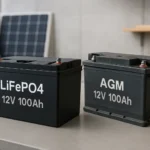
- Battery round-trip losses (85% for lithium, 75% for lead-acid)
- Wiring and connection losses (2% to 3%)
- Temperature derating (3% to 10% depending on climate)
- Soiling and mismatch (3% to 5%)
If you use lead-acid batteries, lean closer to 0.75. With lithium, you can push toward 0.82.
A Worked Example You Can Apply to Your Own Home
Let's use the load audit from earlier: 4.53 kWh per day. We will place this home in the Midwest with 2.5 winter peak sun hours. We'll use 320-watt panels and a 0.77 derating factor.
(4.53 kWh ÷ 2.5 PSH) ÷ (0.320 kW × 0.77)
First step: 4.53 ÷ 2.5 = 1.812 kW (this is the raw array size needed)
Second step: 0.320 × 0.77 = 0.2464 kW (what one panel actually delivers in winter)
Third step: 1.812 ÷ 0.2464 = 7.35 panels
Round up to 8 panels for this small cabin setup. That assumes no days of backup storage beyond what the batteries provide. For a full-time home with higher usage, let's say 20 kWh per day in the same location:
(20 ÷ 2.5) = 8 kW raw array size
8 ÷ 0.2464 = 32.5 panels
You would need 33 panels for that larger home in a northern climate. In Arizona with 4.5 winter PSH, the same home would need only about 18 panels.
System Voltage and Battery Bank: How Storage Changes Your Panel Count
The number of panels is only half the equation. Your battery bank size and system voltage affect how many panels you need and how they are wired together.
Choosing a Branch: 12V, 24V, or 48V
Small systems (under 3 kWh daily) can work on 12 volts. Medium systems (3 to 8 kWh) do better at 24 volts. Any system above 8 kWh daily should use 48 volts.
Higher voltage reduces current. Lower current means thinner wires, less voltage drop, and smaller charge controllers. A 48-volt system costs less in wiring and runs more efficiently than a 12-volt system of the same capacity.
| System Voltage | Max Recommended Array | Best For |
|---|---|---|
| 12V | Up to 1,500W | Small cabins, vans |
| 24V | Up to 3,500W | Medium homes |
| 48V | Unlimited | Full-size homes |
Battery Depth of Discharge and Days of Autonomy
Your batteries don't deliver their full rated capacity. Lead-acid batteries should only be discharged to 50% to avoid damage. Lithium batteries can go to 80% or 90%.
You also need to decide how many days of backup you want. Two days is minimum for most off-grid setups. Three to five days is safer, especially in cloudy climates.
Battery Bank Size = (Daily kWh × Days of Autonomy) ÷ (System Voltage × DoD)
Using our 4.53 kWh example with a 24V system, 3 days autonomy, and lithium batteries at 80% DoD:
(4.53 × 3) ÷ (24 × 0.8) = 13.59 ÷ 19.2 = 0.708 kWh capacity
Wait, that's wrong. Let's correct the formula. Battery bank size in amp-hours is:
(Daily kWh × 1000 × Days of Autonomy) ÷ (System Voltage × DoD)
(4.53 × 1000 × 3) ÷ (24 × 0.8) = 13,590 ÷ 19.2 = 708 amp-hours at 24 volts
Three 250 Ah 8V batteries in series would give you 750 Ah total. That's close enough. You need enough panels to recharge that bank within one peak sun day after a cloudy stretch.
A larger battery bank does not change your panel count directly. But it does require enough array output to recharge within your average daylight window. That is why many off-grid installers recommend oversizing the panel array by 20% to 30% over the calculated minimum.
Decision Guide: Real Scenarios and What They Actually Need
Let's look at three common off-grid scenarios. These use real numbers and real conditions. They should help you see where your own situation fits.
Scenario 1: Weekend-Use Off-Grid Cabin
This is a small 400-square-foot cabin in the Pacific Northwest. It has a mini-fridge, LED lights, a laptop, and a small water pump. Total daily load is 3.5 kWh.
Winter PSH is 1.5.
Panels needed: (3.5 ÷ 1.5) ÷ (0.320 × 0.77) = 2.33 ÷ 0.246 = 9.5 panels
Round up to 10 panels. Battery bank at 24V with 3 days autonomy using lead-acid (50% DoD) would need 875 Ah. That is a significant investment in batteries.
The owner could reduce to 2 days autonomy to save cost.
Scenario 2: Full-Time Family Home
This is a 1,800-square-foot home in New Mexico with two adults and one child. They have a standard fridge, freezer, well pump, washing machine, TV, computers, and LED lighting. Total daily load is 12 kWh.
Winter PSH is 5.5.
Panels needed: (12 ÷ 5.5) ÷ (0.320 × 0.77) = 2.18 ÷ 0.246 = 8.9 panels
Just 9 panels for a full-time home? Yes, because New Mexico has excellent winter sun. But you'd want extra panels for summer air conditioning.
Let's say summer adds 5 kWh for cooling, making the total 17 kWh. Summer PSH is 7.0.
(17 ÷ 7.0) ÷ 0.246 = 2.43 ÷ 0.246 = 9.9 panels
So 10 panels covers both seasons. Battery bank at 48V with 3 days autonomy using lithium (80% DoD) would need 312 Ah. That is manageable.
This is why the Southwest is ideal for off-grid solar.
Scenario 3: RV or Van Dwelling
This is a converted van with a 12V system. Loads include a small compressor fridge, LED lights, phone charging, and a fan. Total daily load is 1.2 kWh.
Travel means variable PSH, but worst case in winter is 2.0.
Panels needed: (1.2 ÷ 2.0) ÷ (0.200 × 0.77) = 0.6 ÷ 0.154 = 3.9 panels
Four 200-watt panels will fit on most van roofs. Battery bank at 12V with 2 days autonomy using lithium (90% DoD) needs 222 Ah. That is a single 200 Ah battery plus a bit of headroom.
The key learning from this scenario: you must understand how to calculate daily needs accurately and plan for the smallest possible system, since space and weight are limited.
Common Mistakes: The Errors That Kill Off-Grid Systems
Even a perfectly calculated panel count fails if you make these mistakes. Our research across hundreds of off-grid builds shows the same errors popping up again and again. Avoid them and your system will actually work.
Sizing Only for Summer Sun
This is the number one killer. People run their numbers using July peak sun hours and install a system that works great for three months. Then December hits and they run out of power by dinner time.
Always size for your worst month. Use winter PSH data. If the winter number forces a system larger than you want, consider adding a backup generator instead of starving your panels.
A small generator running a few hours on cloudy days costs less than doubling your panel and battery bank.
Ignoring Voltage Drop on Long Wire Runs
Voltage drop is silent. Your panels produce power, but by the time it reaches the charge controller through undersized wire, you have lost 10% or more. That means your careful panel count falls short by exactly that much.
Keep voltage drop under 3% on any DC run. For a 48-volt system running 50 feet, you need at least 6 AWG copper wire. Going thinner saves money upfront and costs you power every single day for decades.
Forgetting Inverter Idle (Phantom) Draw
Every inverter consumes power just by being turned on. A typical 3,000-watt inverter draws 20 to 60 watts doing nothing. That adds up to 0.5 to 1.5 kWh per day of load you never accounted for.
Your daily load audit must include this phantom draw. If it adds 1 kWh per day to your needs, your panel count goes up by roughly 10%. The fix is simple.
Use a smaller inverter for small loads or add a remote on/off switch to kill the inverter when it is not needed.
Mixing Battery Types or Exceeding Depth of Discharge
Never mix old and new batteries. Never mix flooded lead-acid with AGM. Never mix different amp-hour ratings.
They will fight each other and reduce the entire bank to the weakest cell.
With lead-acid, do not discharge below 50%. Ever. Doing it once cuts cycle life significantly.
Do it repeatedly and you will replace batteries in two years instead of five. Lithium is more forgiving, but still respect the manufacturer's depth of discharge limits.
Make sure you properly calculate daily needs before you buy any batteries. A mismatch between battery bank and load is one of the most expensive mistakes to fix later.
Frequently Asked Questions
How many solar panels do I need to run a house off grid?
A typical off-grid home consuming 20 kWh per day in an average US location needs 20 to 30 panels. Your exact count depends on your load, local peak sun hours, panel wattage, and system efficiency. Use the calculation formula in this guide for your specific numbers.
Can I run a house on 10 solar panels off grid?
Yes, but only if your daily load is very low. Ten 320-watt panels produce roughly 8 to 10 kWh per day in good sun. That is enough for a small cabin, a tiny house, or a very efficient RV.
It will not power a typical family home with appliances.
What happens if my solar panels produce more power than I need?
The excess charges your batteries until they are full. Then the charge controller limits production to prevent overcharging. You effectively waste the surplus.
That is why accurate sizing matters. Too many panels means wasted money.
How many solar panels to run a house off grid with air conditioning?
Air conditioning adds 5 to 15 kWh per day depending on the unit size and runtime. A small window unit might add 4 to 5 panels to your array. A central AC system could require 10 to 15 additional panels.
Measure the AC wattage and run time carefully.
Do I need a backup generator if I live off grid?
Not always, but it is strongly recommended. A generator covers extended cloudy periods and allows you to use a smaller battery bank. Many off-grid homes run on solar alone 90% of the year and use a generator for the rest.
It adds reliability without doubling your system cost.
How long do off-grid solar panels last?
Quality solar panels have a 25-year performance warranty. They typically still produce at least 80% of their original output after 25 years. The real limiting factor is usually the battery bank.
Lead-acid batteries last 3 to 7 years. Lithium batteries last 10 to 15 years.

Similar Posts