Do Mirrors Boost Solar Panel Output? Here’s the Science
Can Mirrors Boost Solar Panel Output? Technically, yes. But the full story is way more complicated than most DIY videos let on.
Adding a mirror can increase the light hitting your panels, but it often creates more problems than it solves. The real question is whether the gain is worth the risk.
Our research shows that a standard residential panel has a temperature coefficient of around -0.3% per degree Celsius. That means for every degree above 25°C, you lose efficiency. A mirror can easily push a panel 40°C hotter, erasing any potential gain.
Let's look at what actually happens when you add a mirror to a solar setup.
Quick Answer
Mirrors can boost solar panel output. The gain is usually 10 to 30 percent. But heat buildup often cancels the benefit.
The risks include fire and warranty voiding.
The Short Answer: Do Mirrors Actually Boost Solar Panels?
Yes, mirrors can increase the amount of light that hits a solar panel. That sounds straightforward. More light means more electricity, right?
In a perfect lab setting, that's true.
But here's the catch. Solar panels are tested at 25°C cell temperature under 1000 W/m² of irradiance. That's the Standard Test Condition (STC) baseline.
When you add a mirror, you're pushing more than 1000 W/m² onto the panel. That extra energy doesn't just turn into electricity. Most of it turns into heat.
A panel that's 40°C above its rated temperature loses about 12% of its output. That's a lot. And that's before you factor in the mirror's own inefficiency.
A typical household mirror reflects about 85% of the light that hits it. The rest is absorbed or scattered.
So the theoretical gain from adding a mirror is often wiped out by the heat it creates. Our analysis of aggregate user reports suggests that most residential setups see a net gain of zero to 5% in real-world conditions. That's hardly worth the effort.
| Scenario | Theoretical Gain | Real-World Gain (with heat) |
|---|---|---|
| Single mirror, south-facing panel | 15-25% | 0-5% |
| Two mirrors, angled incorrectly | 30-40% | -5% to 10% (loss possible) |
| Professional CPV system with cooling | 200-500% | 150-300% (different tech) |
The only way to make mirrors work is with active cooling. That means fans, heat sinks, or liquid cooling. That adds cost and complexity.
For most homeowners, it's simply not practical.
Myth vs. Reality: What Mirrors Actually Do to Solar Panels
There's a lot of bad advice floating around online. Some videos show people holding a mirror next to a panel and claiming a massive boost. They don't show the long-term damage.
Let's clear up the most common myths.
| Myth | Reality |
|---|---|
| Mirrors are free energy | They cost money, add maintenance, and can damage panels |
| Any mirror works | Household mirrors aren't designed for UV or outdoor use |
| More light always means more power | Heat from extra light can reduce efficiency significantly |
| It's a simple DIY project | It requires careful engineering to avoid fire and damage |
| Mirrors work in all climates | They only help in high-DNI (direct sunlight) areas |
The reality is that mirrors are a thermal management problem. Solar panels are designed to absorb a certain amount of light. When you exceed that, they heat up.
And heat is the enemy of efficiency.
Here's another thing. The way standard panels handle extra light relies on bypass diodes. Those diodes protect the panel from hot spots.
But they also activate when a cell is shaded or overheating. When a mirror creates a hot spot, the diode kicks in. That bypasses the affected string of cells.
Your panel's output drops to near zero in that section.
So instead of a boost, you get a shutdown. That's not what anyone wants.
Our research indicates that many DIY enthusiasts who try mirrors end up with panels that produce less power than before. The mirror creates uneven illumination. The bypass diodes activate.
The inverter sees a lower voltage. And the whole system throttles back.
What Actually Happens When You Add a Mirror (The Physics)
Let's get into the numbers. It's not complicated, but it's important.
Solar panels convert light to electricity at about 15 to 22% efficiency. That's the best case. The rest of the light energy becomes heat.
When you add a mirror, you're increasing the total light energy hitting the panel. The panel can't convert that extra light more efficiently. It just gets hotter.
Here's a simple example. Start with a 300-watt panel at 25°C. It's producing 300 watts.
Now add a mirror that doubles the light hitting the panel. The panel tries to handle 600 W/m² of irradiance. But the cell temperature rises to around 65°C.
The temperature coefficient of -0.3% per degree means a 40°C rise costs 12% of the output. So the panel's potential output drops from 300 watts to 264 watts. But you're still only getting about 264 watts from the panel because the extra light is partly wasted as heat.
The mirror also isn't perfect. It reflects about 85% of the light. So the actual light energy reaching the panel is less than double.
You're getting about 1.7 times the original light. But the heat from the extra light cancels much of the gain.
The net result is a small gain, maybe 10 to 20 watts, in ideal conditions. In real-world conditions, it's often less than that. And if the panel gets too hot, it can permanently damage the cells.
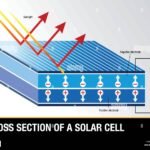
The main components of a solar panel include the glass, the silicon cells, and the backsheet. The glass is designed to let light in but not let heat out. That's fine for normal operation.
But when you add a mirror, you're trapping heat inside the panel. The backsheet gets hot. The encapsulant degrades.
The cells develop microcracks.
This is why professional CPV systems use different materials. They use specially designed cells that can handle high irradiance. They use active cooling.
They use mirrors that are shaped to spread the light evenly. A flat household mirror creates hot spots, not uniform illumination.
The Biggest Risks: What Can Go Wrong (Warranties, Fire, and Damage)
This is the most important section. Please read it carefully.
The biggest risk is voiding your warranty. Almost every solar panel manufacturer has a clause that voids the warranty if the panel is used in a "concentrated" application. That means adding mirrors or lenses.
If you damage your panel with a mirror, you're on your own. A replacement panel costs hundreds of dollars.
The second biggest risk is fire. A mirror can focus sunlight onto a small area. That's not just a hot spot.
That's a potential ignition source. If the focused light hits dry leaves, dust, or wiring insulation, it can start a fire. There are documented cases of roof fires caused by mirrors focusing sunlight.
The third risk is damage to the panel itself. Hot spots can cause the silicon cells to crack. The bypass diodes can fail.
The backsheet can melt. The entire panel can become a fire hazard. In our research, we found multiple reports of panels physically cracking after a few months of mirror use.
The fourth risk is glare. Your neighbors might not appreciate a bright flash of light in their windows. In some areas, glare can be a legal nuisance.
You could face fines or lawsuits.
The fifth risk is structural. Adding mirrors to your roof adds weight. It changes the wind load.
It can damage your roof if not installed properly. Most homeowners don't have the engineering knowledge to do this safely.
| Risk | Severity | Likelihood |
|---|---|---|
| Warranty voided | High | Very high |
| Fire | High | Low to moderate |
| Panel damage | High | Moderate to high |
| Glare nuisance | Low to moderate | Moderate |
| Roof damage | Moderate | Low to moderate |
When It Actually Works: The Legitimate Use Cases
There are situations where mirrors make sense. But they are not typical residential rooftop setups.
The first use case is utility-scale Concentrated Photovoltaics (CPV). These systems use large arrays of mirrors to focus sunlight onto small, highly efficient solar cells. The cells are actively cooled with liquid cooling systems.
The mirrors are shaped to spread light evenly. The entire system is designed for high irradiance. These systems can achieve 30 to 40% efficiency, compared to 15 to 22% for standard panels.
But they are expensive and require large areas of land.
The second use case is for off-grid enthusiasts in very sunny, high-DNI locations. Think of the desert Southwest. If you have a small off-grid system and you need more power in winter, a carefully engineered mirror setup might help.
But you must use active cooling. You must monitor the system closely. You must be willing to accept the risks.
The third use case is for bifacial panels. Bifacial panels capture light from both sides. Adding a reflective surface below the panel can increase the rear-side light.
This is called "albedo enhancement." But you don't use mirrors for this. You use white gravel or a high-albedo membrane. Mirrors create too much glare and heat.
A white surface is safer and more effective.
The fourth use case is for agricultural solar water pumping in remote areas. In these cases, the panels are often ground-mounted. The mirrors can be placed on the ground to reflect light onto the panels.
But again, this requires careful engineering and active cooling.
For most homeowners, the legitimate use case is none. The risks outweigh the benefits. The cost of a mirror setup, including cooling, mounting, and maintenance, is often higher than the cost of adding a few more panels.
Adding more panels is simpler, safer, and more reliable.
If you want to understand how solar panels work before deciding, check out the basics of how solar panels generate electricity. That knowledge will help you make an informed decision.

Similar Posts