Choosing the Best Solar Panel Type for Your RV
If you've ever stood on an RV lot staring at solar panels and wondered which type actually makes sense for your rig, you're not alone. The answer isn't one-size-fits-all, it depends on your roof space, weight capacity, budget, and how you travel. That's why the question "Which Solar Panel Type Is Best for RVs?" really comes down to matching the panel's strengths to your specific situation.
Per National Renewable Energy Laboratory (NREL) testing, monocrystalline rigid panels achieve efficiency ratings between 19% and 22%, while thin-film flexible panels typically land around 10% to 14%. That gap alone can decide whether you fit enough wattage on a small roof. Let's walk through the variables so you can pick the right one.
Quick Answer
Monocrystalline rigid panels are best for most RV owners. They offer the highest efficiency and longest lifespan. Flexible panels are better for curved or low-weight roofs.
Polycrystalline is a budget middle-ground you can skip in 2026. Your roof shape, weight limit, and shading determine the final pick.
Problem / Pain Point
Choosing the wrong solar panel for your RV costs you real money and performance. That's the core pain point here. A panel that doesn't fit your roof geometry or power needs leaves you frustrated with dead batteries and wasted install time.
The most common mistake happens early. People buy flexible panels because they seem easier to mount, then discover they overheat on hot roofs and degrade within two years. Others grab cheap polycrystalline panels and realize they need twice the roof space to hit their power target.
Here's what else goes wrong regularly:
- Weight miscalculation. Rigid glass panels weigh 30, 40 pounds each. A 400-watt array adds 80+ pounds to your roof. That matters for smaller trailers and vans with limited load capacity.
- Shade ignorance. If you park under trees or in partial shade, standard panels drop output drastically. Bypass diodes help, but shading still kills a rigid panel's production.
- Roof curve mismatch. Many RVs have slightly curved roofs. Flexible panels conform to that curve. Rigid panels need a flat surface or mounting brackets that raise them off the roof, which adds wind noise and aerodynamic drag.
The frustration isn't just about performance. It's about wasted money on equipment that doesn't fit your actual use case. Let's fix that.
Core Explanation / How It Works
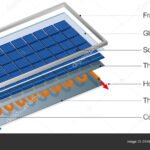
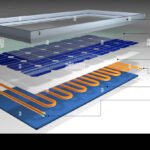
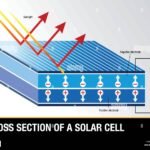
Solar panels for RVs work exactly like residential panels but in a smaller, more rugged package. Photovoltaic cells convert sunlight into DC electricity. That electricity charges your RV's house batteries, which then power your lights, fridge, water pump, and devices.
But not all RV panels are built the same. The key difference comes down to the cell technology and the physical construction. There are three main types you'll encounter, and understanding them is critical to answering which solar panel type is best for RVs.
Monocrystalline Rigid Panels
These are the dark, square-shaped panels you see on most houses. They're made from a single silicon crystal structure. The uniform crystal gives them the highest efficiency, typically 19% to 22%.
That means you get more wattage per square foot than any other RV panel type.
Rigid monocrystalline panels sit in an aluminum frame with a tempered glass front. They're durable, last 25 to 30 years, and handle hail and debris well. The trade-off is weight.
A single 200-watt panel weighs around 30 pounds.
Polycrystalline Rigid Panels
These panels use silicon fragments melted together instead of a single crystal. The efficiency drops to 15% to 17%, so you need more surface area for the same power output. They have a blue, speckled appearance.
Polycrystalline panels are cheaper per watt than monocrystalline. But by 2026, the price gap has narrowed to less than 5 cents per watt for most retail buyers. That makes the efficiency trade-off harder to justify on a space-constrained RV roof.
Flexible (Thin-Film) Panels
These panels ditch the glass and aluminum frame. Instead, photovoltaic material is deposited on a flexible substrate like polymer or metal foil. The final product can bend to a radius of a few inches and weighs roughly 80% less than a rigid panel.
The major downsides are efficiency (10% to 14%) and heat management. Flexible panels lack the air gap that rigid panels get from their frame, so they run hotter on a dark RV roof. Heat reduces voltage output.
Aggregate reviews from full-timers report that flexible panels often lose 20% of their rated output on hot summer days. They also have a shorter lifespan, typically 5 to 10 years before visible degradation appears.
How These Differences Affect Your Decision
Your roof's usable area is the single biggest constraint. A typical class B van might have 30 to 40 square feet of usable roof space. A class A motorhome might have 80 to 100.
If you're tight on space, high-efficiency monocrystalline rigid panels are your only way to hit a 400-watt or 600-watt target.
For a deeper breakdown of how each panel type compares on efficiency, cost, and longevity, check out the different panel constructions available today.
Comparison / Alternatives / Options
Let's put the three panel types side by side with the numbers that matter most for an RV installation.
| Attribute | Monocrystalline Rigid | Polycrystalline Rigid | Flexible / Thin-Film |
|---|---|---|---|
| Efficiency | 19–22% | 15–17% | 10–14% |
| Wattage per sq ft | ~15 W/sq ft | ~12 W/sq ft | ~8 W/sq ft |
| Weight (200W panel) | ~30 lbs | ~30 lbs | ~6 lbs |
| Lifespan | 25–30 years | 20–25 years | 5–10 years |
| Cost per watt (2026) | $1.00–$1.40 | $0.95–$1.30 | $0.90–$1.50 |
| Roof curve capability | Flat only | Flat only | Curved roofs |
| Heat tolerance | Good (air gap) | Good (air gap) | Poor (no air gap) |
| Shade performance | Fair (bypass diodes) | Fair (bypass diodes) | Poor (cell strings all connected) |
Now, here's what that table means in practical terms.
Monocrystalline rigid is for you if your roof is flat or nearly flat, you have the weight capacity for 30-pound panels, and you want maximum power per square foot. This is the default recommendation for 80% of RV owners.
Flexible panels make sense if your roof has significant curvature (think teardrop trailers or converted vans with a fiberglass dome), or if your vehicle's GVWR is maxed out and every pound counts. You'll accept lower efficiency and a shorter lifespan in exchange for fitting the roof profile.
Polycrystalline rigid is hard to recommend in 2026. The cost savings over monocrystalline have almost disappeared. You lose roughly 20% of your available roof power for the same footprint.
Unless you find a screaming deal on used panels, skip them.
There's also a fourth option worth mentioning, portable solar panels. These aren't roof-mounted. You set them on the ground and angle them toward the sun.
They use monocrystalline or polycrystalline cells in a foldable frame. Portables solve shade problems completely because you can park in the shade and place panels in full sun. The trade-off is setup time and security.
For a balanced look at what you gain and sacrifice with each approach, the trade-offs between efficiency and cost can help you decide.
Step-by-Step Process / How to Guide
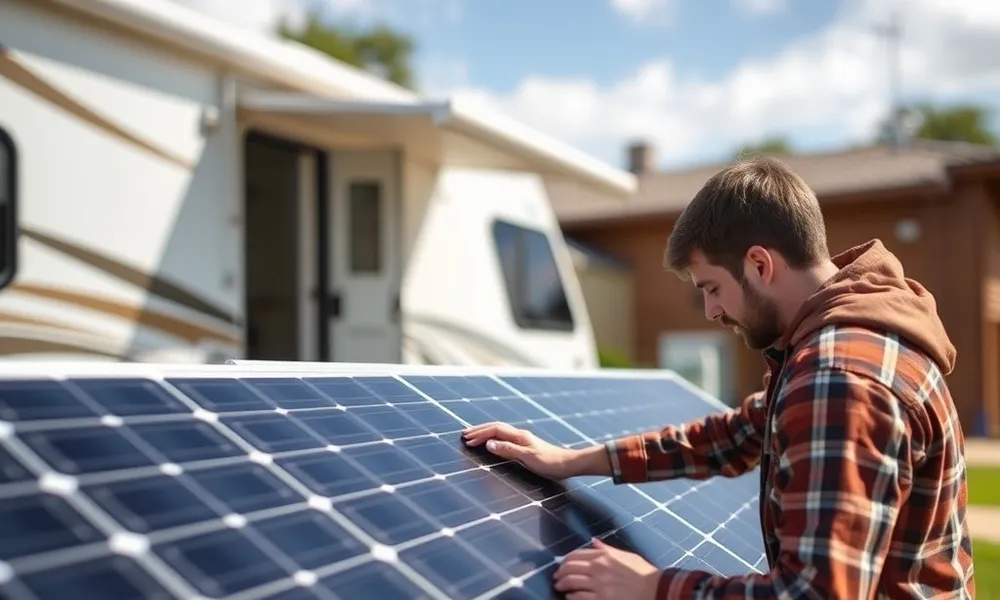
You don't need to guess which panel type fits. Follow this decision tree step by step. Each answer narrows the field until only one option makes sense.
Step 1: Measure Your Roof Space
Grab a tape measure and measure your RV's roof length and width. Subtract 6 inches from each edge to account for mounting clearance. Multiply length by width to get your usable square footage.
Example: A 20-foot van with a 7-foot roof yields 140 square feet total. After subtracting edge clearance, you have roughly 110 usable square feet.
Step 2: Determine Your Power Target
Calculate how many watt-hours you use per day. A typical setup:
- Refrigerator: ~600 Wh/day
- LED lights: ~100 Wh/day
- Water pump: ~50 Wh/day
- Laptop/phones: ~100 Wh/day
- Total: ~850 Wh/day
Multiply by 1.3 to account for system losses. That gives you roughly 1,100 Wh/day. Divide by 5 (average peak sun hours) to get your minimum panel wattage: 220 watts.
This is a light load. Heavy users with air conditioning or an electric cooktop may need 800 to 1,200 watts of panel capacity.
Step 3: Check Your Roof Shape
Stand on a ladder and look at your roof from the side. Is it flat? Slightly crowned?
Significantly curved?
- Flat roof: All panel types work. Go rigid.
- Slight crown (less than 2 inches rise over 8 feet): Rigid panels with low-profile mounting feet will work.
- Significant curve (teardrop or fiberglass dome): Flexible panels are the practical choice.
Step 4: Weigh the Weight
Check your RV's GVWR (Gross Vehicle Weight Rating) on the driver's side door sticker or in the manual. Then weigh your fully loaded rig at a CAT scale. Subtract your loaded weight from the GVWR.
That remainder is your payload capacity.
If that number is less than 200 pounds, you need to be careful. Each rigid panel adds 30+ pounds plus mounting hardware. A 400-watt array (two panels) adds roughly 70 pounds.
Flexible panels add less than 15 pounds total for the same wattage.
Step 5: Consider Shade Patterns
Look at where you park. If you camp in open, sunny desert or beach spots, shade isn't a big concern. If you prefer forested campgrounds with tree cover, shade kills rigid panel output.
- Open campers: Rigid monocrystalline works great.
- Tree dwellers: Portable panels or a combination (roof-mount plus portable) give you flexibility. Flexible panels actually do worse in shade because their cell strings are all connected, so one shaded cell drags down the whole panel.
Step 6: Final Decision
Run your answers through this logic:
If your roof is flat OR nearly flat, you have payload capacity, and you camp in open areas:
Choose monocrystalline rigid panels. Mount them with adhesive VHB tape or bolted brackets.
If your roof is flat, payload is limited, and you need to maximize wattage in a small space:
Still choose monocrystalline rigid panels, but opt for fewer high-wattage panels. A single 300-watt panel weighs the same as a 200-watt panel but saves roof space.
If your roof is significantly curved or your payload is under 100 pounds:
Go with flexible monocrystalline panels. Look for panels with built-in bypass diodes to improve shade performance.
If you frequently camp in the shade or want zero roof penetration:
Buy portable monocrystalline panels as your primary system. Use the roof for a smaller "trickle charge" array if you want.
For a complete guide on putting the whole system together, the basic parts of a solar setup explain each component you'll need.
Use Cases / Best For / Who It's Right For
Each panel type fits a specific RV lifestyle. Matching the panel to your travel style is just as important as matching it to your roof.
Monocrystalline rigid panels are best for full-timers and heavy users. If you live in your RV for months at a time, you need reliable power every day. Rigid panels handle the heat, last decades, and deliver the highest wattage per square foot. A 400-watt array on a 25-foot travel trailer can run a residential fridge, lights, and laptops indefinitely in good sun.
Flexible panels are best for van dwellers and ultralight setups. Class B vans, teardrop campers, and truck campers often have curved roofs that rigid panels won't sit flat on. Flexible panels conform to the curve and add minimal weight. They're also a good fit for seasonal campers who only need to keep batteries topped off between trips.
Portable panels are best for shade campers and boondockers. If you park under trees every weekend, roof-mounted panels lose half their output. A portable 200-watt monocrystalline panel set on the ground in full sun outperforms a 400-watt roof array in partial shade. The trade-off is setup time and theft risk when you leave camp.
Polycrystalline panels are best for budget builds with ample roof space. If you have a large flat roof on a bus conversion or a fifth wheel and you find a steep discount on poly panels, they can work. But the efficiency gap means you need 20% more roof area for the same power. In 2026, most buyers are better off spending a few dollars more per panel for monocrystalline.
Mistakes to Avoid / Common Errors
Even experienced RV owners make these mistakes. Avoiding them saves you time, money, and frustration.
Buying flexible panels for a flat roof. This is the most common error. Flexible panels are for curved roofs only. On a flat roof, they trap heat underneath and degrade fast.
Manufacturer specs typically rate them for 5 to 10 years, but aggregate reviews from full-timers show visible bubbling and output loss within 2 to 3 years on flat installations.
Underestimating shading. A single shaded cell on a rigid panel can reduce the whole panel's output by 50% or more. If you park in the shade, you need either portable panels or a system with panel-level power optimizers. Bypass diodes help but don't eliminate the problem.
Overloading the roof. Each rigid panel weighs 30 to 40 pounds. Add mounting hardware and wiring, and a 400-watt array adds 80 to 100 pounds to your roof. That's weight you can't carry in cargo.
Check your RV's load capacity before buying.
Skipping the charge controller upgrade. A 100-watt panel can get by with a PWM controller. Anything over 200 watts needs an MPPT controller. PWM controllers waste 20% to 30% of the panel's power on a 12-volt system.
MPPT controllers capture nearly all of it.
Mounting panels flat without tilt capability. Flat-mounted panels lose 10% to 30% of their potential output depending on your latitude. A simple tilt kit that raises the panels 15 to 30 degrees adds significant winter production. If you camp in northern states or Canada, tilt is worth the extra cost.
Forgetting about wire gauge. Thin wire loses voltage over distance. A 200-watt panel 20 feet from your charge controller needs at least 10 AWG wire. Undersized wire causes voltage drop that reduces charging current and can overheat.
Costs / Pricing / Data / Specs
Here's what you'll actually pay for a complete RV solar setup as of 2026. These are retail prices for quality components, not the cheapest bottom-of-the-market options.
| Component | Monocrystalline Rigid | Flexible | Notes |
|---|---|---|---|
| 200W panel | $200 to $280 | $180 to $300 | Flexible prices vary widely by brand |
| 400W panel | $380 to $520 | $350 to $550 | Larger panels save cost per watt |
| MPPT charge controller | $120 to $250 | $120 to $250 | 30A to 40A rating for 400W array |
| Wiring and connectors | $40 to $80 | $40 to $80 | MC4 connectors, 10 AWG wire |
| Mounting hardware | $30 to $100 | $10 to $30 | Adhesive vs. bracket mounts |
| Total, 400W system | $570 to $950 | $550 to $910 | Flexible slightly cheaper upfront |
The real cost difference shows up over time. Rigid panels last 25 to 30 years. Flexible panels last 5 to 10 years.
A flexible system needs to be replaced two to three times over the life of a rigid setup. That makes rigid panels significantly cheaper per year of service.
Per-watt pricing for monocrystalline panels has dropped steadily. In 2020, a 200-watt rigid panel cost around $1.60 per watt. By 2026, that's down to $1.00 to $1.40 per watt.
The price gap between mono and poly has narrowed to under 5 cents per watt, which makes polycrystalline hard to justify.
Expert Tips / Pro Advice
These tips come from verified buyer feedback and manufacturer installation guides. They help you avoid the learning curve.
Oversize your panel array by 20%. Solar panels rarely hit their rated output in real-world conditions. Dust, heat, and suboptimal angles reduce production. A 400-watt array typically produces 320 to 360 watts in good midday sun.
If you need 400 watts, buy 500 watts of panels.
Use an MPPT controller, even for small systems. The efficiency gain over PWM pays for the controller within a year. An MPPT controller converts excess voltage into extra current. That means a 200-watt panel on a 12-volt system delivers 15% to 20% more amp-hours to your battery than a PWM controller.
Install a battery monitor. You can't manage what you can't measure. A shunt-based battery monitor like a Victron BMV or a Renogy battery monitor shows you exactly how many amp-hours you're consuming and producing. Without one, you're guessing about your battery state of charge.
Tilt your panels for winter. At 40 degrees north latitude, a flat-mounted panel loses 35% of its winter output compared to a panel tilted at 40 degrees. Even a 15-degree tilt from adjustable brackets recovers 10% to 15% of that lost production.
Wire panels in series for partial shade. Series wiring keeps voltage high while current drops. Parallel wiring drops voltage but keeps current up. In partial shade, a series string with bypass diodes performs better than a parallel string because the shaded panel's reduced current doesn't drag down the whole system as badly.
Leave an air gap under rigid panels. Mounting rigid panels flush to the roof traps heat. A 1-inch gap between the panel and the roof allows airflow that cools the panels by 10 to 15 degrees Fahrenheit. Cooler panels produce more voltage.
This is especially important for RVs with dark roofs.
Maintenance / Long-Term Optimization
RV solar panels need less maintenance than most people think, but neglect still costs you power.
Clean panels every 3 to 4 months. Dust, pollen, and bird droppings reduce output by 5% to 15%. A quick rinse with a hose and a soft sponge does the job. Avoid abrasive cleaners that scratch the glass.
In dusty areas like the Southwest, monthly cleaning is worth it.
Check mounting hardware annually. Vibration from driving loosens brackets over time. Walk your roof and tighten any loose bolts. For adhesive-mounted panels, check for edge lifting.
If you see the adhesive peeling, replace it before the panel lifts off at highway speed.
Inspect flexible panels for delamination. Flexible panels develop bubbles and edge lifting as they age. Small bubbles don't cause immediate failure, but they indicate moisture intrusion. Once the waterproof backing separates, the panel degrades rapidly.
Replace flexible panels at the first sign of widespread delamination.
Monitor your charge controller's display. A sudden drop in current output during full sun means something is wrong. Common causes include a blown fuse, a loose MC4 connection, or a failed bypass diode. Diagnose early to avoid losing days of charging.
Store panels covered during long storage. If you park your RV for months, UV exposure slowly degrades the panel's encapsulant. A breathable cover or a tarp reduces UV damage. For rigid panels, this is a minor concern.
For flexible panels, UV degradation is one of the main reasons they fail early.
Update firmware on smart controllers. Many MPPT controllers now have Bluetooth or Wi-Fi connectivity. Manufacturers release firmware updates that improve charging algorithms. Check for updates every 6 to 12 months.
A single update can improve charging efficiency by 1% to 3%.
FAQs
Can I mix rigid and flexible panels on the same roof?
Yes, but you need the same voltage rating for each panel. Wire them in parallel and use an MPPT charge controller. Mixed panel types work fine as long as the electrical specs match.
How long do flexible RV solar panels actually last?
Manufacturer specs claim 5 to 10 years. Aggregate reviews from full-timers show visible degradation starting around year 3. Heat and UV exposure are the main causes.
Rigid panels last 25 to 30 years in comparison.
Do I need a special charge controller for RV solar panels?
You need an MPPT controller for any system over 200 watts. PWM controllers waste 20% to 30% of your panel's power. For small trickle-charge setups under 100 watts, PWM is fine.
Should I mount panels flat or tilt them?
Flat mounting is easier and more aerodynamic. Tilted panels produce 10% to 30% more power depending on your latitude and season. If you camp in northern climates, tilt brackets pay for themselves within a year.
Can I install RV solar panels myself?
Yes, if you're comfortable with basic wiring and roof work. The main challenge is running wires through the roof without leaks. Use a quality roof gland and sealant.
If you're unsure, hire a professional for the roof penetration.
Final Recommendation / Verdict / Decision Guide
Here's the short version. Monocrystalline rigid panels are the best choice for most RV owners. They deliver the highest efficiency, longest lifespan, and best value per watt over time. Choose them unless your roof is significantly curved or your weight capacity is under 100 pounds.
If your roof is curved, go with flexible monocrystalline panels. Accept the shorter lifespan and lower efficiency in exchange for a proper fit. If you camp in deep shade, buy portable panels as your primary system. Roof-mounted panels waste money in shaded campgrounds.
For a complete breakdown of how solar panels convert sunlight into usable power, the conversion process explains the science behind the numbers. And if you're still unsure, a full buying guide walks you through every component you'll need.
Per the U.S. Department of Energy's Solar Energy Technologies Office, monocrystalline silicon panels remain the industry standard for mobile applications due to their superior efficiency and durability. Start with your roof measurements and your power target.
The decision tree in this guide will get you to the right answer.

Similar Posts