Solar Panel for Pool Pump: Is It Worth It?

Your pool pump is the quietest energy hog you own. Run it eight hours a day through summer and it can add $40 or more to your monthly electric bill. That's why a solar panel for pool pump system is one of the smartest backyard upgrades you can make.
But sizing one correctly takes arithmetic, not guesswork.
Data from the U.S. Department of Energy shows swimming pool pumps can account for up to 25 percent of a home's seasonal electricity use. Manufacturer specs on a typical 1.5 horsepower pump show a draw of 1,100 to 1,500 watts during operation.
That's serious power, but it's also a predictable load that solar offsets beautifully. Let's walk through what you actually need.
Quick Answer
A solar panel for pool pump system powers your pool filter directly from sunlight. Size it to match your pump's wattage and daily runtime. Most 1 HP pumps need 1,500 to 2,500 watts of solar panels.
Add battery storage if you plan to pump at night.
Why Your Pool Pump Is the Hidden Energy Hog in Your Backyard
Your pump runs longer than almost any appliance in your home, and it draws serious power the whole time. A 1.5 HP model pulls 1,100 to 1,500 watts continuously, and most pools need 6 to 12 hours of filtration daily. For context, a refrigerator uses only 150 to 300 watts.
Your pool pump can draw five times that, hour after hour.
Let's put numbers on it. At 1,200 watts for 8 hours, your pump consumes 9.6 kilowatt-hours daily. At the national average of roughly $0.15 per kWh , that's $1.44 per day, or about $43 per month just for the pump.
Over a six-month pool season, you're looking at $258 or more. And that's without factoring in rate increases.
Now look at what solar can do. A properly sized system covering those 8 hours of runtime wipes out that $43 monthly cost. Over 5 years, that's over $2,500 in savings.
Not bad for a system that sits on your roof doing nothing but soaking up sun.
The real kicker? Your pump runs hottest during the sunniest part of the day. That's when solar panels produce the most power.
It's a natural match. No need to shift your schedule or run the pump at odd hours. Let the sun do the work.
The Three Numbers That Determine Your Solar Setup
Three numbers control everything. Get these right and the rest falls into place.
Your pump's running wattage. This is the steady-state draw while the pump is on. The nameplate on your pump's motor shows voltage and amps. Multiply volts times amps to get watts.
If the label says 115V and 10A, that's 1,150 watts. That's your baseline. Don't forget the startup surge, which can be 2 to 3 times higher for a split second.
Your inverter needs to handle that spike.
Your daily runtime in hours. How many hours per day does your pump actually run? Check your timer settings. Most pools need 6 to 12 hours of filtration daily.
If you run the pump 8 hours, multiply that by your wattage. A 1,150-watt pump running 8 hours needs 9,200 watt-hours per day. That's 9.2 kWh of energy.
Your peak sun hours at your location. This is where most people get it wrong. Peak sun hours are not the same as daylight hours. They measure the number of hours per day when sunlight is strong enough to produce full rated power from your panels.
The National Renewable Energy Laboratory provides maps showing average peak sun hours. In Phoenix, you get about 6. Peak sun hours.
In Seattle, it's closer to 3.5. That difference doubles the panel count you need.
Here's how those three numbers work together. Divide your daily energy needs by your peak sun hours. That gives you the minimum solar array wattage.
Add a 25 percent safety margin for cloudy days and system losses. That's your target.
Direct Solar vs. Battery Backup: The Big Fork in the Road
This decision shapes everything else about your system. It comes down to one question: when do you need the pump to run?
Direct solar, no batteries. Your pump runs only when the sun is shining. That's the simplest and cheapest setup. Panels feed an inverter, the inverter powers the pump, and when the sun drops, the pump stops.
No batteries means no extra cost, no maintenance, and no complex charge controllers. This works perfectly if you can run your pump between 10 AM and 4 PM. Most pool timers can handle that easily.
The downside is obvious. On cloudy days, your pump may run slower or stop entirely. If you need to run the pump at night, you're out of luck.
And if you live in an area with frequent overcast weather, you might not get consistent filtration. But for sunny climates, this is the most cost-effective approach by far.
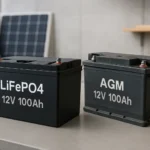
Solar plus battery storage. Batteries store excess solar energy during the day so the pump can run after dark. This costs significantly more. A quality lithium battery bank adds $1,000 to $3,000 to your system.
You also need a charge controller and a compatible inverter.
The upside is total flexibility. Run the pump whenever you want. Handle cloudy days with stored energy.
Even run the pump during off-peak hours if you're on a variable rate plan. For people with heavy tree cover or who work odd hours, batteries make the system usable.
Which should you choose? If you're home during the day and your pool pump timer is set to peak sun hours, go direct solar. It's cheaper, simpler, and pays back faster. If you must run the pump at night or your pool is shaded during the afternoon, budget for batteries.
There's no wrong answer as long as you match the setup to your schedule.
How to Size Your Solar Array (Step-by-Step)
Let's walk through the actual math. Grab a calculator or just follow along with your own numbers.
Step 1: Find your pump's wattage. Look at the motor nameplate. Multiply volts by amps. Example: 230V × 6.5A = 1,495 watts.
Round up to 1,500 watts for simplicity.
Step 2: Calculate daily energy needs. Multiply wattage by daily runtime. At 1,500 watts for 8 hours, that's 12,000 watt-hours, or 12 kWh per day.
Step 3: Find your peak sun hours. Use an online solar irradiance map or check local weather data. Let's say you're in Atlanta with 4.5 peak sun hours.
Step 4: Divide energy by sun hours. 12,000 watt-hours ÷ 4.5 hours = 2,667 watts. That's the minimum solar array size to break even on a perfect sunny day.
Step 5: Add a safety margin. Multiply by 1.25 to account for cloudy days, panel degradation, and system losses. 2,667 × 1.25 = 3,334 watts. Round up to 3,400 watts.
Step 6: Choose your panels. Modern residential panels range from 400 to 500 watts each. 3,400 watts ÷ 400 watts per panel = 8.5 panels. You'd need 9 panels rated at 400 watts each.
Step 7: Size your inverter. Your inverter must handle the pump's running wattage plus the startup surge. A 1,500-watt pump with a 3,000-watt surge needs an inverter rated for at least 3,000 watts surge capacity. Go with a 4,000-watt inverter for headroom.
Here's the table for quick reference:
| Pump Size | Daily Energy (8 hrs) | Panels Needed (400W each) | Inverter Size |
|---|---|---|---|
| 0.5 HP (600W) | 4.8 kWh | 4-5 panels | 2,000W |
| 1.0 HP (1,000W) | 8.0 kWh | 6-7 panels | 3,000W |
| 1.5 HP (1,500W) | 12.0 kWh | 9-10 panels | 4,000W |
| 2.0 HP (2,000W) | 16.0 kWh | 12-13 panels | 5,000W |
These numbers assume 4.5 peak sun hours. Adjust up or down based on your location.
5 Common Mistakes That Wreck Solar Pool Pump Systems
Mistake 1: Ignoring the startup surge. Your pump draws more power for the first second than during steady operation. A 1,500-watt pump can spike to 4,000 watts on startup. If your inverter is sized only for running watts, it trips the moment the pump kicks on.
Always check the inverter's surge rating.
Mistake 2: Undersizing for cloudy days. People size their array for perfect summer sun, then wonder why the pump won't run in March. Cloud cover can cut solar output by 50 to 80 percent. That 25 percent safety margin isn't optional.
It's the difference between a reliable system and a frustrating one.
Mistake 3: Mounting panels flat. Solar panels angled at your latitude produce 30 to 40 percent more energy than flat-mounted panels. If you lay them flat on a roof with low pitch, you're leaving significant power on the table. Adjustable ground mounts let you change the angle seasonally for maximum output.
Mistake 4: Ignoring voltage drop over long wire runs. If your panels are 100 feet from your pump, voltage drop can rob you of 10 percent or more of your power. Use thicker wire (8 AWG or 6 AWG) for long runs. Keep the system voltage higher (48V instead of 12V or 24V) to reduce losses.
Mistake 5: Skipping the charge controller for battery systems. If you're using batteries, a PWM charge controller wastes 20 to 30 percent of your solar power. An MPPT (Maximum Power Point Tracking) controller captures nearly all of it. The extra $50 to $100 pays for itself in the first season.
Avoid these five and you're already ahead of most DIY solar pool pump setups. The rest is just wiring and mounting.
Your Quick Decision Flowchart: Which Setup Is Right for You?
Run through these questions in order. The answer at the end points you to the right system.
Can you run the pump during peak sun hours (10 AM to 4 PM)? If yes, go direct solar with no batteries. If no, you need a battery backup system.
Do you have roof space facing south with no shade? If yes, roof mount works. If no, plan for a ground mount with adjustable tilt.
Is your pump under 1.5 HP? If yes, a standard string inverter works. If no, consider microinverters or a larger inverter with higher surge capacity.
Do you live in an area with frequent overcast weather? If yes, add 30 percent more panels to your array. If no, the standard sizing formula works.
Is your budget under $3,000? If yes, focus on a direct solar system sized for your pump's minimum daily runtime. If no, consider adding battery storage for full flexibility.
Here's the quick summary:
- Sunny, daytime pumping, under 1.5 HP: Direct solar, 4,000W inverter, 8-10 panels. Budget $2,500 to $3,500.
- Shaded, nighttime pumping, or over 1.5 HP: Add battery storage, MPPT charge controller, and larger inverter. Budget $4,000 to $6,500.
- Small pool, occasional use: Reduce panel count by half, use a smaller inverter. Budget $1,500 to $2,000.
Match your setup to your actual needs and you'll get a system that pays for itself in 4 to 7 years, depending on local electricity rates.
Frequently Asked Questions
Can I use a single solar panel to run my pool pump?
No. A single 400W panel produces about 2 kWh per day. Most pool pumps need 8 to 12 kWh daily.
You need at least 4 to 10 panels depending on pump size and sun hours.
Do I need a special inverter for a pool pump?
Yes. Your inverter must handle the pump's startup surge, which is 2 to 3 times the running wattage. A standard string inverter rated for continuous wattage won't work.
Look for an inverter with a surge rating that matches your pump's peak draw.
How long do solar panels for pool pumps last?
Most residential solar panels carry a 25-year performance warranty. They typically produce at least 80 percent of their rated output after 25 years. The inverter may need replacement after 10 to 15 years.
Batteries last 5 to 10 years depending on type and usage.
Will my pump run on cloudy days?
With direct solar, output drops significantly on overcast days. You may get 20 to 50 percent of normal power. A battery backup system stores energy from sunny days and provides consistent power regardless of weather.
Can I install the system myself?
If you're comfortable with basic electrical work and roof mounting, yes. But you'll need to follow local building codes and may require permits. Many DIYers install the panels and hire an electrician for the inverter connection.
That's a safe middle ground.
How much roof space do I need?
Each 400W panel measures roughly 6 feet by 3.5 feet, or about 21 square feet. A 9-panel system needs about 190 square feet of usable roof space. Ground mounts require similar area but offer easier access for cleaning and angle adjustment.
Your Quick Decision Flowchart: Which Setup Is Right for You?
Start with your schedule and work through the branches. The first question is always the same: can you run the pump between 10 AM and 4 PM on sunny days? If yes, direct solar without batteries is your most cost-effective route.
If no, plan for battery storage.
The next branch is about your pump's draw. A pump under 1.5 HP pairs well with a 3,000 to 4,000 watt inverter. Larger pumps need a 5,000 watt plus inverter with strong surge handling.
Check your motor's surge rating before you buy anything.
Location decides your panel count. In the Southwest with 6 peak sun hours, a 1 HP pump needs 5 to 6 panels. In the Pacific Northwest with 3.5 peak sun hours, the same pump needs 8 to 9 panels.
Use the solar irradiance data for your zip code, not a neighbor's advice.
Budget filters the rest. Under $3,000 means direct solar sized for your minimum daily runtime. Over $3,000 opens up battery storage, high-tilt ground mounts, and a larger array for cloudy day coverage.
Stable roof space and shading matter more than most people realize.
Here's the decision summary:
- Direct solar: Best for daytime pumping, sunny climates, and budgets under $3,000.
- Battery backup: Best for night pumping, shaded locations, or variable electricity rates.
- Hybrid systems: Add a small battery to direct solar to handle morning surges and afternoon clouds.
Frequently Asked Questions
Can I run a pool pump with a single 400W solar panel?
No. A 400W panel produces roughly 2 kWh per day, depending on your location. A small 0.5 HP pump needs 4 to 5 kWh daily.
You'll need at least 4 panels just to cover short filter cycles.
What size inverter do I need for a 1 HP pool pump?
Look for an inverter rated at 3,000 watts continuous with at least 5,000 watts surge capacity. A 1 HP pump draws around 1,000 watts running but can spike to 2,500 watts on startup. Undersizing your inverter is the most common reason solar pool pump systems trip.
How much battery capacity do I need for overnight pumping?
A 1 HP pump running 4 hours at night consumes about 4 kWh. A 48V, 100Ah lithium battery holds roughly 4.8 kWh. That covers one night with a small safety buffer.
If you need 8 hours overnight, double the battery capacity.
Should I get MPPT or PWM charge controller?
MPPT, no question. A Maximum Power Point Tracking controller captures 20 to 30 percent more energy than PWM in real-world conditions. The higher upfront cost pays for itself within the first season.
PWM is only worth it on tiny, low-wattage systems.
Do I need permits for a solar pool pump system?
Most local building codes require an electrical permit for any grid-connected system. Off-grid and battery systems usually need one too. Check your county or city website for requirements.
Many areas also require a licensed electrician for the AC wiring side of the installation.

Similar Posts