How Many Volts Can a Solar Panel Produce?
Ever looked at the label on a solar panel and wondered why it says "12V" but your multimeter reads something closer to 20V? You're not alone. That's actually normal, and understanding the difference between those numbers is the first step to building a safe, efficient solar system.
The question of how many volts can a solar panel produce has a straightforward answer, but the numbers change based on a few key factors.
Manufacturer specifications indicate that a typical 12V nominal panel puts out around 20 to 22 volts in open circuit. That's per standard silicon solar cell behavior, each cell generates about 0.5 to 0.6 volts. That's the same principle behind how solar panels work, regardless of panel size.
As of 2026, almost all residential panels follow this same underlying cell voltage, whether you're looking at a small 100W portable panel or a 400W rooftop unit. Let's start with the quick answer, then dig into the details so you can size your system with confidence.
Quick Answer
A standard 12V nominal solar panel produces 18 to 22 volts open circuit. Under load, it delivers 15 to 18 volts. Larger panels with more cells produce higher voltages.
A 60-cell residential panel runs about 35 to 40 Voc. Check your charge controller's max input voltage before connecting any panel.
Image source: YouTube / solaracademyzone (YouTube thumbnail (fair-use with source credit))
Voc vs. Vmp — Why the Two Numbers Matter So Much
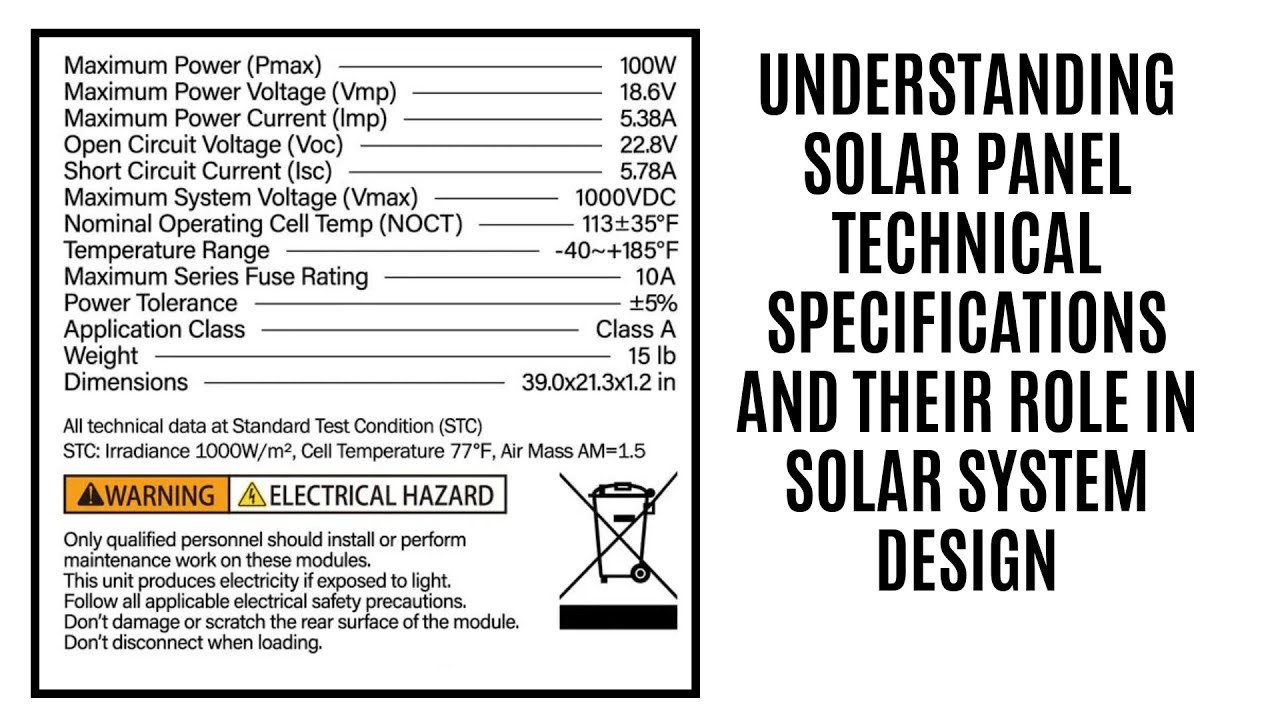
Every solar panel datasheet lists two critical voltage values: Voc (open-circuit voltage) and Vmp (maximum power voltage). Voc is what you measure when the panel is disconnected and in full sun. Vmp is the voltage when the panel is actually charging a battery or feeding an inverter.
Here's a typical breakdown for a 12V nominal 100W panel:
| Measurement | Typical Value | When It Applies |
|---|---|---|
| Voc (open-circuit voltage) | 20 to 22 volts | No load, full sun, cold temperature |
| Vmp (maximum power voltage) | 15 to 18 volts | Under normal operating load, full sun |
Why does this matter for you? Voc determines whether your charge controller or inverter will survive. If you connect a panel with a 22V Voc to a charge controller rated for a max 25V input, you're cutting it close, on a cold day that voltage can spike and fry the controller. Always size your equipment for the panel's Voc, not its Vmp or nominal rating.
Those voltage values come directly from the silicon cells inside each panel. For a deeper look at how those cells are built, check out the main components of a solar panel.
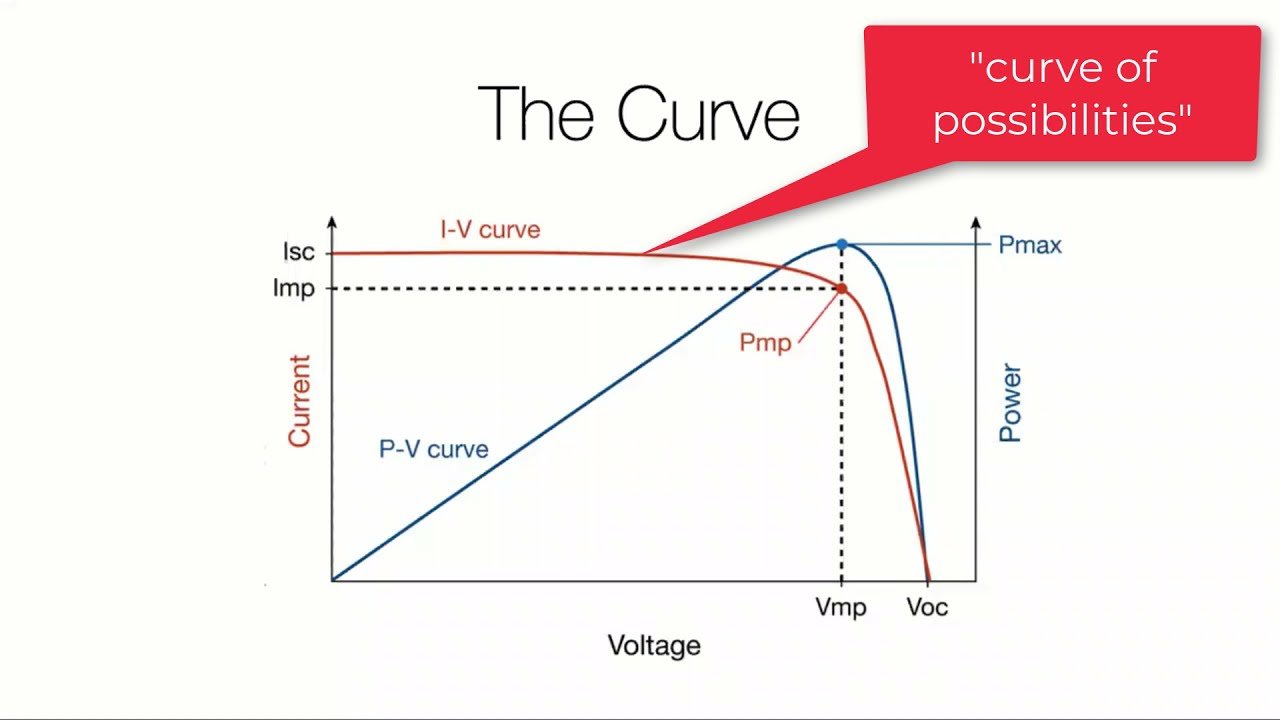
Image source: YouTube / Mark Mrohs (YouTube thumbnail (fair-use with source credit))
This I-V curve shows exactly where Voc and Vmp fall on the graph. The flat section on the right is Voc, no current flowing. The "knee" of the curve is Vmp, where the panel delivers its rated wattage.
How Cell Count and Panel Size Affect Voltage
The voltage a panel produces comes down to one simple rule: each silicon cell generates about 0.5 to 0.6 volts. The cells are wired in series inside the panel, so the total voltage is roughly the number of cells multiplied by 0.5V.
Here's how that plays out for the most common panel sizes:
- 36-cell panel (small portable or 100W-150W): Voc around 21-22V, Vmp around 17-18V. This is your standard "12V" panel.
- 60-cell panel (common residential rooftop, 250W-350W): Voc around 35-40V, Vmp around 28-32V. This is a "20V" or "24V" nominal panel but often used with MPPT controllers.
- 72-cell panel (commercial or large residential, 350W-500W): Voc around 45-50V, Vmp around 36-40V. This is typically a "24V" or "48V" nominal panel.
If you are shopping for a system, these voltage ranges matter for choosing the right charge controller. A small 36-cell panel works fine with a cheap PWM controller. The larger panels really need an MPPT controller to handle the higher voltage efficiently.
For more on the different types available today, from thin-film to monocrystalline, take a look at the various types of solar panels.
Real-World Voltage: Temperature, Sunlight, and Load
The numbers you see on a datasheet, 22V Voc, 18V Vmp, are measured under Standard Test Conditions (STC). That means 25°C cell temperature, full sun (1000 W/m²), and the panel aimed directly at the sun. Real-world conditions are rarely that perfect.
Three factors shift the voltage you actually get:
- Temperature. Panels lose voltage as they heat up. For every degree Celsius above 25°C, Voc drops by about 0.3% to 0.5%. On a scorching rooftop that hits 65°C, your "22V" panel might only produce 17-18V open circuit. The flip side is more dangerous: cold weather gives you a voltage spike, which we'll cover next.
- Sunlight intensity. Less sun means lower current output, but voltage stays relatively stable until the light gets very dim. Even on a cloudy day, your panel's Voc can be close to its rated value, it just can't deliver much power.
- Load. If you short-circuit the panel, voltage drops to zero. Under a normal charging load, it sits at Vmp. No load, it rises to Voc. This is why a charge controller manages the voltage to keep it in the sweet spot.
To get the full picture of how sunlight turns into electrical voltage, read more on how solar panels generate electricity.
The Danger of Cold-Weather Voltage Spikes
Here is the single most overlooked risk in DIY solar. Cold temperatures cause Voc to rise. A panel rated at 22V at 25°C can hit 25V or more at -20°C.
If your charge controller has a max input voltage of 25V, you're risking instant damage.
The temperature coefficient for Voc is typically listed on the datasheet, usually around -0.3% per °C. That means for every degree below 25°C, voltage increases by 0.3%. On a freezing winter morning in Minnesota or the Alps, that can add 10-15% to your Voc.

Image source: Wikimedia Commons / Grand Canyon National Park (CC BY)
Snowy conditions like the ones in this photo can push panel voltage well above the label rating. This is why the National Electrical Code (NEC) requires you to calculate the maximum Voc for your site's coldest expected temperature. You then size your charge controller and inverter to handle at least that number, plus a safety margin.
The rule of thumb: take your panel's Voc, multiply by 1.25 for cold climates, and make sure your charge controller's max input voltage exceeds that result. If you have multiple panels in series, multiply the string Voc by 1.25 as well.
The National Renewable Energy Laboratory publishes detailed temperature coefficient data for common panels, which you can use for a precise calculation. And if you're still in the planning phase, our solar panel buying guide walks through selecting equipment that can handle these voltage swings safely.
Image source: YouTube / MattMan’s Solar (YouTube thumbnail (fair-use with source credit))
Image source: YouTube / Learning Engineering (YouTube thumbnail (fair-use with source credit))

Similar Posts