Exactly How Many Solar Panels for 1 HP Pump?
If you've ever tried running a 1 HP pump on solar, you already know the numbers on a spec sheet don't always match what happens in real life. The question "how many solar panels to run a 1 hp pump" doesn't have a single answer, it changes based on your pump type, your location, and whether you're using batteries. Start with this rule of thumb: a standard 1 HP well pump drawing 1,100, 1,300 running watts typically needs 4 to 6 solar panels rated at 400W each, assuming 5 peak sun hours and a battery-backed system.
But here's where it gets tricky. That same pump can pull 3,000+ watts during start-up for a second or two. Per NREL data, peak sun hours range from under 3 in cloudy regions to over 6 in the Southwest, which directly shifts how many panels you'll need.
Let's walk through the variables so you can nail down your exact number.
Quick Answer
A 1 HP pump usually needs 4 to 6 solar panels (400W each) with batteries. Run it without batteries and you need 6 to 8 panels. Use a DC pump and you might get away with 3 to 4.
Your final number depends on surge wattage, daily runtime, and local sun hours.

Image source: Wikimedia Commons / USDA
Core Explanation: What a 1 HP Pump Actually Draws (Running Watts vs. Surge)
Here's the first thing most people get wrong. A 1 HP motor doesn't draw 746 watts, that's the theoretical output. Real-world pumps pull more because of inefficiency, friction, and the head height they're pumping against.
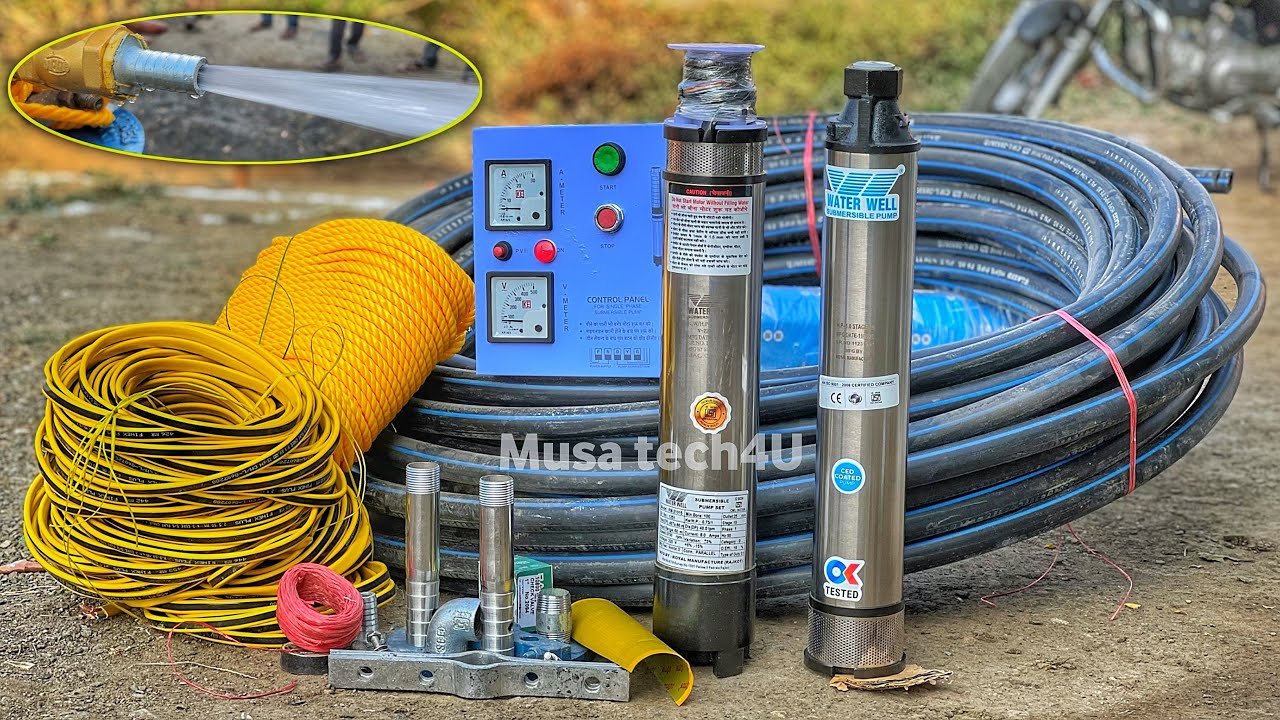
A typical 1 HP submersible well pump draws 1,100 to 1,300 watts while running. Add a few hundred more if you're pumping from 200 feet deep. A 1 HP jet pump or centrifugal pump might draw 1,000 to 1,200 watts.
Then comes the surge. Induction motors draw 2.5 to 3 times their running wattage for a split second when they start. For a 1 HP pump, that means 2,800 to 3,600 watts for about half a second.
Your inverter and your solar array both have to handle that spike, not just the steady draw.
Image source: YouTube / Musa tech4U (YouTube thumbnail (fair-use with source credit))
Why surge matters for solar
Solar panels don't "store" extra power for surges. If your array is sized exactly for running watts, that surge can pull voltage down low enough that the pump fails to start. Your inverter needs to be rated for at least 3,000 continuous watts and 6,000 surge watts to be safe.
Your battery bank or capacitor bank is what actually delivers that start-up current, not the panels themselves.
So when you're doing the math, remember: running watts tells you how many panels you need for steady operation. Surge watts tells you whether your inverter and batteries can actually fire the motor.
Decision Branch 1: Direct Solar (No Batteries) vs. Battery-Backed System
This is the biggest fork in the road. Your choice changes the panel count by 30 to 50 percent.
Direct solar — panels run the pump only when the sun shines
You don't need batteries. The pump runs during daylight hours, speeds up and slows down with cloud cover, and stops completely at night. This works for irrigation or livestock watering where timing doesn't matter.
You need more panels here. Without batteries to buffer the surge, your array must produce enough instantaneous power to start the motor. That means roughly 1.5 to 2 times the surge wattage in panel capacity.
A 3,500W surge requires 5,000 to 7,000 watts of panel capacity. At 400W per panel, that's 12 to 17 panels.
The trade-off: no battery cost, no maintenance, simpler wiring. The downside: your pump only runs when the sun is strong, and cloudy days mean no water.
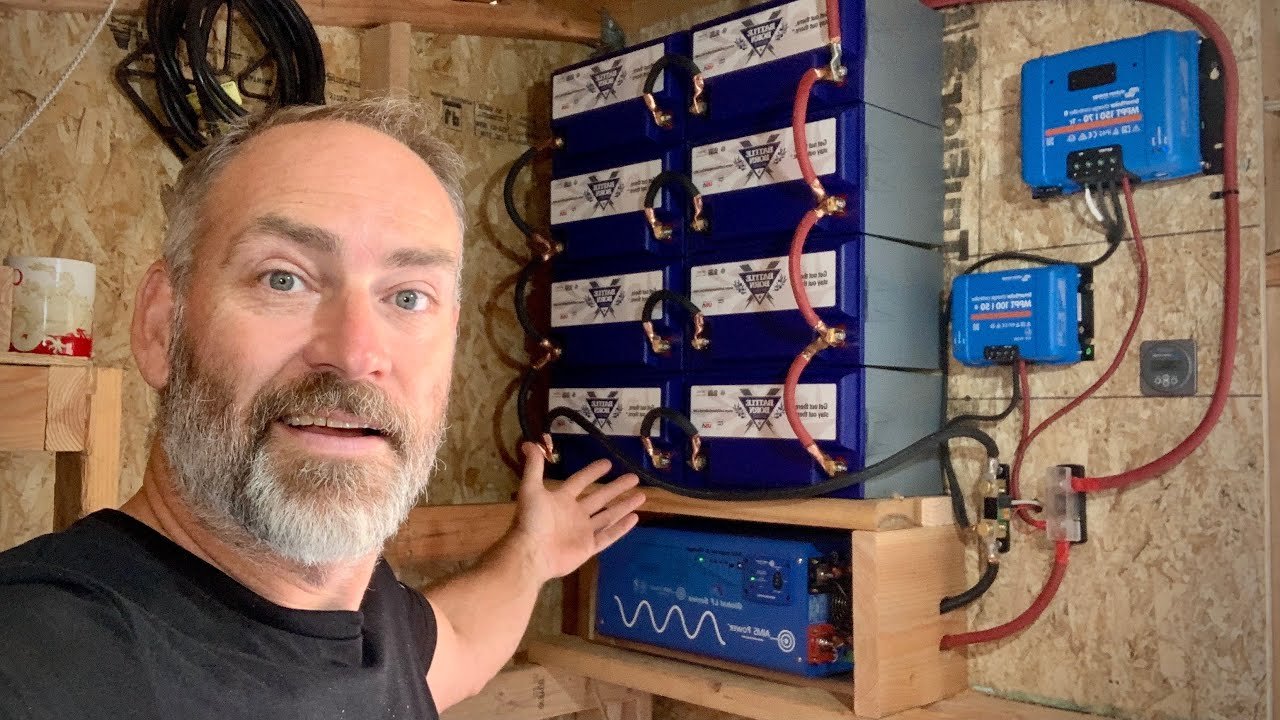
Image source: YouTube / Martin Johnson, Off Grid Living (YouTube thumbnail (fair-use with source credit))
Battery-backed system — panels charge batteries, batteries run the pump
This is the setup for most homes. A battery bank handles the surge, smooths out cloudy weather, and lets you pump water any time of day.
You need fewer panels because the batteries buffer the load. The panels just need to replace the energy you use each day, plus a margin for cloudy days. A typical daily pump run of 30 to 60 minutes at 1,200 watts uses 0.6 to 1.2 kWh.
With a battery bank sized for two days of autonomy and accounting for inverter losses, you need roughly 1.5 to 2.0 kWh of solar generation per day. At 5 peak sun hours and 400W panels, that's 3 to 5 panels.
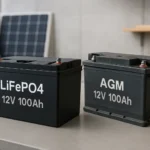
The trade-off: batteries cost money and need replacement every 5 to 10 years. But you get reliable water on demand, rain or shine.
| Factor | Direct Solar (No Batteries) | Battery-Backed System |
|---|---|---|
| Panel count (400W each) | 12–17 panels | 3–5 panels |
| Runs at night? | No | Yes |
| Handles cloudy days? | No | Yes (2–3 days typical) |
| Surge handling | Needs oversize array | Batteries handle it |
| System cost (panels only) | Higher | Lower |
| Total cost with batteries | N/A | Moderate |
Decision Branch 2: AC Pump vs. DC Pump for Solar
If you're starting from scratch with a solar system, the pump type itself is a major variable. This choice changes your panel needs, your inverter needs, and your whole system cost.
Standard AC pump (120V or 240V)
Most off-grid homes already have an AC well pump in the ground. You don't want to pull it and replace it if it's working. So you work with what you have: an AC pump, an inverter, a battery bank, and solar panels.
The AC route requires an inverter big enough to handle the surge. It also loses about 10 percent of your power in the DC to AC conversion. You need slightly more panels to compensate.
For the same daily runtime, add one extra 400W panel over a DC system.
This is the path of least resistance for retrofits. If your existing pump is healthy, the "how many solar panels to run a 1 hp pump" answer leans toward the battery-backed column above: 4 to 6 panels.
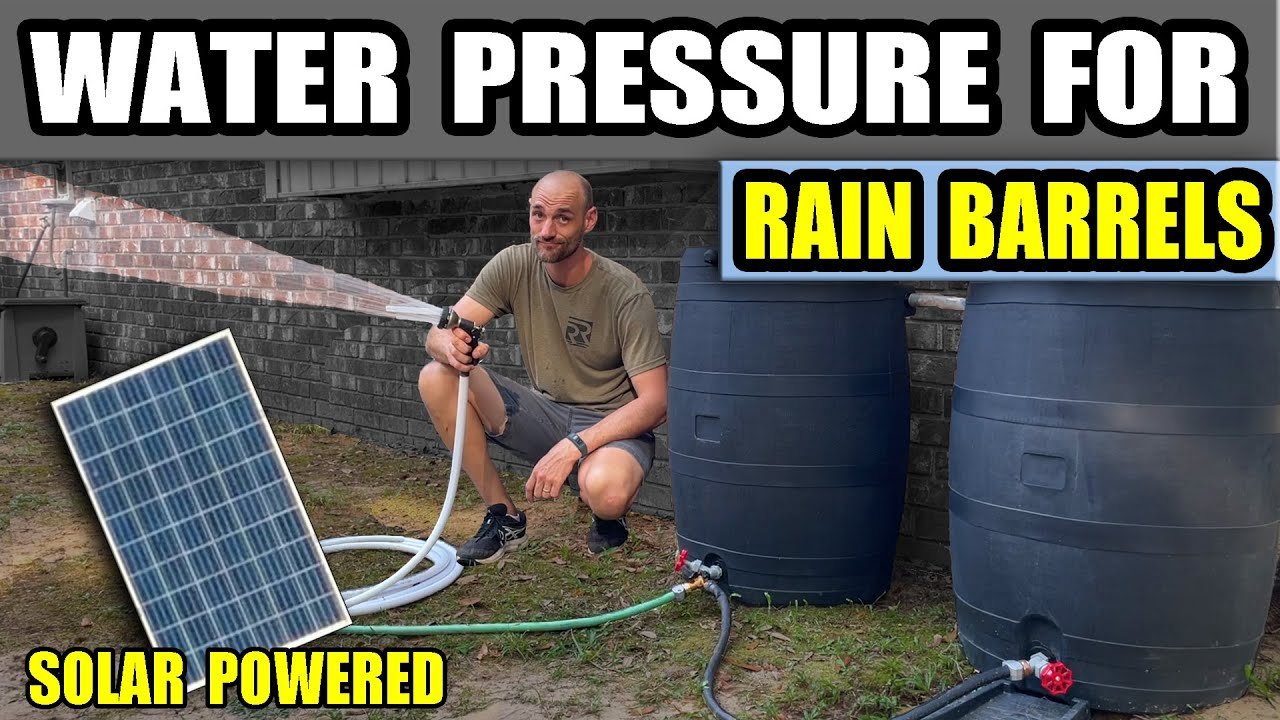
Image source: YouTube / Ryan Rutter (Rutter Realty Gulf Coast) (YouTube thumbnail (fair-use with source credit))
DC pump (12V, 24V, or 48V)
DC pumps skip the inverter entirely. Panels connect to a charge controller, which feeds the pump directly or charges batteries. No conversion losses.
No inverter surge rating to worry about.
DC pumps are often more efficient for solar because they can run on lower voltage and match panel output more naturally. A good 1 HP DC pump running at 48V might draw 900 to 1,000 watts vs. 1,200 for an AC equivalent. That reduces the panel count by about 20 percent.
The catch: DC pumps cost more upfront. They're less common, and replacement parts can be harder to find in rural areas. If your well is deep and you need high head pressure, AC pumps still dominate that market.
DC pumps shine in surface applications, shallow wells, and irrigation.
| Pump Type | Typical Running Watts | Surge Watts | Panels Needed (400W, battery system) | Inverter Required? |
|---|---|---|---|---|
| AC (1 HP submersible) | 1,100–1,300 | 2,800–3,600 | 4–6 | Yes (pure sine wave) |
| DC (1 HP surface/irrigation) | 900–1,100 | 1,800–2,500 | 3–5 | No |
Step-by-Step Process: How to Calculate Your Exact Panel Count
Let's walk through the math. Grab your pump's spec sheet or a clamp meter, and follow these steps.
Step 1: Find your pump's actual running watts
Check the nameplate. If it says "1 HP" but doesn't list watts, multiply amps by volts. A pump pulling 10 amps at 120V draws 1,200 watts.
Better yet, measure it with a clamp meter while it's running under load. That number is your starting point.
Step 2: Determine daily run time
How many hours per day does your pump run? A typical home well pump runs 30 to 90 minutes total per day. Irrigation pumps can run 4 to 8 hours.
Multiply running watts by hours to get daily watt-hours.
Example: 1,200 watts x 1 hour = 1,200 watt-hours per day.
Step 3: Account for system losses
Add 15 percent for inverter losses, wire resistance, and battery charge/discharge inefficiency. Multiply your daily watt-hours by 1.15.
1,200 x 1.15 = 1,380 watt-hours.
Step 4: Factor in peak sun hours
Look up your location on a solar insolation map or use a tool from a .gov source like NREL. Peak sun hours vary from 3 (cloudy regions) to 6+ (Southwest). Divide your adjusted daily watt-hours by your local peak sun hours.
1,380 watt-hours / 5 hours = 276 watts of solar needed per hour of sun.
Step 5: Divide by panel wattage
If you're using 400W panels, divide 276 by 400. That's 0.69, round up to 1 panel. Wait, that seems too low, right?
Because this calculation assumes your battery bank can store that energy smoothly. The panel count here covers the daily energy replacement, not the instantaneous power.
For a battery-backed system with a 1 HP pump running one hour per day at 5 sun hours, you need roughly 1 to 2 panels (400W each). But that's a best-case scenario. Most installations need 3 to 5 panels to handle cloudy days, morning/evening low light, and the fact that pumps don't always run during peak sun hours.
For direct solar (no batteries), you skip the daily energy math and instead calculate based on instantaneous power. Your array needs to produce the pump's surge wattage in real time. For a 3,500W surge with derating factors, aim for 5,000 to 6,000 watts of panels.
That's 12 to 15 panels at 400W each.

Image source: Wikimedia Commons / CharlesMJames (CC BY-SA)
Panel count summary table
| Scenario | Running Watts | Daily Runtime (hours) | Peak Sun Hours | 400W Panels Needed | System Type |
|---|---|---|---|---|---|
| Home well, moderate sun | 1,200 | 1 | 5 | 3–4 | Battery-backed |
| Home well, cloudy region | 1,200 | 1 | 3 | 5–6 | Battery-backed |
| Irrigation, full sun | 1,200 | 4 | 6 | 5–7 | Battery-backed |
| Direct solar, no batteries | 1,200 | varies | 5 | 12–15 | No batteries |
| DC pump, moderate sun | 1,000 | 1 | 5 | 2–3 | Battery-backed |
Common Mistakes to Avoid (Surge, Sun Hours, Voltage Drop)
After looking at dozens of real-world setups, these three mistakes cause the most frustration.
Mistake 1: Ignoring the surge
People size the array for running watts, then the pump hums and never starts. The motor draws three times its running wattage for that first half second. If your inverter and battery bank can't deliver that, no amount of extra panels will fix it.
Always size your inverter for 3x the running watts minimum. Use a battery bank large enough to handle that surge without voltage sag.
Mistake 2: Using annual average sun hours
Averaging sun hours across the year sounds smart, but it hides the worst months. December in the Pacific Northwest gives you 1.5 peak sun hours, not 4. If you size for the annual average, your pump stops working in winter.
Size for your worst month, or plan to reduce pump usage in winter.
Mistake 3: Ignoring voltage drop on long wire runs
Your solar panels might be 100 feet from the pump or battery bank. At 12V or 24V, voltage drop eats your power fast. A 100-foot run of 10 AWG wire at 20 amps drops 3.8 volts at 12V, that's over 30 percent loss.
Bump up to 4 AWG or switch to a 48V system to keep losses under 3 percent.
Use a voltage drop calculator before you buy wire. Oversizing wire gauge is cheap compared to losing a third of your solar power to heat.
Real-World Scenarios: Example Setups for Different Locations
Scenario A: Arizona homestead, 1 HP submersible AC pump
- Peak sun hours: 6.5
- Pump specification: 1,200W running, 3,000W surge
- Daily runtime: 45 minutes
- Setup: Battery-backed with 48V lithium bank
Panel count: Four 400W panels. The high sun hours mean the panels recharge the battery quickly. The battery handles the surge.
Total array: 1,600W. This system runs year-round with no issue.
Scenario B: Pacific Northwest off-grid cabin, same pump
- Peak sun hours: 2.5 in winter, 4.5 in summer
- Setup: Battery-backed with larger bank
Panel count: Six 400W panels. Winter sun is weak, so you need more collection area and a larger battery. Expect to run the pump less in December or supplement with a generator on cloudy stretches.
Scenario C: Texas irrigation, direct solar, no batteries
- Peak sun hours: 5.5
- Pump: 1 HP centrifugal, 1,000W running
- Daily runtime: 4 hours during sun
Panel count: Fourteen 400W panels. No batteries means the panels must produce the running watts plus surge in real time. This is a big array, but it's simpler and cheaper over the long run with no batteries to replace.
Expert Tips: Optimizing Your Solar Pump System
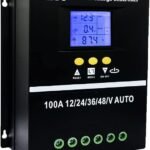
Use an MPPT charge controller, not PWM. MPPT pulls more power from your panels in low light and cold temperatures, that's 20 to 30 percent more energy in winter. The extra cost pays for itself in one season.
Mount your panels at the right tilt for your latitude, and adjust it seasonally if you can. A fixed tilt at latitude angle gives you decent year-round production. Adjusting it 15 degrees steeper in winter and flatter in summer adds about 10 percent annual energy.
If your pump has a long wire run from the house, consider a 48V system instead of 12V or 24V. Higher voltage means lower current, which means thinner wire and fewer losses. It also makes the battery bank easier to size for the surge.
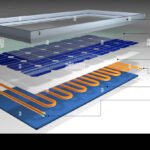
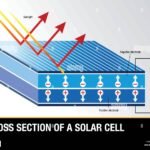
Understanding the basic science behind solar panels helps when you're troubleshooting performance issues. The conversion process from sunlight to electricity is straightforward, but factors like temperature, shading, and soiling all affect output. Keep your panels clean and free of shade during peak hours.
If you're choosing between different panel varieties, remember that monocrystalline panels generally perform better in low light than polycrystalline. That matters more in cloudy regions than in the desert.
Weighing the trade-offs between system complexity and cost is part of every solar pump project. A battery-backed system costs more upfront but gives you freedom to pump water on your schedule. Direct solar costs less initially but only works when the sun is high.
Frequently Asked Questions
Can I run a 1 HP pump directly from solar panels without batteries?
Yes, but you need a much larger array, roughly 12 to 15 panels at 400W each. The panels must produce the pump's surge wattage in real time. Cloud cover or shade can stop the pump instantly.
How many solar panels do I need for a 1 HP pump running 2 hours per day?
With a battery-backed system and 5 peak sun hours, you need 4 to 6 panels rated at 400W each. That covers your daily energy use plus some margin for cloudy weather.
Do I need a special inverter for a solar well pump?
Yes. You need a pure sine wave inverter rated for at least 3x the pump's running watts to handle the start-up surge. A 3,000W continuous / 6,000W surge inverter is a safe minimum for a 1 HP AC pump.
How long will a battery bank run a 1 HP pump?
A 48V 100Ah lithium battery bank (4.8 kWh usable) can run a 1 HP pump drawing 1,200W for about 3.5 to 4 hours continuously. Most homes only need 30 to 90 minutes per day.
Can I use a 1 HP DC pump to reduce my panel count?
Yes. A 1 HP DC pump draws 900 to 1,100 running watts with a lower surge. You can often reduce your panel count by 20 to 30 percent compared to an AC pump with the same output.
What happens to my solar pump system in winter?
Your panel production drops with fewer sun hours. If you sized for winter conditions, the pump runs fine but less often. If you sized for summer averages, you'll need to supplement with a generator or reduce water usage in the winter months.

Similar Posts