Solar Battery Charge Time: What to Expect
You're standing in your living room, staring at the battery monitor on your solar system, wondering why the number is barely climbing. "How long do solar batteries take to charge?" is the exact question running through your mind. It feels like it should be simple, but the answer keeps shifting depending on who you ask.
Here's the honest truth: charge time depends on four key variables that are unique to your setup. Manufacturer specifications as of 2026 show that a typical lithium battery can go from 20% to 100% in anywhere from 2 to 12 hours depending on your solar array size, battery capacity, and the season. Let's walk through exactly how to figure out your number.
Quick Answer
Solar batteries take 2 to 12 hours to fully charge. Lithium batteries charge fastest, often hitting full in 2 to 6 hours. Lead-acid batteries need 4 to 12 hours because of their longer absorption phase.
Your actual time depends on battery capacity, solar panel wattage, sunlight hours, and charge controller type. A 100Ah lithium battery with 400W of solar panels in full sun charges in roughly 3 to 4 hours.
The Short Answer (What You Actually Came Here For)
If you want the quick number without the math, here it is. A typical home solar battery like a 10kWh lithium pack paired with 3000W of solar panels charges from 20% to 100% in about 3 to 5 hours during summer. The same battery with 1500W of panels takes 6 to 10 hours.
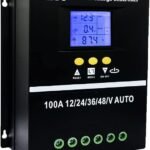
For smaller setups like RVs or cabins with a single 100Ah battery and 200W of solar panels, expect 5 to 8 hours in good sun. Those numbers assume a proper charge controller set up correctly. A poorly configured PWM controller might add another hour or two compared to a good MPPT unit.
Depth of discharge matters too. If you only drain the battery to 50% instead of 80%, your charge time is basically cut in half. Most lithium batteries can handle deeper cycles, but lead-acid batteries really appreciate shallower discharges for longevity.
Temperature also plays a role you can't ignore. Cold batteries charge slower. A lithium battery below 50°F may take 20 to 30 percent longer.
Below freezing, many lithium batteries refuse to charge at all until they warm up. That's the BMS protecting the cells.
The Four Variables That Control Your Charge Time (And How to Check Yours)
Let's break down the four factors that determine how fast your battery fills up. Understanding these is the difference between guessing and knowing exactly what your system will do.
Battery Capacity (How Big Is Your Tank)
This is the most obvious variable. A bigger battery takes longer to fill than a smaller one, all else being equal. Battery capacity is measured in kilowatt-hours (kWh) for home systems or amp-hours (Ah) for smaller 12V setups.
A 5kWh battery charges twice as fast as a 10kWh battery with the same solar panels. That's simple math. But here's what trips people up: the usable capacity matters more than the total capacity.
Most lead-acid batteries can only safely discharge to about 50%. So a 10kWh lead-acid bank really only stores 5kWh of usable energy. Lithium batteries can go to 80% or 90% depth of discharge.
To find your battery's capacity, check the label or manufacturer spec sheet. If you see 100Ah at 12V, that's 1.2kWh. But remember, only about 0.6kWh of that is usable with a lead-acid battery.
Solar Input (How Fast You Pour)
This is where most people get their math wrong. Your solar panels are rated in watts, but that rating is under ideal lab conditions. Real-world output is usually 70 to 85 percent of the panel's rating.
A 400W panel array in perfect noon sun might actually deliver 320W to 340W after accounting for heat, angle, and wiring losses. That's the number you should use for calculations, not the glossy sticker on the panel.
Your charge controller type makes a big difference here. MPPT controllers can extract 20 to 30 percent more power from your panels than PWM controllers, especially in cooler weather or when your battery voltage is low. If you're still using a PWM controller, upgrading to MPPT effectively adds more solar power without buying new panels.
Check out the different solar panel technologies and their real-world efficiency differences by reading up on the various options available.
Sunlight Hours (How Long Your Faucet Runs)
This is the variable you can't control, but you can predict it. Peak sun hours vary dramatically by location and season. A homeowner in Arizona gets about 6 peak sun hours in June and 3 in December.
Someone in Seattle gets 5 in June and barely 1 in December.
Peak sun hours are not the same as daylight hours. A peak sun hour is when the sun is strong enough to deliver 1000W per square meter. Early morning and late afternoon light doesn't count for much.
To find your location's numbers, check the NREL solar maps online. Input your city and you'll get monthly averages. Use the worst month for sizing if you want reliable winter charging.
Battery Chemistry (How Fast It Accepts Charge)
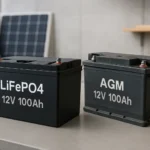
Lithium batteries are the speed demons here. They can accept a high charge rate right up to about 90 percent full before tapering off. Lead-acid batteries have a different charging profile.
They charge quickly in the bulk phase up to about 80 percent, then spend a long time in the absorption phase trickling in the last 20 percent.
That absorption phase is what kills lead-acid charge times. A lead-acid battery might reach 80 percent in 2 hours but need another 3 to 4 hours to finish the job. Lithium batteries finish the last 20 percent in about 30 minutes.
Your battery's maximum charge rate, called the C-rate, also matters. Most lithium batteries can handle a 0.5C charge rate, meaning a 100Ah battery can safely take 50 amps. Some high-end units handle 1C.
Lead-acid batteries typically max out at 0.2C to 0.3C.
How to Calculate Your Exact Charge Time in 3 Steps
Grab a calculator or just your phone. This takes two minutes and gives you a number that matches your real setup.
Step 1: Find Your Battery's Usable Capacity
Take your total battery capacity in watt-hours and multiply by your usable depth of discharge. For lithium, that's usually 0.8. For lead-acid, use 0.5.
If you have a 10kWh lithium battery and you typically drain it to 80%, your usable capacity is 8kWh or 8000 watt-hours. That's the amount you actually need to replace.
Step 2: Calculate Your Real Solar Input
Take your total solar panel wattage and multiply by 0.75 for a realistic derating factor. Then multiply that number by your peak sun hours.
If you have 2000W of panels with 5 peak sun hours, your daily solar harvest is roughly 2000 x 0.75 x 5 equals 7500 watt-hours. That's 7.5kWh per day into your batteries under average conditions.
Step 3: Divide to Get Your Charge Time
Take the usable capacity from step 1 and divide by the hourly input from step 2, then multiply by the number of hours in your sun window.
From the examples above, 8000 watt-hours needed divided by the real solar input of 1500 watts per hour gives you about 5.3 hours in peak sun.
That's your answer. A 10kWh lithium battery drained to 80% with 2000W of panels should recharge in about 5 to 6 hours on a sunny summer day.
For a more detailed breakdown of all the parts that affect this calculation, you can explore the individual components that make up a solar energy system.
Decision Guide: Match Your Situation to Your Charge Time
This section helps you find your scenario quickly without doing the full math each time.
You Have a Small RV or Van Setup
If you run a 100Ah lithium battery with 200W of portable panels, expect 6 to 8 hours for a full charge from 20%. That's assuming clear summer sun. In winter, double that time.
Solution: add another 100W panel and your time drops to 4 to 5 hours.
You Have a Small Cabin or Tiny House
A 200Ah lithium battery bank at 12V with 400W of panels needs about 6 to 9 hours in summer. That's tight for year-round use. Most cabin owners find that 600W of panels gives them a comfortable 4 to 6 hour recharge window.
You Have a Whole-Home Backup System
A typical home battery like a 13.5kWh Powerwall with 4000W of solar charges in about 4 hours in summer and 7 to 8 hours in winter. That's assuming you have enough panels dedicated to battery charging and not running the house at the same time.
You Have Lead-Acid Batteries
If you're running a flooded lead-acid or AGM battery bank, add about 30 to 50 percent to the times above. A 100Ah lead-acid battery with 200W of panels takes 8 to 12 hours from 50% depth of discharge. The absorption phase is the bottleneck.
You Live in a Northern Climate
If you're above the 45th parallel, winter charging is a different game. Your peak sun hours drop to 1 or 2 per day in December. That same RV setup that charges in 6 hours during July will take 15 to 20 hours in January unless you add panel capacity or use a generator to supplement.
The Biggest Mistakes That Make Charging Slower (Or Stop It Entirely)
Let's cover the common errors that quietly sabotage your charge times. Avoid these and your system will perform as expected.
Undersizing Your Solar Array
This is the number one mistake. People match their battery capacity to their daily usage but forget that solar panels don't produce their rated output for most of the day. A 100W panel produces maybe 70W on average.
A 400W array produces about 300W.
Rule of thumb: your solar array should be at least 1.5 times your battery charger's maximum input rate. For lithium batteries that can take a fast charge, undersizing the array means you're leaving charge speed on the table.
Using a PWM Controller With High-Voltage Panels
PWM controllers are simple and cheap, but they waste voltage. If you have 24V panels charging a 12V battery, a PWM controller throws away half your panel voltage. That cuts your charge speed in half.
MPPT controllers convert that extra voltage into more amps. They typically deliver 20 to 30 percent more charge current. The upgrade pays for itself in faster charge times.
Ignoring Voltage Drop in Your Wiring
Thin wires create resistance. Resistance reduces the voltage that reaches your controller and battery. A 3 percent voltage drop means 3 percent slower charging.
A 5 percent drop means 5 percent slower.
Keep your wire runs short and use the correct gauge. For a 20 amp charge current at 12V, you need at least 10 AWG wire for runs under 10 feet. For longer runs, go thicker.
Letting Your Batteries Get Too Cold
Lithium batteries below 32°F won't charge. The BMS blocks it to prevent damage. Lead-acid batteries will charge below freezing, but they accept current much slower.
At 20°F, a lead-acid battery's charge acceptance drops by about 40 percent.
If you live somewhere cold, consider a heated battery or an insulated enclosure. Some lithium batteries come with internal heaters that draw a small amount of power to keep the cells warm enough to charge.
Discharging Too Deeply Before Recharging
Every time you drain your battery to its absolute limit before recharging, you add an extra hour or two to the next charge cycle. The last 20 percent of battery capacity charges much slower than the first 80 percent.
For lead-acid batteries, deep discharges also cost you battery life. A lead-acid battery cycled to 50% depth of discharge lasts about twice as many cycles as one cycled to 80%.
Understanding how solar panels actually convert sunlight into electricity can help you optimise your whole system for better charging performance.

Similar Posts