Do Solar Panels Actually Need Direct Sun?
Yes, they absolutely work without direct sun, but the performance depends on several factors that most people don't consider until after they've already installed their system. The question "do solar panels need direct sun" comes up constantly from homeowners with trees, cloudy climates, or roofs that don't face perfectly south. The real answer is more nuanced than a simple yes or no.
According to National Renewable Energy Laboratory data, solar panels can produce 10 to 25 percent of their rated output on heavily overcast days. That's enough to make a meaningful dent in your electric bill, but it's nowhere near the nameplate rating you see on the box. Let's walk through what actually happens when sunlight hits a panel, and more importantly, what happens when it doesn't.
Quick Answer
Solar panels don't need direct sun to work. They generate electricity from any light. Indirect and diffuse light still triggers the photovoltaic effect.
Output drops significantly without direct sun. You'll see 10 to 25 percent of rated power on overcast days. Partial shade on even one cell can cripple your whole system if you have the wrong inverter setup.
The Short Answer: Yes They Work, But Here's the Real Story
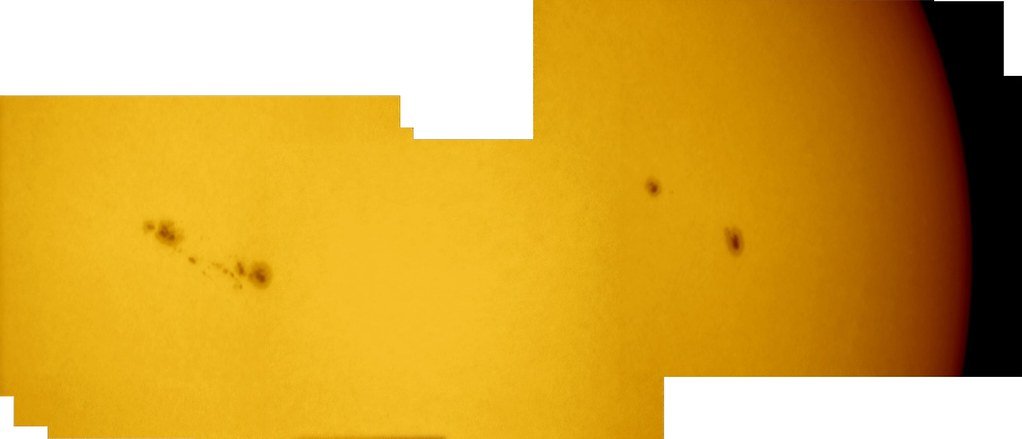
Image source: Openverse / blobrana2 (PDM 1.0)
If you've ever seen solar panels on a grey winter day and wondered whether they're doing anything at all, here's the truth: they are producing power, just not much of it. The photovoltaic cells inside each panel respond to any light above a certain threshold. That threshold is around 20 watts per square meter of irradiance, which is roughly the brightness of a well-lit room.
Direct sunlight delivers roughly 1,000 watts per square meter at sea level on a clear day. That's what manufacturers use to rate their panels. When clouds roll in, that number drops to 100 to 300 watts per square meter.
Your panels keep working the whole time. They just produce less.
The real issue isn't clouds. It's shade. A tree branch, a chimney, or a neighboring building casting a shadow across part of your array can cause a much bigger problem than an overcast sky.
We'll get into why that happens in a moment.
How Sunlight Actually Makes Power: Diffuse vs. Direct Beam
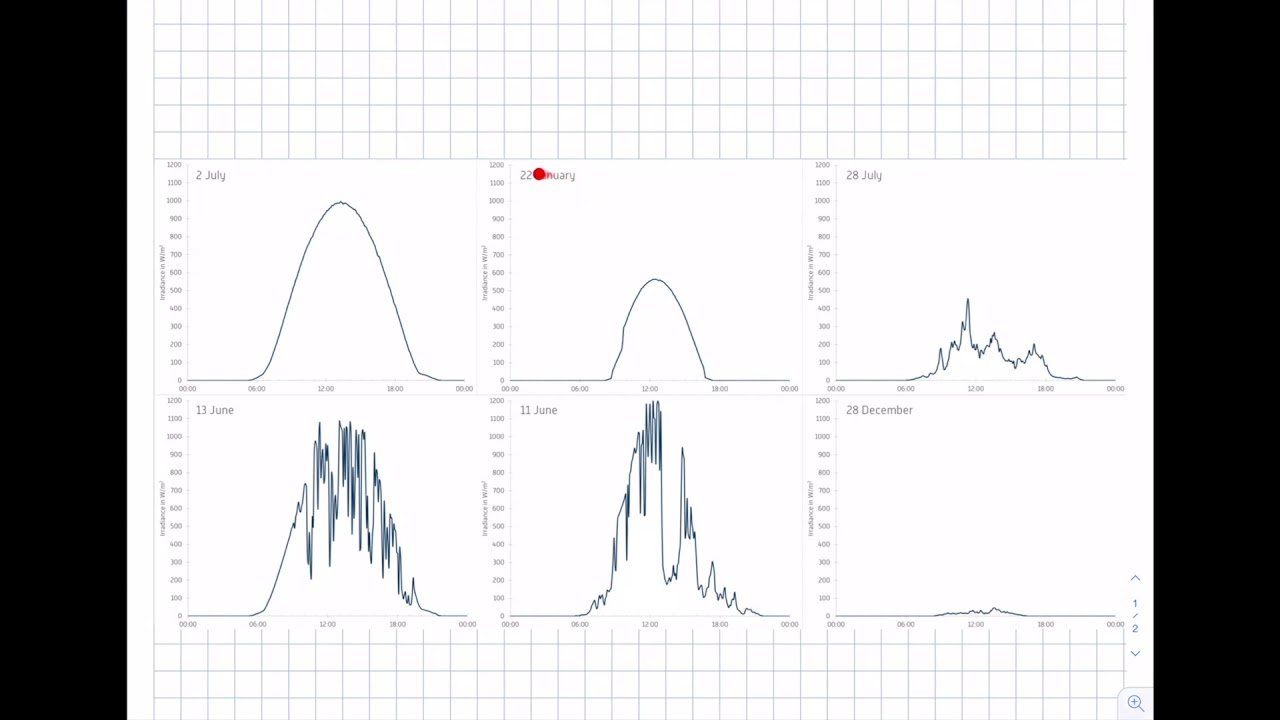
Image source: YouTube / Prof. Dr. Henrik te Heesen (YouTube thumbnail (fair-use with source credit))
Sunlight reaches your panels in two forms. Direct beam radiation is the bright, straight-line light you see on a cloudless day. Diffuse radiation is the scattered light that bounces off clouds, dust, moisture, and the ground before hitting your panels.
Both types generate electricity.
On a sunny day, direct beam radiation makes up about 90 percent of the total light hitting your panels. The remaining 10 percent is diffuse. On a fully overcast day, 100 percent of the light is diffuse.
There is no direct beam at all. Your panels still produce power from that scattered light, just at a fraction of their peak capacity.
Here is what the breakdown looks like in practical terms:
| Sky Condition | Direct Beam | Diffuse Light | Typical Output vs. Rated Power |
|---|---|---|---|
| Clear sunny day | 90% | 10% | 90–100% |
| Light clouds / hazy | 50% | 50% | 50–70% |
| Heavy overcast | 0% | 100% | 10–25% |
| Dense shade (tree, building) | 0% | 5–10% | 2–5% or zero |
The key takeaway is that your panels are never truly idle during daylight hours. The combination of direct and diffuse light means they produce something from sunrise to sunset. The amount varies wildly based on weather, season, and your latitude.
The Big Problem: What Happens When Even One Cell Is in Shade

Image source: YouTube / Tech Simulator (YouTube thumbnail (fair-use with source credit))
Here is where most people get blindsided. A solar panel is made up of individual cells wired together in series. If one cell in that series gets shaded, it stops producing current.
That shaded cell becomes a resistor instead of a generator. It drags down the output of every cell connected to it in that string.
In a standard 60-cell panel wired as a single string, shading just one cell can reduce the panel's output by 50 percent or more. The panel doesn't fail completely, but it performs far worse than you'd expect from a single small shadow.
Manufacturers mitigate this with bypass diodes. These are small components that route current around shaded sections of the panel. Most modern panels have three bypass diodes, splitting the panel into three sections.
If you shade one section, the diode bypasses that section entirely. You lose about one third of the panel's voltage, but the rest keeps working.
That bypass diode is a lifesaver, but it has limits. If your entire array is wired in one long string back to a single string inverter, a shaded panel on one end of the string pulls down the whole string. The inverter sees less voltage from the entire array and throttles back.
The fix is either microinverters on each panel or DC power optimizers that condition the output of each panel individually. Both options isolate the shading problem to the single shaded panel rather than letting it affect the whole system. We'll compare those choices in the decision tree below.
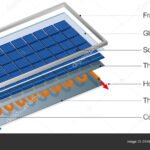
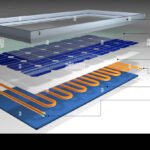
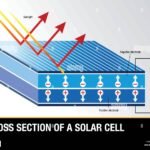
Before we go further, it helps to understand the main parts that make up a panel and how they interact. The cell layout, busbars, and bypass diode placement all affect how well a panel handles shade.
Your 3-Part Decision Tree: Shade Type, Panel Type, and Inverter Type

Image source: Wikimedia Commons / Fieldsken Ken Fields (CC BY-SA)
This is where you actually figure out what works for your specific situation. Three variables determine whether your system performs well in less-than-ideal light: the type of shade, the type of panel, and the type of inverter you choose. Let's walk through each branch.
Branch 1: How Much Shade Do You Actually Have?
Grab a notebook and walk around your property at different times of day. Mark where shadows fall on your roof or ground mount area. You need to know three things.
First, the duration. Does the shade last 30 minutes in the morning or four hours in the afternoon? Second, the coverage area.
Does it hit one corner of one panel or cover half the array? Third, the source. Is it a fixed object like a chimney or a seasonal issue like deciduous trees that lose their leaves in winter.
If your shade is light and brief, say less than an hour in the early morning, a standard system with a string inverter will handle it fine. If your shade covers more than 10 percent of your array for more than two hours per day, you need either microinverters or power optimizers.
Branch 2: Which Solar Panel Type Handles Low Light Best?
Not all panels respond to low light the same way. Here is how the three main types compare.
Monocrystalline panels are the most efficient overall. They convert roughly 20 to 23 percent of sunlight into electricity. Their low light performance is good.
They work well in diffuse light and maintain decent output down to about 50 watts per square meter.
Polycrystalline panels are slightly less efficient at 15 to 18 percent. Their low light performance is adequate but noticeably worse than monocrystalline below 200 watts per square meter.
Thin film panels are the wild card. They are less efficient overall at 10 to 12 percent, but they perform better in low light than crystalline panels. They also handle partial shade better because their cells are arranged differently.
The trade off is that you need more roof space to get the same total wattage.
For a shaded or partially cloudy location, the different panel technologies each have distinct strengths. Thin film is your best bet for consistent shade coverage. Monocrystalline is better if your shade is minimal but you want maximum output on sunny days.
Branch 3: Your Inverter Choice Makes or Breaks the Whole System
This is the most important decision you will make for a partially shaded installation. There are three options.
A string inverter takes all the panels wired in series and converts their combined DC power to AC. It is the cheapest option, costing roughly $1,000 to $2,000 installed. But if one panel in the string is shaded, every panel in that string suffers.
This is fine for unshaded roofs. It is terrible for shade.
Microinverters sit under each panel and convert DC to AC at the panel level. They cost more, typically $150 to $250 per panel. The benefit is that shading on one panel has zero effect on the others.
Each panel operates independently.
DC power optimizers sit on each panel but feed into a central string inverter. They condition the DC power from each panel so the inverter sees optimal voltage. They cost less than microinverters but more than a bare string inverter.
They offer similar shading isolation to microinverters.
If you have any significant shade, skip the string inverter. Go with microinverters or optimizers. The extra upfront cost pays for itself in recovered production.
What to Expect on Overcast Days: Real Numbers, Not Marketing
Image source: YouTube / electnology (YouTube thumbnail (fair-use with source credit))
Let's put real numbers on this so you know what to expect. A 400 watt panel rated at standard test conditions will produce roughly 400 watts in direct sun at noon on a clear summer day. On a heavily overcast winter day, that same panel will produce 40 to 100 watts.
That is 10 to 25 percent of its rating.
Here is a more detailed breakdown based on real world measurements from monitored installations.
| Sky Condition | Output as Percentage of Rated Power | Typical Daily Generation for a 5 kW System |
|---|---|---|
| Clear summer day | 90–100% | 25–30 kWh |
| Partly cloudy | 50–70% | 15–20 kWh |
| Overcast winter day | 10–25% | 3–6 kWh |
| Heavy rain / thick fog | 5–10% | 1–3 kWh |
Those numbers assume no additional shade from trees or buildings. If you add partial shade on top of overcast conditions, you can drop into the single digits.
The common question is whether those lower numbers are worth it. For a grid tied system, yes. Every kilowatt hour you generate is one you do not buy from the utility.
Even on a bad day, your system offsets some of your baseline load. For off grid systems, you need to oversize your array and battery bank to ride through consecutive overcast days.
If you are trying to decide whether solar makes financial sense in a cloudy region, the upsides and downsides of your specific climate matter a lot. Germany is one of the cloudiest regions in Europe, and it has one of the highest solar adoption rates in the world. It works.
You just need realistic expectations about annual generation.
The Worst Mistakes People Make When Shade Is Involved
The first mistake is assuming that a little shade is fine with a string inverter. We covered why that assumption costs you. One shaded panel in a string of ten can cut the output of all ten by 30 to 50 percent.
People see a small shadow and think it is negligible. It is not.
The second mistake is not trimming trees before installation. A branch that shades one panel for two hours in the afternoon costs you more in lost generation over 25 years than the cost of removing that branch. Do the tree work first.
The third mistake is ignoring seasonal shade patterns. That tree that looks harmless in winter when it has no leaves will cast a long shadow in summer when the sun is higher and the canopy is full. You need to evaluate shade during both seasons.
The fourth mistake is buying cheap panels with fewer bypass diodes. Some budget panels have only two bypass diodes instead of three. That means a smaller shaded area triggers a larger drop in output.
Stick with panels that have three bypass diodes as a minimum.
When Solar Still Makes Sense Without Direct Sun (and When It Doesn't)
Solar makes sense in almost every location that gets regular daylight. The question is whether it makes financial sense.
If you live in Seattle, Portland, or the UK, you will get fewer peak sun hours than someone in Phoenix or Los Angeles. According to NREL data, Seattle averages about 3.5 peak sun hours per day. Phoenix averages 6.5.
That means a 5 kW system in Seattle generates about 5,000 kWh per year. The same system in Phoenix generates about 9,500 kWh.
That Seattle number is still meaningful. At national average electricity rates, 5,000 kWh per year saves you roughly $800 to $1,000 annually. The system pays for itself over time.
It just takes longer than it would in the desert.
Solar does not make sense if your roof is heavily shaded for most of the day. If a building or large tree blocks direct sunlight for more than four hours during peak production hours (10 AM to 3 PM), you will struggle to generate enough power to justify the installation cost. In that case, ground mount panels in a sunnier part of your property or community solar subscriptions are better options.
Understanding how they actually generate electricity helps you set realistic expectations. The physics does not change based on your latitude. The economics does.
Your Action Plan: What to Do Before You Buy
Start with a shade study. You can use a tool like a solar pathfinder or a phone app that maps sun exposure on your roof throughout the year. Some solar installers include this as part of their quote.
Do not skip it.
Next, choose your panel type based on your shade profile. Thin film if you have persistent light shade. Monocrystalline if your roof is mostly clear.
Avoid polycrystalline for shaded installations.
Then pick your inverter. String inverter only for completely unshaded roofs. Microinverters or optimizers for anything with shade.
Get at least three quotes from installers. Ask each one to run a production estimate using your specific roof and shade data. Compare the numbers.
The installer who accounts for your shade accurately will quote a lower annual production estimate than the one who ignores it. That lower number is the honest one.
Factor in tree trimming costs if needed. One time removal of a problem branch costs a few hundred dollars. Living with the shade costs you thousands in lost production over the life of your system.
For a deeper walkthrough of everything involved, a full guide to picking the right system covers the sizing, equipment selection, and installer evaluation steps in more detail.
Frequently Asked Questions
Do solar panels work at night?
No. Solar panels require light to generate electricity. They produce zero power at night regardless of moonlight or streetlights.
The light levels are far below the threshold needed to trigger the photovoltaic effect. You need batteries or grid connection for nighttime power.
How much power do solar panels produce on a cloudy day?
Expect 10 to 25 percent of the panel's rated wattage on a fully overcast day. A 400 watt panel produces 40 to 100 watts. On partly cloudy days with breaks of sun, output fluctuates between 50 and 70 percent as clouds pass overhead.
Do solar panels need direct sunlight or just light?
Just light. Photovoltaic cells respond to any light above roughly 20 watts per square meter. Direct sunlight is about 1,000 watts per square meter.
Diffuse light from clouds, fog, or haze still drives current through the cells, just at a lower rate.
What is the best solar panel for low light conditions?
Thin film panels have the best low light response of any consumer panel type. Monocrystalline panels are a close second and offer higher overall efficiency. The difference matters most below 200 watts per square meter of irradiance.
Can solar panels work through glass?
Yes, but with reduced output. Standard window glass blocks some ultraviolet and infrared wavelengths that panels use. You lose roughly 10 to 30 percent of potential output depending on the glass type and angle.
Tempered glass and low e coatings reduce transmission further.
Should I get solar if my roof has shade?
Yes, if you can mitigate the shade with microinverters or power optimizers and the shade is not severe. A professional shade analysis will tell you whether the annual production is high enough to justify the investment. Heavy all day shade is a dealbreaker.

Similar Posts