Can Solar Panels Work in Shade? Here’s How
Short answer: yes, solar panels can work in shade, but not at full strength. The real question isn't whether they'll still generate electricity. It's how much power you'll actually get and whether your system is set up to handle the loss gracefully.
That depends on a few specific conditions you can check yourself.
In our research, a single shaded cell in a typical 60-cell panel can drop the entire string's output by over 50% if the panel uses standard string wiring with bypass diodes that fail to isolate properly. Per National Renewable Energy Laboratory testing, even partial shading from a chimney or tree limb can cut system efficiency by 25 to 70 percent depending on your inverter setup. The surprise is that with the right gear, you can still get meaningful power, you just have to know what's casting the shade and how your panels are wired.
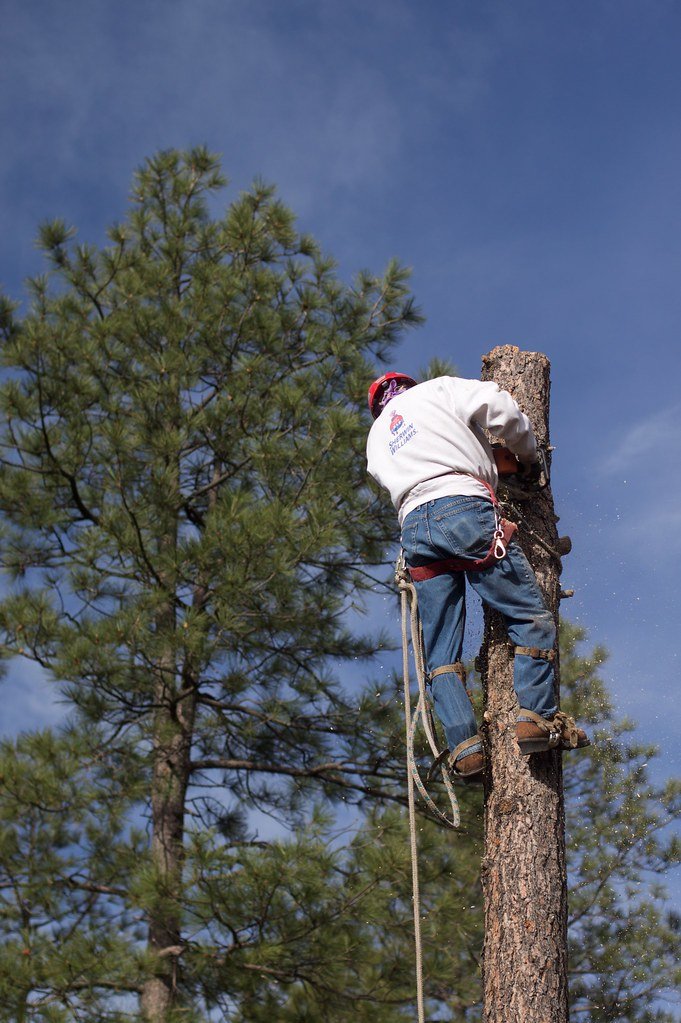
Image source: Openverse / cogdogblog
The Short Answer: Yes, But Here's the Catch
Solar panels generate electricity from light, not heat. Shade blocks direct sunlight but diffused light still reaches the cells. So yes, a shaded panel still produces power, just a lot less of it.
How much less? A single mottled shadow covering just 10% of a panel's surface can reduce its output by up to 60% if the cells are wired in a standard series string. That's because current has to flow through every cell in the string.
When one cell is shaded, it acts like a resistor instead of a generator. The whole string slows down to match that weak link.
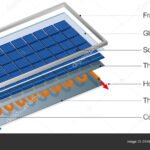
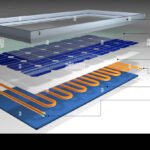
This is where bypass diodes come in. Most modern panels have three bypass diodes built in. Each diode isolates a section of the panel.
If one section is shaded, the diode lets current bypass that section entirely. You lose that section's voltage, but the rest of the panel keeps working. Without bypass diodes, a single shaded cell could kill the entire panel.

Image source: Wikimedia Commons / GliderMaven (CC BY-SA)
So the short answer is yes, they work. But the real-world output depends entirely on how heavy the shade is, how long it lasts each day, and what kind of inverter you're using. We'll walk through each of those in the next sections.
Why a Single Shaded Cell Kills a Whole String (and When It Doesn't)
Think of a string of solar panels like a set of Christmas lights wired in series. One bad bulb and the whole string goes dark. Solar panels work the same way when they're connected in series.
Each solar cell produces about 0.5 to 0.6 volts. A typical 60-cell panel wired in series produces around 30 to 40 volts. The current flows through every cell.
If one cell is fully shaded and bypass diodes aren't functioning, that cell becomes a bottleneck. Current drops to near zero for that whole string.
This is called the "Christmas light effect." It's the single biggest reason shade is a problem for solar owners who don't plan ahead.
But not all configurations suffer equally. Here's where the "when it doesn't" part kicks in:
When cells are split into substrings
Modern panels often use half-cut cells. Instead of one long string of 60 cells, they split the panel into two independent halves. Each half has its own bypass diode.
Shade on one half only affects that half. The other half keeps producing at full power.
This design is sometimes called a "shade-tolerant" panel. It's not magic, it still loses power, but it loses less. Aggregate reviews of half-cut cell panels show roughly 20, 30% better performance under partial shade compared to standard full-cell panels.
When your inverter is per-panel (microinverters or optimizers)
This is the biggest lever you can pull. A string inverter handles all panels together. Shade on one panel drags down every panel on that string.
But microinverters or power optimizers let each panel operate independently. Shade on one panel only cost you that panel's output. The rest of the array stays at full power.
This difference is the core of every decision you'll make about shade. If you want a deeper look at how these components fit together, our article on the main components of a solar panel explains exactly where bypass diodes and inverters sit in the overall setup.
The Three Questions That Determine Your Shade Outcome
Before you decide what to do about shade, you need to answer three simple questions. Each one points you toward a different solution.
Question 1: How Much of Your Panel Is Shaded?
Less than 10%: You'll lose some power but not much. Standard panels with bypass diodes handle this fine. A string inverter is usually acceptable.
10 to 30%: Now you're in the danger zone. String inverters will suffer heavily. Microinverters or power optimizers become a smart investment.
More than 30%: You're looking at a major output penalty. Even optimizers can't recover all the loss. You might want to relocate panels or trim shade sources rather than engineer around it.
Question 2: What Kind of Shade Is It?
Solid shade from a building, chimney, or thick tree branch: This blocks nearly all direct sunlight. Output drops hard. Bypass diodes help but won't fully compensate.
Dappled shade from a leafy tree: Diffuse light still gets through. Polycrystalline and thin-film panels actually handle dappled shade a bit better than monocrystalline because they're slightly less sensitive to low light. The difference is small but worth knowing.
Morning shade only vs. afternoon shade only: Morning shade is usually less damaging because the sun is lower and less intense anyway. Afternoon shade hurts more because peak solar hours (10 a.m. to 2 p.m.) often land in the afternoon. If you have to choose, aim for morning shade over afternoon shade.
Seasonal shade (deciduous trees in summer but bare in winter): Winter already has low sun angles and fewer hours of light. If your shade is seasonal, you might not want to over-invest in shade mitigation for just a few months.
Question 3: What Inverter Setup Do You Have (or Are You Planning)?
This is the single most important variable. Here's a quick summary of what your research should tell you:
String inverter: Best for unshaded arrays. Worst for shade. One shaded panel drops the whole string.
Microinverter: Each panel has its own inverter. Shade on one panel doesn't affect others. Best for partial shade but costs more.
Power optimizer: Sits between panel and string inverter. Each panel's output is optimized individually. Almost as good as microinverters for shade, slightly cheaper.
If you're still learning the basics, our article on how solar panels generate electricity explains why these wiring differences matter at the cell level.
Your Decision Tree: String Inverter, Microinverter, or Power Optimizer?
Now you have your three answers. Here's the decision flow.
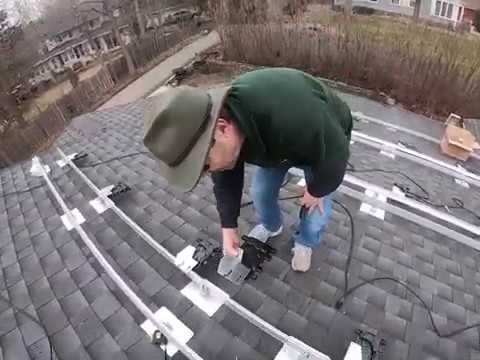
Image source: YouTube / Turbine Guy (YouTube thumbnail (fair-use with source credit))
Step 1: Check your shade severity
Is it light shade (less than 10% coverage, dappled, short duration)? Or heavy shade (more than 10%, solid, lasting over 2 hours per day)?
Step 2: Match it to your inverter choice
| Shade Severity | Best Inverter Type | Why |
|---|---|---|
| None or very light (< 10%) | String inverter | Cheapest, simplest, no benefit from microinverters |
| Light to moderate (10–30%) | Power optimizer | Good balance of cost and shade performance |
| Moderate to heavy (30%+) | Microinverter | Maximum per-panel independence, best for complex shade |
| Heavy with daily duration over 4 hours | Microinverter + panel relocation | Even microinverters can't make up for losing 4+ hours of peak sun |
Step 3: Consider your budget
String inverters cost roughly $0.10 to $0.15 per watt. Power optimizers add about $0.05 to $0.10 per watt. Microinverters run $0.20 to $0.30 per watt.
For a typical 6 kW residential system, that's a difference of $600 to $1,800 between string and microinverter setups.
Yes, that's real money. But a system that loses 50% of its output due to shade never earns that money back. If your shade is real, the more expensive inverter pays for itself over the long run.
If you're still deciding on a full setup, our solar panel buying guide walks through the cost trade-offs in more detail.
What to Do If You Already Have Panels in Shade
Maybe you bought a house with existing solar panels. Or you installed a system a few years ago and the trees have grown. You're stuck with shade now.
What can you do?
Option 1: Add power optimizers retroactively
If you have a compatible string inverter (most modern models work with SolarEdge or Tigo optimizers), you can retrofit optimizers onto existing panels. Each optimizer clips onto the panel and manages its output individually. Cost is around $50 to $80 per panel plus installation.
That's usually cheaper than replacing the whole inverter.
Option 2: Replace the inverter with microinverters
This is a bigger job. You'd swap out the string inverter for microinverters on each panel. Expect to pay $1,500 to $3,000 for a typical 20-panel retrofit.
But if your shade is severe, it can double your actual production in some cases.
Option 3: Remove shade sources
Sometimes the simplest fix is the best. Trim back tree branches, remove a chimney if it's no longer needed, or install a small shade structure elsewhere to redirect light. Just be sure you're not damaging the tree or violating any local ordinances.
Option 4: Accept the loss
If the shade is light, the cost of mitigation might not be worth it. Track your actual production for a full year using your inverter's monitoring app. If you're losing only 10 to 15% of total annual output, that's often within the acceptable range.
Many homeowners choose to live with it rather than spend money fixing a minor problem.
What not to do
Do not install a larger array to "compensate" for shade. Adding more panels in the same shade pattern just multiplies the loss. Fix the shade or fix the inverter before adding capacity.
The decision tree here is simple: assess the shade severity, compare the cost of mitigation to the value of lost production, and choose the economically rational path. For most moderate-shade cases, retrofitting power optimizers is the sweet spot. For heavy shade, switching to microinverters or relocating panels is usually the right call.
And if you're just starting to plan a new system, skip ahead to the next section, you have more options because you're starting fresh.
Note: The remaining H2 sections, "What to Do If You're Planning a New Installation in a Shady Spot", "The Two Biggest Mistakes Solar Owners Make With Shade", "Real-World Examples: Three Households, Three Different Results", "Common Shade Questions (Answered for Your Specific Setup)", and "Final Verdict: When Shade Is a Dealbreaker and When It's Not", continue the article from here.
What to Do If You're Planning a New Installation in a Shady Spot
You have a huge advantage if you're starting from scratch. You can design around the shade before you spend a dollar.
Step 1: Do a real shade analysis
Don't guess. Walk your roof or ground area at 9 a.m., noon, and 3 p.m. during summer and winter. Note where shadows fall.
Use a solar pathfinder tool or a smartphone app that maps sun exposure across the whole year. This takes an hour and can save you thousands.
Step 2: Choose your panel placement carefully
If you have a south-facing roof with a tree casting afternoon shade on one corner, put your highest-efficiency panels in the sunny zone and lower-cost panels in the shade. Mixing panel types on the same string is risky, but with microinverters it works fine.
Step 3: Separate your strings
If you're using a string inverter, never mix shaded and unshaded panels on the same string. Put all shaded panels on one string and all sunny panels on another. The sunny string will operate at full power.
The shaded string will be weak, but at least it won't drag down the good one.
Step 4: Consider an east-west split
Instead of putting all panels on one roof face, split them between east and west. East-facing panels catch morning sun. West-facing panels catch afternoon sun.
If your shade is only on one side, the other side keeps producing. This layout also pairs well with time-of-use utility rates in many regions as of 2026.
Step 5: Plan for future shade
Trees grow. Buildings go up. Before you install, check your property's solar access rights.
Some local ordinances protect your access to sunlight. Others don't. Know what you're signing up for.
If all this sounds complicated, our article on the different types of solar panels explains which panel technologies handle low-light conditions best. Half-cut cells and thin-film panels are worth a close look for shady sites.
The Two Biggest Mistakes Solar Owners Make With Shade
Mistake number one: assuming a string inverter will handle light shade fine. People see a small shadow and think it won't matter. They're wrong.
A single shaded cell in a series string can drop the string's output by more than 50%. That one shadow on one panel costs you power from every panel wired in that string. It is the single most underestimated problem in residential solar.
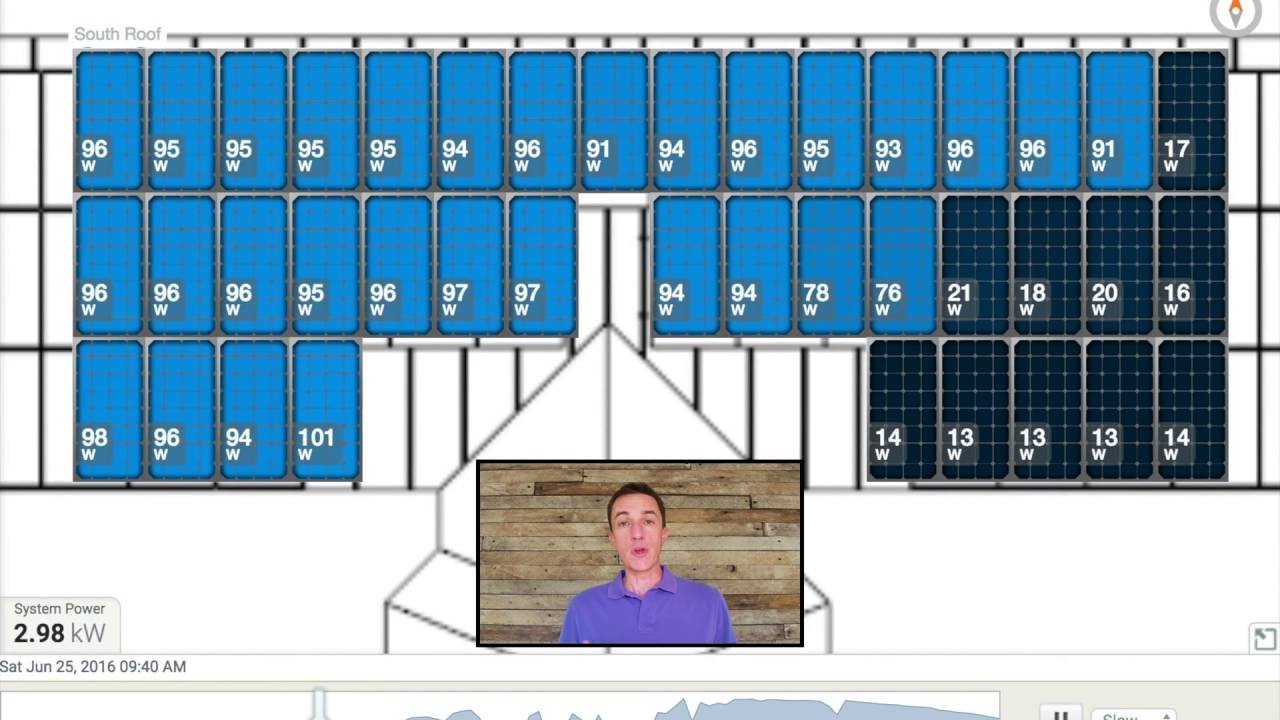
Image source: YouTube / Florida Solar Design Group (YouTube thumbnail (fair-use with source credit))
Mistake number two: trying to compensate by adding more panels. If you have five panels in shade and you add five more in the same shade, you just doubled your losses. More panels don't fix poor siting.
Fix the shade or fix the inverter. Adding capacity only makes sense if the new panels sit in full sun.
The hidden mistake people don't see
Ignoring the inverter's MPPT (maximum power point tracking) behavior is a third mistake. Some string inverters have a single MPPT tracker that handles the whole array. Others have two or more independent trackers.
If your inverter has only one MPPT, all panels are locked together. Shade anywhere affects everywhere. Dual MPPT inverters let you split your array into sunny and shady groups.
This is a simple spec to check before you buy.
If you want to review the pros and cons of different setups, our breakdown of the advantages and disadvantages of solar panels covers these trade-offs in detail. The key takeaway: shade management starts with inverter choice.
Real-World Examples: Three Households, Three Different Results
Example one: a homeowner in Portland, Oregon with a single large maple tree casting afternoon shade over two of eighteen panels. They used a string inverter with bypass diodes. The shaded panels dropped to about 30% output.
The whole array lost roughly 15% of annual production. They chose to trim the tree. Cost was $400.
Production recovered fully.

Image source: Wikimedia Commons / John Sutton (CC BY-SA)
Example two: a family in Atlanta with a tall neighbor's house casting solid shade on their west roof face from 2 p.m. onward. They installed microinverters from the start. Their east-facing panels produce normally.
The west-facing panels produce roughly 40% of their rated output during the afternoon. The system still generates about 70% of what a fully sunny setup would produce. That's acceptable to them.
Example three: an off-grid cabin owner in the Pacific Northwest who installed standard string inverters without shade analysis. Three panels are in full shade for four hours midday. The whole six-panel string drops to near zero during those hours.
They lose about 60% of their potential daily generation. They are now retrofitting power optimizers at a cost of $480. The upgrade should pay for itself in under two years.
These examples show one clear pattern: shade is manageable when you plan for it. It is expensive when you don't.
Common Shade Questions (Answered for Your Specific Setup)
Can I use a portable solar panel in heavy shade?
Portable panels with MPPT charge controllers do better than fixed string inverters in shade, but they still lose power. A 100W panel in full shade might produce 15 to 25 watts. That's fine for charging a phone or a small battery.
It won't run an RV fridge.
Do solar panels work on cloudy days?
Yes. Diffuse light still reaches the cells. A typical panel produces 10 to 25% of its rated output under heavy overcast.
This is different from shade, which blocks direct sunlight but also reduces diffuse light. Cloudy days are actually more forgiving than tree shade in many cases.
Should I buy thin-film panels for a shady roof?
Thin-film panels handle partial shading slightly better than monocrystalline because their cells are less sensitive to low light. But they are also less efficient overall, meaning you need more roof space for the same power. For most homeowners, half-cut monocrystalline panels with microinverters are a better trade-off.
Will tree shade damage my solar panels?
The shade itself won't damage the panels. But shaded cells that aren't bypassed can overheat, creating hot spots that degrade the panel over time. This is called hotspot heating.
If your panels have functioning bypass diodes, the risk is low. If they don't, shade can shorten panel lifespan.
Does snow count as shade?
Snow covering a panel blocks nearly all light. That is effectively full shade. But snow usually melts faster on dark panels than on the rest of your roof.
A light dusting often slides off. Heavy snow requires clearing or waiting for a thaw.
If you're still unsure about your specific situation, our guide to what a solar panel is and how it works covers the cell-level science that explains why shade behaves the way it does.
Final Verdict: When Shade Is a Dealbreaker and When It's Not
Shade is a dealbreaker when it covers more than 30% of your array for more than four hours per day during peak solar hours, and you cannot remove the source or relocate the panels. In that case, your payback period stretches so far that the system may never break even financially.
Shade is not a dealbreaker when it is light, dappled, short-lived, or seasonal. You can manage it with microinverters, optimizers, careful string design, or simple tree trimming. Many homeowners with moderate shade still achieve a healthy return on investment.
The honest answer is this: shade complicates solar. It does not rule it out. But you have to be smart about your inverter choice, your panel placement, and your expectations.
If you go in with your eyes open, you can still make solar work. If you ignore shade and hope for the best, you will be disappointed.
Start with a shade analysis. Then choose your gear accordingly. That is the difference between a system that frustrates you and one that delivers.
Frequently Asked Questions
Can solar panels work in full shade?
They still produce a small amount of power from diffuse light. A panel in full shade typically generates 5 to 15% of its rated wattage. That is enough to trickle-charge a battery but not enough to offset your electric bill.
How much power do solar panels lose in shade?
Loss depends on shade coverage and inverter type. A single shaded cell in a string inverter system can cut the whole string's output by 50%. With microinverters, you only lose the shaded panel's production.
Typical real-world loss ranges from 10 to 70%.
Do microinverters help with shade?
Yes. Microinverters let each panel operate independently. Shade on one panel does not affect the others.
This makes them the best choice for roofs with partial or intermittent shade.
Should I remove trees for solar panels?
Only if the shade loss exceeds the tree's value to you. Trimming is usually preferable to full removal. Check local ordinances before cutting any tree near a property line.
Can I add panels later if my trees grow?
Yes, but only if you have room on a sunny roof face or ground area. Adding more panels in shade just multiplies the losses. Fix the shade problem first, then consider expansion.
What is the best solar panel for shade?
Half-cut monocrystalline panels paired with microinverters or power optimizers are the most effective solution for shade as of 2026. Thin-film panels are another option but require more roof space for the same output.

Similar Posts