Will a 1500W Inverter Run a Microwave?
Can a 1500 watt inverter run a microwave? Yes, it can, but only when the rest of your power system passes the math first. The inverter's wattage rating is just the beginning, not the full answer.
Here's a concrete reality check: a microwave labeled 900 watts typically pulls 1,400 to 1,600 watts from the wall during operation. The startup surge can hit 2,000 watts or more for a fraction of a second. As of 2026, that gap between label and real draw is still the most common reason inverters shut down.
So before you plug in, let's walk through the numbers that actually matter.
The Short Answer: Yes, But Only If Your Whole System Passes the Math
Yes, a 1500 watt inverter can run most countertop microwaves. The catch is that you need an inverter with enough surge headroom and a battery bank built for heavy draw.
If the microwave's input watts are under 1,500, the inverter's continuous rating is fine. You still need peak power for the startup spike, usually around 2x continuous.
The real test happens in the first second. Check the inverter's surge rating before relying on the continuous number. If it trips, don't blame the microwave.
Look at the battery bank, cable gauge, and connection tightness.
Microwave Wattage Explained: Cooking Watts vs. Input Watts vs. Surge Draw
The wattage printed on the front of the microwave is cooking power, not electrical draw. Cooking watts measure how much microwave energy heats the food. Input watts measure what the appliance actually takes from your inverter.
Most microwaves need 1.5 to 2 times their cooking rating in input power. A 700-watt model can draw 1,100 to 1,300 watts. A 1,100-watt model can pull 1,600 to 1,900 watts.
| Cooking watts | Typical input watts | Startup spike |
|---|---|---|
| 700W | 1,100–1,300W | 1,500–2,000W |
| 900W | 1,400–1,600W | 1,800–2,400W |
| 1,100W | 1,600–1,900W | 2,200–2,800W |
The startup spike matters because inverter ratings have two values, continuous and surge. A 1500W continuous inverter usually allows 3,000W for a few seconds. That's enough for many compact microwaves, but not for every large one.
Pure sine wave output is also worth checking. Modern digital controls, clocks, and touchpads often misbehave on modified sine wave power. Aggregate reviews show humming, poor heating, and resetting clocks after a mismatch like that.
The Real Bottleneck: Your Battery Bank, Wire Gauge, and Inverter Type
Here's where most setups fail. The inverter might be rated for 1,500 watts, but the battery bank still has to deliver the current.
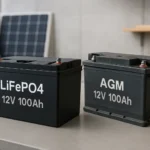
At full load, a 12-volt system draws about 125 to 150 amps from the battery through the inverter. That's way beyond what a small starter battery can safely handle. You need a deep-cycle or lithium battery rated for continuous high discharge.
Cable gauge is just as critical. Thin wires waste power as heat and cause voltage drops that trip inverters. For 150-amp draws, use at least 2 AWG cable.
Use 1/0 AWG for longer runs to the battery.
| System voltage | Current at 1,500W | Recommended cable |
|---|---|---|
| 12V | ~147A | 2 AWG to 1/0 AWG |
| 24V | ~74A | 6 AWG to 4 AWG |
| 48V | ~37A | 10 AWG to 8 AWG |
The waveform type matters too. Pure sine wave inverters produce clean AC power that matches utility electricity. Modified sine wave units can cause buzzes, flickers, and electronics errors.
If your microwave has a digital display, choose pure sine wave.
And if you're charging from solar, remember the battery is only as full as your array can refill it. Understanding which panel type suits your rig matters when you depend on sun for daily power. It helps to know what's inside each panel too, because efficiency and lifespan vary by build.
How to Check Your Setup Step by Step
You don't need to be an electrician to verify this, but you need to be methodical.
- Find the microwave's nameplate. It's usually on the back or the door frame. Look for input watts, not cooking watts.
- Multiply that input wattage by 1.25. This gives you the safe continuous inverter rating you should aim for.
- Confirm the inverter's surge rating. It must exceed the microwave's startup spike, not just its running load.
- Measure the battery voltage and capacity. A 100Ah 12V battery gives you roughly 1,200 watt-hours at full charge. At 1,500 watts, that's under an hour of theoretical runtime, less in practice.
- Check cable size and fuse. Use the ampacity charts in the National Electrical Code to match wire size to current, and never oversize the fuse beyond the cable rating.
- Run a test with the microwave alone. Unplug everything else, start a short cycle, and watch for voltage sag at the battery terminals. If you're solar-powered, understand how your panels refill the battery before you assume a full battery.
If the inverter shuts down, start your diagnosis with the battery and wiring, not the inverter. That's where most overloads actually come from.
Just like sizing any off-grid solar system, the goal is to work backward from the appliance's real needs. That way you buy once and run safely.
Common Mistakes That Destroy Inverters, Batteries, and Microwaves
Troubleshooting threads consistently show the same patterns, and they're almost always avoidable.
- Confusing cooking watts with input watts. This is the #1 error. It leads you to buy an inverter that's too small.
- Trusting budget surge ratings. As of 2026, cheap inverters often list peak power that lasts milliseconds, not the 1, 3 seconds a microwave needs.
- Running other loads during microwaving. Lights, fridge, and TV can push the total over the inverter's limit.
- Undersizing cables. Long skinny wires cause voltage drop, overheating, and nuisance shutdowns.
- Draining batteries below 50%. Lead-acid batteries lose capacity and life when deep-cycled repeatedly.
One more mistake is forgetting that your whole power chain is only as strong as its weakest link. If the microwave still trips, check the battery charge level first, then the fuse, then the inverter. In our research, the battery bank is the culprit more often than the inverter itself.
If this feels like a lot of moving parts, that's because it is. But the payoff is a quiet, generator-free kitchen that runs on stored sun. Just make sure you understand solar's real trade-offs before you commit to the wiring.
Safety Rules for Off-Grid Microwave Use — and When to Call a Professional
Running a 1500W inverter near its limit means you're dealing with serious current. This isn't just about convenience. It's about preventing fire, equipment damage, and personal injury.
The first safety rule is fusing the DC side. Install a fuse or circuit breaker within 18 inches of the battery positive terminal. Use a fuse rated for the wire gauge, not the inverter's maximum rating.
For a 150A draw, that typically means a 150A or 175A Class T or ANL fuse.
A disconnect switch is mandatory too. You need a way to kill power to the inverter without touching the battery terminals. Install it on the positive cable between the battery and the inverter.
Ventilation matters more than most people realize. Lead-acid batteries release hydrogen gas during charging. That gas is explosive in enclosed spaces.
Your battery bank needs a vented compartment or at least passive airflow near the top. Lithium iron phosphate batteries don't off-gas, but they still generate heat under heavy load. Leave a few inches of clearance around the inverter for its cooling fan.
Watch for these warning signs. If the inverter case feels hot to the touch, if the microwave dims the lights, or if you smell burning plastic, shut everything down immediately. Those symptoms point to undersized wiring, a loose connection, or an overloaded system.
Call a professional if you're uncertain about wire sizing, if you're mixing battery chemistries, or if the inverter trips repeatedly after you've checked the obvious causes. A licensed electrician or RV technician can verify your setup against the National Electrical Code (NEC) guidelines. That's cheaper than replacing melted gear.
Frequently Asked Questions
Can a 1500W inverter run a 1200W microwave?
Yes, but it depends on the inverter's surge rating. A 1200W input microwave can spike to 2,000W or more at startup. You need a 1500W continuous inverter with at least a 3,000W surge rating.
Pure sine wave is strongly recommended for digital controls.
How long will a 100Ah battery run a microwave?
A 100Ah lithium battery at 12V gives about 1,200 watt-hours of usable energy. A 1,400W input microwave will run for roughly 45 minutes total. That's theoretical.
Real-world runtime is shorter because the inverter draws power even when idle, and battery voltage drops under load.
Will a modified sine wave inverter damage a microwave?
It can cause problems. The microwave may hum, heat unevenly, or fail to start. The digital clock and display may reset or behave erratically.
The magnetron itself usually survives, but the control board can suffer long-term stress. Pure sine wave is safer.
Can I run other appliances while the microwave is on?
Not on a 1500W inverter. The microwave alone uses most of the available power. Adding a refrigerator compressor, a coffee maker, or even LED lights can push the total over the inverter's limit.
Run the microwave as a standalone load for best results.
Does microwave wattage mean input or output?
The wattage on the front label is output power, also called cooking power. The input power is higher. Always check the nameplate on the back of the microwave.
That's the number you use for inverter sizing.
Final Verdict: What I'd Do Before Flipping That Switch
Here's the bottom line. A 1500W inverter can run a microwave, but only if every part of the system is built for the load.
Start with the microwave nameplate. Confirm the input watts. Multiply by 1.25 for a safety margin.
Then verify the inverter's surge rating covers the startup spike. Then check the battery bank can deliver the current without sagging below the inverter's cutoff voltage.
If any of those numbers don't line up, upgrade the weakest link first. That's usually the battery bank or the cable gauge. Don't just buy a bigger inverter and hope the problem goes away.
The one-sentence action plan is this: read the microwave nameplate, do the math, build the system around the real numbers, and test with nothing else running. That's the difference between a setup that works for years and one that shuts down on the first hot meal.

Similar Posts