SolarPanel Voltage Explained: The Complete Guide
If you have ever stared at the sticker on the back of a solar panel and wondered what those numbers actually mean, you are not alone. Solar Panel Voltage Explained in plain language is exactly what we are tackling here, because getting voltage wrong can fry your charge controller, create a fire hazard, or just waste your money on equipment that will never work right.
Manufacturer specifications confirm that a single 400 watt residential panel can produce anywhere from 37 to 50 volts depending on the model and conditions. That voltage shifts with temperature, with wiring length, and with the type of equipment you pair it to. The difference between Voc, Vmp, and nominal voltage trips up even experienced DIY builders.
Let us walk through each piece so you can design a system that is safe, efficient, and actually works.
Quick Answer
Solar panel voltage determines system safety and component compatibility. Voc is the maximum voltage a panel produces with no load. Vmp is its voltage at peak output.
Nominal voltage (12V, 24V, 48V) describes the battery voltage you are designing for, not the panel itself. Cold weather raises voltage significantly and can damage equipment if ignored.
Why Solar Panel Voltage Matters More Than You Think
Voltage is not just a number on a spec sheet. It dictates what charge controller you can use, what inverter works, how thick your wire needs to be, and whether your system passes an electrical inspection.
Here is what is actually at stake:
- Equipment damage. Exceed the maximum input voltage on a charge controller or inverter and you can destroy it instantly. That is a several hundred dollar mistake.
- Fire risk. Undersized wire carrying higher current at lower voltage can overheat. Voltage drop also wastes power that you already paid for.
- System failure. If your panel voltage is too low for your battery bank, your charge controller may never reach the charging voltage your batteries need.
- Permit failures. Electrical codes like the National Electrical Code (NEC) set maximum voltage limits for residential solar. As of 2026, the limit is typically 600 volts for homes in the United States.
The good news is that voltage is predictable. You can calculate it, measure it, and design around it. A few minutes of planning upfront saves you from buying equipment twice.
If you are still shopping for panels, our solar panel buying guide walks through the specs that actually matter for your setup.
The Two Voltage Numbers You Actually Need to Know (Voc vs. Vmp)
Every solar panel datasheet lists two voltage numbers. They serve completely different purposes and mixing them up causes real problems.
Voc stands for open circuit voltage. This is the maximum voltage the panel produces when it is not connected to anything. No current flows. It is the highest voltage the panel can ever reach under standard test conditions.
Vmp stands for maximum power voltage. This is the voltage the panel produces while it is actually working and delivering power to your system. It is always lower than Voc because voltage drops slightly when current starts flowing.
Here is how they compare for a typical 400 watt residential panel:
| Measurement | Typical Value | What It Tells You |
|---|---|---|
| Voc | 45 to 50 volts | Maximum voltage for string sizing and equipment limits |
| Vmp | 37 to 42 volts | Operating voltage when the panel is producing power |
| Current (Imp) | 9 to 11 amps | Current flowing at maximum power |
| Wattage | 400W (STC) | Rated output under standard test conditions |
When you design a solar array, you use Voc to make sure you never exceed your charge controller or inverter input limits. You use Vmp to estimate real world power production and to make sure the voltage is high enough to charge your batteries.
Do not use Vmp when you need Voc and do not use Voc when you need Vmp. That is the most common sizing error we see in solar panel builds.
Nominal Voltage Is Not Real Voltage: The Common Trap
Here is where things get confusing. Panels are often labeled as 12 volt or 24 volt panels. That label does not describe what the panel actually produces.
A 12 volt nominal solar panel produces roughly 18 to 22 volts open circuit. That is because it needs to be higher than the 12 volt battery voltage to push current into the battery. A 24 volt nominal panel produces about 36 to 45 volts open circuit.
| System Nominal | Actual Voc Range | Actual Vmp Range | Best Used With |
|---|---|---|---|
| 12V panel | 18V to 22V | 15V to 18V | 12V battery bank, PWM or MPPT |
| 24V panel | 36V to 45V | 30V to 38V | 24V battery bank, MPPT preferred |
| Grid tie panel | 37V to 50V | 30V to 42V | String inverter, microinverters |
The trap is that someone buys a 12 volt panel thinking it matches a 12 volt battery perfectly. They connect it directly, and it works. But they do not understand why their charge controller gets hot or why their wires feel warm.
The voltage difference is real and it has to go somewhere.
For off grid systems, match your panel array voltage to your battery bank voltage. Our research shows that MPPT charge controllers handle a wider voltage range and make better use of higher voltage panels even with a 12 or 24 volt battery. A PWM controller needs the panel voltage to stay relatively close to the battery voltage or it wastes the excess as heat.
How Cold Weather Can Push Your System Past Its Limits
Solar panels have a surprising behavior in cold weather. Their voltage actually goes up as the temperature drops.
Every panel has a temperature coefficient for Voc printed on its datasheet. It is usually around negative 0.25 to negative 0.35 percent per degree Celsius. That means at 25 degrees Celsius (standard test temperature) the panel is at its rated Voc.
At freezing, the voltage rises. At subzero temperatures it rises even more.
Here is a real world example. A panel with a Voc of 48 volts at 25 degrees Celsius and a temperature coefficient of 0.30 percent per degree Celsius:
- At 0 degrees Celsius, Voc rises to roughly 51.6 volts
- At minus 10 degrees Celsius, Voc rises to roughly 53.2 volts
- At minus 20 degrees Celsius, Voc rises to roughly 54.8 volts
Now imagine you have a string of eight panels wired in series. At standard temperature you are at 384 volts. At minus 20 degrees Celsius you are over 438 volts.
If your inverter has a 400 volt maximum input limit, you just exceeded it. That can destroy the inverter.
The National Electrical Code (NEC Article 690.7) requires you to calculate the maximum voltage using the lowest expected temperature for your location. The U.S. Department of Energy publishes climate data you can use for this calculation.
Do not skip it. A cold snap in January can push your system past its limits even if it runs fine all summer.
Series vs. Parallel: The Voltage Decision That Affects Everything
How you wire your panels changes the voltage and current in your system. There are two basic configurations and a combination of both.
Series wiring connects the positive of one panel to the negative of the next panel. Voltages add together. Current stays the same.
If you have three 40 volt panels in series, you get 120 volts total.
Parallel wiring connects all positives together and all negatives together. Volts stay the same. Current adds together.
Three 40 volt panels in parallel still produce 40 volts, but current triples.
| Configuration | Voltage | Current | Best For |
|---|---|---|---|
| Series | Adds | Same | Higher voltage for MPPT, longer wire runs |
| Parallel | Same | Adds | Lower voltage systems, shading tolerance |
| Series parallel | Mix | Mix | Large arrays, balancing voltage and current |
The right choice depends on your equipment and site conditions. MPPT charge controllers work better with higher voltage strings because they can convert excess voltage into charging current more efficiently. Series wiring also allows you to use thinner copper wire because higher voltage carries the same power with less current.
There is a catch. Partial shade on one panel in a series string can drag down the whole string. Bypass diodes help but they are not a perfect fix.
If your site has shadows from trees or a chimney, parallel wiring or a series parallel combo is often smarter.
Our solar panel buying guide covers how to plan your array layout before you buy, which saves you from mismatched equipment after installation.
Matching Panel Voltage to Your Charge Controller (MPPT vs. PWM)
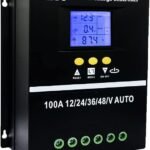
Your charge controller is the bridge between your solar panels and your battery bank. Get the voltage match wrong and you either fry the controller or waste a huge chunk of your solar harvest.
PWM controllers are simpler and cheaper. They work by connecting the panel directly to the battery and then switching the connection on and off to regulate charge. The panel voltage must be close to the battery voltage for a PWM controller to work efficiently.
A 12 volt nominal panel feeding a 12 volt battery is fine. But if you wire a high voltage grid tie panel into a PWM controller, you waste the extra voltage as heat.
MPPT controllers are smarter and more expensive. They convert excess voltage into additional charging current. An MPPT controller can take a 40 volt panel and efficiently charge a 12 volt battery.
That flexibility is a big deal. It allows you to wire panels in series for higher voltage strings, which means you can use thinner wire and reduce voltage drop over long runs.
| Controller Type | Panel Voltage vs Battery | Efficiency | Best Use Case |
|---|---|---|---|
| PWM | Must be close to battery voltage | 65 to 75 percent | Small systems, same nominal voltage |
| MPPT | Can be higher than battery voltage | 93 to 97 percent | Larger systems, mixed voltages, cold climates |
Here is the practical rule. If your panel Voc exceeds your battery voltage by more than about 50 percent, use an MPPT controller. If they are close in nominal voltage, a PWM controller is fine for a small budget system.
Aggregate user reviews confirm that MPPT controllers pay for themselves within a year on systems over 200 watts by recovering the energy that PWM would waste.
Check the maximum input voltage rating on your charge controller before you wire anything. That rating is based on the coldest temperature your site will see, not the datasheet Voc at 25 degrees Celsius. Our solar panel buying guide includes a step by step string sizing calculator for this exact reason.
5 Common Voltage Mistakes That Damage Equipment or Waste Money
Most solar problems trace back to one of these five voltage errors. Avoid these and your system will run reliably for years.
Mistake 1: Using an MPPT controller but wiring panels for 12 volts. You lose the main advantage of MPPT. Wire panels in series to raise voltage and let the MPPT do its job converting that extra voltage into current. Keeping panels at 12 volts with an MPPT controller wastes efficiency you already paid for.
Mistake 2: Ignoring the temperature coefficient of Voc. This is the cold weather trap we covered earlier. Every winter a handful of DIY builders blow their inverters because they sized based on the datasheet number without correcting for temperature. Use the lowest recorded temperature for your area and calculate the maximum Voc before you buy equipment.
Mistake 3: Mixing panels with different voltages in the same string. If you wire a 40 volt panel in series with a 30 volt panel, the lower voltage panel becomes a bottleneck. It limits the current of the entire string. The 40 volt panel never reaches its potential.
Stick to panels with matching specs in each series string.
Mistake 4: Undersizing wire for the current. Higher voltage allows thinner wire. But if you wire in parallel and drop the voltage, current goes up. That higher current needs thicker wire.
Use a voltage drop calculator with your actual system voltage and run length. We cover wire sizing in the next section.
Mistake 5: Exceeding the inverter input voltage limit. Inverters have a maximum DC input voltage and a startup voltage threshold. Your array Voc at the coldest temperature must stay below the inverter maximum. And your array Vmp under load must stay above the startup threshold or the inverter never turns on.
Design for both numbers.
Safe Practices for Measuring and Verifying Panel Voltage
Sometimes you need to verify what your multimeter tells you. A voltage reading can confirm that a panel is healthy, that wiring is correct, or that a problem exists in the string.
What you need. A digital multimeter rated for at least 600 volts DC. Most cheap multimeters handle this. Gloves rated for the voltage you are measuring.
Safety glasses.
How to measure Voc. Set your multimeter to DC voltage. Make sure the panel is in full sun or as close to it as possible. Touch the red probe to the positive MC4 connector and the black probe to the negative connector.
Read the number on the display. It should match the panel datasheet Voc within a few percent.
How to measure Vmp. You need a load on the panel to measure Vmp. A charge controller connected to a battery or a test load provides that. Measure voltage at the input terminals of the charge controller while the system is running and the sun is strong.
This reading is lower than Voc and should be close to the datasheet Vmp.
Safety warning. Solar panels produce DC voltage even in low light. A cloudy day still delivers a serious shock hazard. Always disconnect panels from the charge controller before working on wiring.
Cover panels with an opaque cloth if you need to work on connectors while the sun is out.
Troubleshooting a low voltage reading. If Voc is significantly lower than the datasheet value, check for shading, dirty panels, or a failed bypass diode inside the junction box. If Voc reads zero, the panel may have an internal break. If Voc is normal but Vmp is very low, you may have a wiring issue or a bad connector creating resistance in the circuit.
Sizing Wire for Voltage Drop Without Guessing
Wire sizing is not exciting. But undersized wire steals power you already generated and can become a fire hazard. The math is straightforward.
Voltage drop is the loss of voltage that happens as current travels through resistance in the wire. Longer runs and higher currents increase voltage drop. Higher voltage reduces voltage drop for the same power level.
The industry standard is to keep voltage drop under 3 percent for the DC side of a solar system. For a 12 volt system, 3 percent is only 0.36 volts. That is not much margin.
For a 48 volt system, 3 percent is 1.44 volts. Much more forgiving.
| System Voltage | 3 Percent Drop Allowed | 10 Amp Load at 50 Feet |
|---|---|---|
| 12V | 0.36V | 10 AWG |
| 24V | 0.72V | 12 AWG |
| 48V | 1.44V | 14 AWG |
The table above shows why higher voltage systems use less copper. At 48 volts, you can run 14 gauge wire for that same load and stay within the 3 percent drop. At 12 volts, you need 10 gauge wire.
Use a voltage drop calculator for your specific run length and current. Input the wire length round trip (both positive and negative runs), the current in amps, and the system voltage. It tells you the minimum wire gauge.
Then go up one size as a safety margin.
Ampacity is a separate concern. The wire must handle the current without overheating. The National Electrical Code (NEC) publishes ampacity tables for different wire types and insulation ratings.
For outdoor solar runs, use PV wire or THWN rated for sunlight and wet locations.
When to Call an Electrician or Solar Pro
Some voltage problems are easy to fix yourself. Others require a licensed professional. Knowing the difference protects your equipment and your home.
Call a pro if any of these apply to you:
- Your system voltage exceeds 50 volts DC. Once you stack panels in series, voltage climbs quickly. Anything over 50 volts is a serious shock hazard. At 150 volts and above, arc flash becomes a real risk.
- You are connecting to the utility grid. Grid tied systems require permits, inspections, and interconnection agreements. A licensed electrician handles the AC side and the utility disconnect.
- Your roof has complex penetrations or multiple planes. Running conduit, sealing roof penetrations, and grounding properly takes experience. Mistakes here cause leaks or fire.
- You are unsure about your string sizing calculations. If you cannot verify that your Voc at lowest temperature stays under your equipment limits, get a second set of eyes on the math. Blowing an inverter costs more than a consultation.
- Your local jurisdiction requires a permit and a licensed installer. Many areas do not allow homeowners to pull permits for solar work. Check with your building department before you start.
What you can handle yourself safely. Measuring Voc with a multimeter on a disconnected panel. Running wire through conduit on the ground before it reaches the roof. Mounting panels on ground racks.
Cleaning panels. Monitoring the system once it is installed and operating.
A good solar pro will review your voltage calculations and wire sizing for a modest fee even if you install the system yourself. That is a cheap insurance policy compared to the cost of replacing fried electronics.
Quick Reference: Typical Voltage Values for Common Panel Types
Here is a practical reference for the most common residential panel sizes you will encounter. Use these numbers for initial planning but always verify against the actual datasheet for your specific model.
| Panel Wattage | Typical Voc (STC) | Typical Vmp (STC) | Best String Size for 48V Battery |
|---|---|---|---|
| 100W to 150W | 18V to 22V | 15V to 18V | 3 to 4 in series |
| 200W to 300W | 32V to 40V | 26V to 33V | 2 to 3 in series |
| 350W to 450W | 40V to 50V | 33V to 42V | 2 in series |
| 500W to 600W | 45V to 55V | 37V to 46V | 2 in series (check Voc carefully) |
For a 12 volt battery bank, a single 100W panel with a Voc around 20 volts works well with an MPPT controller. For a 48 volt system, two 400 watt panels in series gives you roughly 80 to 100 volts, which is well within the input range of most MPPT controllers.
Keep these numbers handy when you are shopping. A quick glance at the Voc tells you if your charge controller can handle it. And a quick check of Vmp tells you if you have enough voltage to start charging your batteries on a warm day.
Frequently Asked Questions
What is the difference between Voc and Vmp on a solar panel?
Voc is the open circuit voltage measured with no load attached. It is the highest voltage the panel can produce. Vmp is the voltage at maximum power, measured while the panel is delivering current to a load.
Vmp is always lower than Voc.
Can I use a 24 volt panel with a 12 volt battery?
Yes, but only with an MPPT charge controller. A PWM controller would waste the extra voltage as heat. The MPPT converts the higher voltage into additional charging current, which actually improves efficiency over a lower voltage panel.
What happens if my solar panel voltage is too high?
Exceeding the maximum input voltage of your charge controller or inverter can destroy the electronics instantly. The risk is highest in cold weather when Voc rises. Always calculate your string voltage using the lowest expected temperature for your location.
How do I measure solar panel voltage with a multimeter?
Set your multimeter to DC voltage. Connect the red probe to the positive MC4 connector and the black probe to the negative connector. Read the display while the panel is in full sun.
This gives you Voc. Compare it to the datasheet value to confirm the panel is healthy.
Should I wire my panels in series or parallel for higher voltage?
Wire in series to increase voltage. Series adds the voltage of each panel while keeping current the same. This is ideal for MPPT charge controllers and longer wire runs.
Use parallel wiring only if you need to keep voltage low for a PWM controller or to handle shading issues.
What is the maximum voltage for residential solar systems?
The National Electrical Code (NEC) limits residential systems to 600 volts maximum as of 2026. Commercial systems can go up to 1000 volts. Your inverter and charge controller will have their own lower maximum ratings that you must stay under.

Similar Posts