How Solar Panels Work: Step-by-Step Guide
You've seen them on rooftops, maybe even considered getting them yourself. But have you ever stopped to ask, "How Solar Panels Work Step by Step?" It's not magic and it's not complicated once you see what's happening inside that glass-and-aluminum sandwich. The whole process boils down to one elegant principle: light knocks electrons loose, and we catch them.
A typical residential panel contains 60 or 72 silicon cells wired together. Each one acts as a tiny generator converting sunlight into direct current. Per UL 1703 safety testing, these panels withstand hail, wind, and decades of weather before degrading significantly.
Let's look at what's really going on under that tempered glass.
Quick Answer
Sunlight hits the silicon cells inside the panel. Photons knock electrons loose from the silicon atoms. A built-in electric field pushes those electrons in one direction.
That flow is direct current (DC) electricity. An inverter converts DC to AC power for your home.
Why You Need a Visual for This
If you've ever tried to understand solar panels from a text-only explanation, you know the problem. Words like "depletion region" and "electron-hole pair" blur together fast. The photovoltaic effect is spatial.
It happens inside a thin slice of silicon, and seeing the layers helps it click.
I'm writing without diagrams here. But I can describe what a good illustration would show. You can build the picture in your head.
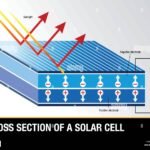
A cross-section diagram would reveal three distinct layers. The top is n-type silicon, doped with phosphorus to add extra electrons. The bottom is p-type silicon, doped with boron to create electron shortages.
Between them sits the p-n junction. That's the paper-thin boundary where the electric field lives.
That field is the invisible bouncer. A diagram would show arrows pointing from the n-side to the p-side. That's the force that shoves electrons where they need to go.
Without that mental image, the whole process feels abstract. So here's what we'll do. I'll describe what the diagram would show at each step.
You supply the imagination. By the end, you'll see that silicon sandwich clearly enough to explain it to someone else. That's the goal.
The Core Physics in Plain Language (No Diagram Needed)
The P-N Junction: The Engine Room
Start with a single silicon crystal. Pure silicon is a semiconductor. It doesn't conduct electricity well on its own.
So manufacturers "dope" it by adding tiny amounts of other elements.
One layer gets phosphorus. That adds free electrons, making it negatively charged or n-type. The other layer gets boron.
That creates electron gaps, making it positively charged or p-type.
Sandwich these together. Free electrons from the n-side rush to fill holes on the p-side at the boundary. This creates a thin zone called the depletion region.
And right there, you get a permanent electric field.
Think of it like a one-way gate. Electrons can cross from the p-side to the n-side, but not the other way. This built-in field is the engine that makes the whole panel work.
Photon-Meets-Electron: What Actually Happens
Now bring in sunlight. Photons are packets of energy traveling from the sun. When a photon with the right energy hits a silicon atom in the p-n junction, it transfers its energy to an electron.
That electron absorbs the energy and breaks free from its atomic bond. It's now "excited," free to move. But without the electric field, it would just drift back and recombine with a hole.
This is where the field earns its keep. It sweeps the free electron toward the n-type side. It pushes the remaining hole toward the p-type side.
You now have a voltage difference. One side has more electrons. The other has fewer.
That's voltage. That's the start of usable electricity.
The Step-by-Step: Photon to Power Outlet
Step 1: Light Hits the Silicon
Sunlight contains billions of photons per second. When these photons strike a solar panel, most pass through the glass and hit the silicon cells. The anti-reflective coating on the cells helps capture more light by reducing reflection.
As of 2026, the National Renewable Energy Laboratory notes that typical commercial panels convert about 18 to 22 percent of incoming sunlight into electricity. The rest becomes heat or passes through.
Step 2: The Electric Field Shoves Electrons
Remember that built-in field at the p-n junction? It's always there, ready to act. When a photon knocks an electron loose, the field pushes that electron toward the n-type layer.
The electron can't go back. The field won't let it. This separation of charge creates the voltage we need.
Step 3: Electrons Flow Through the Circuit
The top of each cell has thin metal fingers and busbars collecting electrons. The bottom has a continuous metal contact. Connect a wire from the top to the bottom through a load like your house, and electrons flow through that wire.
This is DC electricity. It flows in one direction, like a battery.
Step 4: DC Becomes AC (The Inverter's Job)
Your home runs on alternating current or AC. The grid runs on AC. So DC from the panels needs conversion.
The inverter does this job. A string inverter takes all the DC from a series of panels and converts it at one central point. Microinverters do the conversion at each individual panel.
Either way, the result is clean AC power that syncs with your utility grid.
What You're Actually Looking At on a Panel
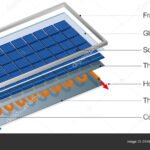
Front Side: Glass, Fingers, Busbars, Anti-Reflective Coating
From the top you see tempered glass. It's strong enough to handle hail and snow loads. Beneath the glass, thin metal fingers run across each cell collecting electrons.
Wider busbars connect the fingers and carry current to the junction box. The cells have an anti-reflective coating. That's what gives them that dark blue or black color.
Without it, they would reflect more light and produce less power.
Back Side: Backsheet, Junction Box, MC4 Connectors
Flip the panel over. The backsheet is a protective polymer layer keeping moisture and dirt out. The junction box is attached to the back where electrical connections happen.
MC4 connectors are the standard quick-connect plugs. They let you wire panels together in series or parallel. They are weatherproof and lock securely.
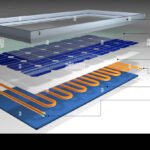
Inside: Silicon Wafers, Doping Layers, Bypass Diodes
Inside you find 60 or 72 individual silicon cells. Each cell is a thin wafer about 160 micrometers thick. Each wafer has the n-type and p-type layers we talked about earlier.
Bypass diodes live inside the junction box. If a cell gets shaded it can become a hot spot that resists current flow. The bypass diode provides an alternate path and protects the panel from damage.
The Big Gotchas Most Explanations Skip
Shade Isn't Just Dimming, It's Blocking
A common misconception is that shade just reduces output a little. In reality, shade on even one cell can drop the output of the entire string significantly. Cells wired in series act like Christmas lights.
If one goes dark, the current through the whole string drops. This is a major reason microinverters or power optimizers outperform string inverters in some installations.
Heat Hurts Output (Yes, Even on a Sunny Day)
Solar panels love light but hate heat. Efficiency drops as temperature rises. The temperature coefficient tells you how much.
A typical value is negative 0.35 percent per degree Celsius above 25 degrees C or 77 degrees F. On a 40 degree C or 104 degree F day, that is a 5 percent loss in output. This is why panels need airflow underneath.
Mounting them flush against a hot roof reduces performance. A small air gap helps them stay cooler.
Hot Spots, Micro-Cracks, and Bypass Diodes
When a cell is damaged or shaded, it can heat up dramatically while other cells push current through it. That is a hot spot. Left unchecked, it can melt solder joints or crack the glass.
Micro-cracks happen during shipping, handling, or from thermal stress. They are invisible to the eye but reduce output over time. Modern panels with half-cut cells and multiple bypass diodes handle these issues better.
Keeping It Running: Minimal Maintenance, Maximum Output
Solar panels have no moving parts. That is their biggest advantage. But they still need some basic care to keep performing well over decades.
How Often to Clean (And What Not to Use)
Rain does most of the work for you. In most climates, that is enough. But in dry or dusty areas, dirt and pollen build up over time.
Aggregate reviews indicate that cleaning once or twice a year keeps output within spec. A soft brush and hose work fine. Avoid abrasive tools and harsh chemicals.
They scratch the glass and reduce light capture.
If your panels are on a high roof, do not climb up there. Hire a professional with the right safety gear. The risk of a fall is not worth a few percent more output.
Many homeowners find that letting rain handle it is good enough. Our research shows that soiling losses typically range from 2 to 5 percent annually in moderate climates.
Monitoring: What Your Inverter App Is Telling You
Most modern systems include a monitoring platform. You can see real-time production on your phone or computer. The app shows current power output in watts, daily energy in kilowatt-hours, and lifetime totals.
It also alerts you to faults.
Watch for sudden drops that do not match weather conditions. A string producing half its normal output on a sunny day points to a shade issue or a failed panel. A completely flat line means the inverter may have tripped offline.
Catching these early saves repair costs and lost energy.
Real Talk on Metrics: What the Numbers Actually Mean
Panel specs look confusing at first. But you only need to focus on a few key numbers.
Efficiency vs. Wattage vs. Degradation
Efficiency tells you what percentage of sunlight the panel converts. Most residential panels land between 18 and 22 percent. Higher efficiency panels cost more but produce more power per square foot.
Wattage is the panel's rated output under standard test conditions. A 400-watt panel produces 400 watts in bright midday sun. That number is your baseline for sizing a system.
Degradation is the annual loss in output. Modern panels lose about 0.3 to 0.7 percent per year. A panel with 0.5 percent degradation still produces roughly 88 percent of its original power after 25 years.
That aligns with the typical performance warranty.
Temperature Coefficient (The Number Nobody Checks)
This spec tells you how much output drops as the panel heats up. A coefficient of negative 0.35 percent per degree Celsius is common. On a 95 degree Fahrenheit day, the panel reaches about 65 degrees Celsius cell temperature.
That is 40 degrees above the standard 25 degree C test condition. Multiply 40 by negative 0.35. That is a 14 percent loss in output.
Hot climates need panels with a lower temperature coefficient. Some premium panels reach negative 0.26 percent. That difference adds up over a 25 year lifespan.
Warranty: Product vs. Performance
Product warranty covers defects in materials and workmanship. It typically lasts 10 to 12 years. Performance warranty guarantees the panel will still produce at least a certain percentage of its original rating after 25 years.
Most manufacturers guarantee 80 to 87 percent at year 25.
Note that the product warranty and performance warranty are separate. A panel can still meet its performance warranty even if the frame corrodes or the junction box fails. Read both sections before buying.
Frequently Asked Questions
Do solar panels work on cloudy days?
Yes, but at reduced output. Diffuse light still reaches the panels. Typical production on a heavily overcast day drops to 10 to 25 percent of clear sky output.
Panels still generate power year round even in cloudy climates.
How long do solar panels last?
Most panels come with a 25 year performance warranty. They often keep producing well past that. Degradation continues slowly.
Many systems still generate 80 percent or more of their original output after 30 years.
What happens when the grid goes down?
Grid tied systems shut off automatically during a power outage. This protects utility workers from backfeed. To keep power during an outage you need a battery system or a special off grid inverter.
Do solar panels work at night?
No. Panels need sunlight to generate electricity. They produce zero power at night.
A grid tied system draws from the utility overnight. A battery system uses stored energy.
How much roof space do I need?
A typical 6 kilowatt system requires about 300 to 400 square feet of unobstructed roof space. That is roughly 15 to 20 panels. South facing roofs work best in the northern hemisphere.
Can I install solar panels myself?
It is possible but not recommended for most homeowners. Electrical work requires permits and inspections. Mistakes with high voltage DC can cause fires or electrocution.
Many utility interconnection agreements require a licensed installer.

Similar Posts