100Ah Battery Charge Time: 300W Solar Panel

The question of how long to charge 100ah battery with 300w solar panel is one of the most common we hear from people building small off-grid systems. It looks like simple math at first glance. Just divide capacity by wattage and you get a neat number, right?
But the real answer shifts dramatically depending on four key variables that most beginners miss.
Our research draws on manufacturer specifications and solar industry standards to give you a grounded answer. As of 2026, the most realistic range for a full charge under good conditions is 4 to 8 hours. With a less ideal setup that window can stretch to 10 to 16 hours.
The reason for that huge gap comes down to four factors we will walk through step by step.
Image source: YouTube / Watt's Next? (YouTube thumbnail, fair-use with source credit)
Quick Answer
Charging a 100Ah battery with a 300W solar panel takes 4 to 8 hours in optimal sun. This assumes a lithium battery, an MPPT controller, and 5 peak sun hours. A lead-acid battery with a PWM controller can take 10 to 16 hours.
Your specific conditions change the number significantly.
The Real Answer Depends on These 4 Variables
There is no single answer to this question. The time shifts based on four interconnected factors that each affect how much usable power reaches your battery.
Here is what controls your charge time:
- Battery chemistry, Lithium batteries accept power faster than lead-acid.
- Charge controller type, MPPT controllers capture up to 30 percent more energy than PWM.
- Depth of discharge, A battery at 50 percent charges much faster than one at 20 percent.
- Available sunlight, Peak sun hours vary wildly by location and season.
| Variable | Impact on Charge Time |
|---|---|
| Battery chemistry | Up to 50 percent difference |
| Charge controller | 20 to 30 percent efficiency gap |
| Depth of discharge | 2 to 6 hours depending on starting level |
| Sunlight hours | 2x to 4x difference between summer and winter |
Each variable multiplies the effect of the others. That is why two people with the same panel and battery can get wildly different results. The rest of this guide walks through each factor so you can calculate your own realistic number.
How Solar Charging Actually Works (300W Panel + 100Ah Battery)
Understanding the charging process helps you see why these variables matter. Your solar panel produces DC electricity when sunlight hits it. That power flows through a charge controller, which regulates voltage and current before sending it to the battery.
The Three Charging Stages
Most charge controllers use a three-stage process for lead-acid batteries. Lithium batteries skip the final stage.
Bulk charge, The controller sends maximum current to the battery. This is the fastest stage. For a 300W panel feeding a 100Ah battery, bulk charge current typically runs between 15 and 25 amps depending on your controller.
Absorption, Voltage reaches its peak (around 14.4 to 14.8 volts for a 12V system). Current tapers down as the battery fills. This stage adds 1 to 2 hours for lead-acid batteries.
Float, Voltage drops to a maintenance level (around 13.2 to 13.6 volts). This keeps the battery topped off without overcharging.
Why Panel Wattage Does Not Tell the Whole Story
A 300W panel produces 300 watts only under ideal lab conditions. In the real world, you lose power from heat, wiring resistance, controller inefficiency, and panel angle. Using the fundamentals of how panels work helps you set realistic expectations.
Image source: YouTube / Scott's Solar (YouTube thumbnail, fair-use with source credit)
Variable #1: Battery Type — Lead-Acid vs LiFePO4
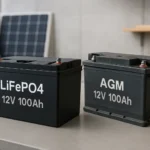
Your battery chemistry is the single biggest factor in charge time. Lithium iron phosphate (LiFePO4) batteries accept charge much faster than lead-acid. They also tolerate deeper discharge without damage.
| Factor | Lead-Acid (AGM/Flooded) | Lithium (LiFePO4) |
|---|---|---|
| Usable capacity | 50 percent DoD max | 80 to 100 percent DoD |
| Absorption phase | Required (1-2 hours) | Not required |
| Charge efficiency | 80 to 85 percent | 95 to 98 percent |
| Full charge time with 300W panel | 6 to 10 hours | 4 to 6 hours |
Why Lead-Acid Takes Longer
Lead-acid batteries enter an absorption phase once they hit about 80 percent state of charge. Current drops significantly during this stage. The charger then holds voltage steady while the battery slowly fills the remaining capacity.
That last 20 percent can take as long as the first 80 percent.
Why Lithium Is Faster
Lithium batteries do not need an absorption phase. They accept a constant current right up to full charge. A BMS (battery management system) handles the final cutoff.
This eliminates the long tail end that plagues lead-acid charging.
The Depth of Discharge Difference
Lead-acid batteries should not be discharged past 50 percent. That means you only have about 50Ah of usable capacity. Lithium batteries can safely go to 80 or even 100 percent DoD, giving you 80Ah or more of usable power.
The trade-off is that charging from a deeper discharge takes longer regardless of chemistry.
If you are still deciding between the two, weighing the pros and cons of each chemistry will help you choose.
Variable #2: Charge Controller — MPPT vs PWM
Your charge controller acts as the brain of the system. It decides how much of your panel's power actually reaches the battery. The type you use creates a major difference in charge time.
PWM Controllers
PWM (Pulse Width Modulation) controllers act like a switch. They connect the panel directly to the battery and pulse the connection to regulate voltage. The problem is that a 300W solar panel typically operates at 30 to 40 volts.
A PWM controller drops that down to battery voltage (12 to 14 volts). The excess voltage is simply lost.
PWM efficiency for a 300W panel feeding a 12V battery runs around 70 to 78 percent. That means you effectively lose 60 to 90 watts before the power even reaches your battery.
MPPT Controllers
MPPT (Maximum Power Point Tracking) controllers are smarter. They actively track the panel's optimal voltage and convert the excess voltage into additional current. This boosts efficiency to 95 percent or higher.
| Controller Type | Real-World Efficiency | Current into 12V Battery | Charge Time for 100Ah (5 PSH) |
|---|---|---|---|
| PWM | 70 to 78 percent | 15 to 18 amps | 7 to 9 hours |
| MPPT | 93 to 98 percent | 22 to 25 amps | 4 to 6 hours |
Which One Should You Use?
If you already own a PWM controller, it works fine for small systems. Just plan for a longer charge time. If you are planning your purchase carefully, an MPPT controller pays for itself in faster charging and better performance in low light.
The difference is especially noticeable on cloudy days or in winter. An MPPT controller can still produce useful current when a PWM controller would barely register.
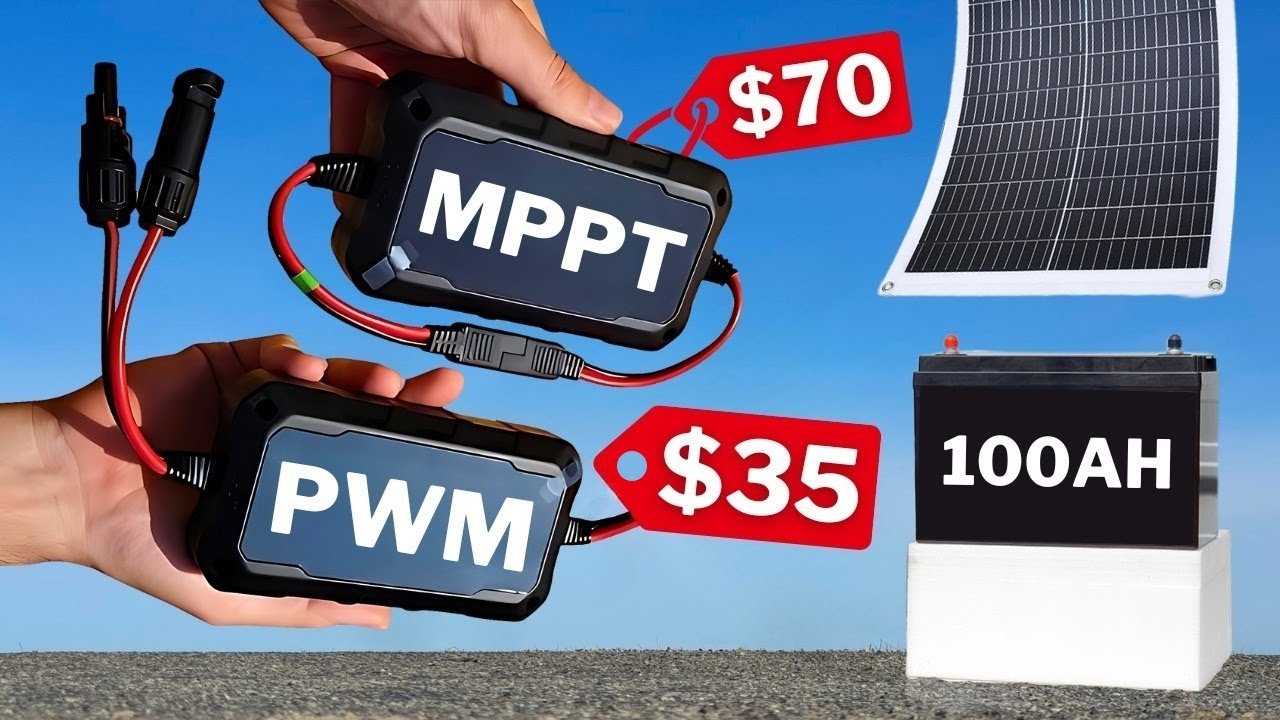
Image source: YouTube / The One Good Road (YouTube thumbnail, fair-use with source credit)
Variable #3: Depth of Discharge — How Empty Is Your Battery?
Depth of discharge (DoD) measures how much capacity you have used. A fully charged battery is at 0 percent DoD. A battery at 50 percent DoD is half empty.
This matters because charging slows down as the battery fills.
Why It Matters for Charging Time
Charging from a deeper discharge takes longer for two reasons. First, you have more amp-hours to replace. Second, lead-acid batteries spend more time in the absorption phase when starting from a lower state of charge.
| Starting DoD | Usable Capacity to Replace | Approximate Charge Time (Lithium, MPPT, 5 PSH) |
|---|---|---|
| 30 percent | 30Ah | 2 to 3 hours |
| 50 percent | 50Ah | 4 to 5 hours |
| 80 percent | 80Ah | 6 to 8 hours |
The Lead-Acid Penalty
Lead-acid batteries compound this issue. At 50 percent DoD, you have used only 50Ah, but you can only replace that amount safely. If your lead-acid battery hits 80 percent DoD, you may shorten its lifespan significantly.
Practical Advice
Know your starting voltage before you plug in. A 12V lead-acid battery at 12.1 volts is roughly 50 percent discharged. A lithium battery at 13.0 volts resting is around 50 percent.
Check your battery voltage with a multimeter or your charge controller display before calculating charge time.
If you typically run your battery down to 80 percent DoD with lithium, expect a full workday of good sun to recharge. If you only use 30 percent of your capacity each day, you may be fully charged by lunchtime.
Variable #4: Sunlight Hours – The Biggest Variable
This factor can change your charge time more than any other. A 300W panel in Arizona summer produces vastly more energy than the same panel in Seattle winter.
What Are Peak Sun Hours?
A peak sun hour (PSH) is one hour where solar irradiance averages 1000 watts per square meter. That is the standard test condition for panel ratings. In reality, sunlight intensity changes throughout the day.
Morning and evening light produces far less power than midday.
The total daily PSH for a location tells you how many hours of full-strength sun you get aggregated across the day.
| Location | Summer PSH | Winter PSH | Average Annual PSH |
|---|---|---|---|
| Phoenix, AZ | 7.0 to 7.5 | 4.5 to 5.0 | 6.0 to 6.5 |
| Seattle, WA | 5.5 to 6.0 | 1.0 to 1.5 | 3.5 to 4.0 |
| London, UK | 4.5 to 5.0 | 0.5 to 1.0 | 2.5 to 3.0 |
| Sydney, AU | 5.5 to 6.0 | 4.0 to 4.5 | 4.5 to 5.0 |
How PSH Affects Your Charge Time
A 300W panel produces roughly 300 watt-hours per peak sun hour after accounting for real-world losses. Multiply that by your local PSH to get daily energy.
At 5 PSH, you get about 1500 watt-hours daily. A 100Ah battery at 12V holds 1200 watt-hours. In theory that is a full charge in one day.
At 2 PSH you get about 600 watt-hours. That is only half a charge.
Seasonal Shifts Matter
Your winter charge time could be three times longer than summer. If you rely on solar year-round, size your system for the worst month. A 300W panel that fully charges your battery in June may only reach 40 percent in December.
Always check the NOAA solar insolation data for your specific coordinates before planning your system.

Image source: Wikimedia Commons / Merikanto
The Simple Formula to Calculate Your Exact Charge Time
You can estimate your own charge time with a straightforward calculation. It accounts for your specific variables and gives a far more accurate result than guessing.
The Formula
Charge time (hours) = (Battery capacity in Ah × Depth of discharge × System voltage) ÷ (Panel wattage × PSH × System efficiency)
Let us break that down with real numbers for a common scenario.
Example: Lithium Battery with MPPT Controller
Assume a 100Ah lithium battery at 50 percent DoD, a 300W panel, 5 PSH, and 93 percent system efficiency.
(100Ah × 0.5 × 12V) ÷ (300W × 5 × 0.93)
600 watt-hours needed ÷ 1395 watt-hours daily production = 0.43 days
Multiply 0.43 × 5 hours = about 2.2 hours of charging time.
That seems fast because three variables work in your favor. Low DoD, high PSH, and high efficiency.
Example: Lead-Acid Battery with PWM Controller
Assume a 100Ah lead-acid battery at 50 percent DoD, a 300W panel, 4 PSH, and 75 percent efficiency.
(100Ah × 0.5 × 12V) ÷ (300W × 4 × 0.75)
600 watt-hours needed ÷ 900 watt-hours daily production = 0.67 days
Multiply 0.67 × 4 hours = about 2.7 hours of bulk charge.
Then add 1 to 2 hours for the absorption phase. Your total is 4 to 5 hours.
The Absorption Phase Adjustment
The formula works well for lithium batteries because they accept current through the full charge cycle. Lead-acid batteries need the extra absorption time added afterward. Our research suggests planning for 1.5 hours minimum in absorption for most lead-acid batteries.
Real-World Scenarios: What You Can Expect
Theory is helpful, but real numbers from different setups show the practical range.
Scenario One: Best Case
You live in the US Southwest. You have a 100Ah LiFePO4 battery, an MPPT controller, and you discharge to 50 percent. In July you get 7 PSH.
Your bulk charge completes in about 1.5 hours. No absorption phase needed. Total charge time is under 2 hours.
You can fully recharge during the morning and run loads on solar the rest of the day.
Scenario Two: Average Case
You live in a temperate region with 4 to 5 PSH. You use a 100Ah AGM battery, an MPPT controller, and discharge to 50 percent.
Bulk charging takes about 3 hours. Absorption adds 1.5 hours. Total is 4.5 to 5 hours.
Your battery reaches full charge by midafternoon on a clear day.
Scenario Three: Worst Case
You live in the Pacific Northwest with 2 PSH in winter. You have a 100Ah flooded lead-acid battery, a PWM controller, and discharge to 50 percent.
Daily production is about 450 watt-hours. Your battery needs 600 watt-hours for a full charge. You cannot fully recharge in one day.
After two days of partial charging, your battery may stay in absorption for extended periods. This condition can sulfate the battery over time.
| Scenario | Battery | Controller | PSH | Charge Time |
|---|---|---|---|---|
| Best | LiFePO4 | MPPT | 7.0 | 1.5 to 2 hours |
| Average | AGM | MPPT | 4.5 | 4.5 to 5 hours |
| Worst | Flooded | PWM | 2.0 | 2+ days partial |
When to Add More Panel
If your scenario looks like the worst case, add another 300W panel in parallel. That doubles your charging current and compensates for poor winter sun. A second panel also helps if you discharge your battery deeper than 50 percent regularly.
Common Mistakes That Kill Your Charging Speed
Several errors routinely slow down solar charging. Avoiding them saves you hours of waiting.
Mistake One: Using a PWM Controller with High-Voltage Panels
A 300W panel has a nominal voltage of 30 to 40 volts. A PWM controller drops that to battery voltage and wastes the difference. You lose up to 30 percent of your panel capacity.
If you already own a PWM controller, look for panels with a VMP close to 18 volts. That minimizes the voltage drop waste. Better yet, invest in an MPPT controller if your budget allows.
Mistake Two: Parking the Panel Flat
Solar panels produce peak power when sunlight hits them at 90 degrees. A flat panel loses significant energy, especially in winter when the sun is lower.
Angle your panel toward the sun. In summer, tilt it to your latitude minus 15 degrees. In winter, tilt it to your latitude plus 15 degrees.
Adjust the angle seasonally for best results.
Mistake Three: Ignoring Shading
A single shaded cell can drop your panel output by 50 percent or more. Even a small shadow from a branch or antenna creates a disproportionate loss.
Mount your panel where it receives full sun from 10 AM to 4 PM minimum. That window covers the bulk of daily solar production. Trim nearby vegetation regularly.
Mistake Four: Undersized Wiring
Thin wires create voltage drop that robs power before it reaches your battery. At 20 amps and 12 volts, a 10-foot run of 10 AWG wire loses about 3 percent. A 16 AWG wire loses nearly 10 percent.
Use a voltage drop calculator for your specific run length. Keep losses under 3 percent for best performance.
How to Get the Most Out of Your 300W Panel
Small adjustments can add 20 to 30 percent more daily energy without spending a dollar on new equipment.
Adjust Your Panel Angle Regularly
A panel fixed at one angle only hits peak output for part of the year. Adjusting it four times per year aligns it with seasonal sun angles.
Spring and fall tilt to your latitude. Summer tilt 15 degrees less. Winter tilt 15 degrees more.
A simple adjustable mount costs little and pays for itself in extra energy.
Clean Your Panels
Dust, pollen, and bird droppings reduce output measurably. A study from the National Renewable Energy Laboratory found that dust accumulation can cut output by 25 percent in dry climates.
Wipe your panels with water and a soft cloth every few weeks. In dusty areas, clean them monthly. Never use abrasive cleaners or scrub hard enough to scratch the glass.
Use a Battery Monitor
A battery monitor with a shunt tracks energy going in and out of your battery. It shows your actual state of charge and tells you when charging is complete.
This tool eliminates guesswork. You can see exactly how much energy your panel delivered and how much your battery accepted. The data helps you fine-tune your system over time.
Reduce Your Load During Charging
Every watt your devices draw during daytime is a watt that does not charge your battery. If possible, run heavy loads like pumps or refrigerators during peak sun hours when the panel can power them directly.
This lets the full 300W output go toward charging during lower light periods. Your battery reaches full charge faster because it only needs to store leftover energy.
Understanding the core components of a solar setup helps you identify other optimization opportunities in your system.
Frequently Asked Questions
Can I charge a 100Ah battery with a 300W panel in one day?
Yes, in most conditions. With a lithium battery and MPPT controller, you typically finish in 4 to 6 hours of good sun. Even with lead-acid and PWM, one full sunny day usually gets you there if you start above 50 percent DoD.
What size charge controller do I need for a 300W panel?
A 30 amp controller works for a 300W panel on a 12V system. That gives you headroom above the maximum current of about 25 amps from an MPPT controller. A 20 amp controller works only with PWM since the current output is lower.
Do I need an MPPT controller or is PWM good enough?
PWM works if you are on a tight budget or have a small system. But you lose 20 to 30 percent of your panel power. MPPT pays for itself in faster charging and better low-light performance over the life of your system.
How long does a 300W panel take to charge a 100Ah battery from empty?
You rarely want to run a battery completely empty. Lead-acid batteries should not go below 50 percent DoD. Lithium can handle 100 percent DoD but takes longer.
From truly empty with lithium and MPPT, expect 6 to 8 hours in good sun.
Does panel angle really make a difference?
Yes, a big difference. A flat panel loses 15 to 25 percent of potential energy compared to an optimally angled one. The loss is worse in winter when the sun sits lower.
Adjusting your panel angle seasonally adds meaningful daily energy.
Your Decision Guide: What to Do Next
Start by checking your local peak sun hours using the NOAA solar insolation data. Then identify your battery chemistry and charge controller type. If you have a lead-acid battery with a PWM controller, plan for longer charge times and consider upgrading to MPPT when your budget allows.
If you find your system cannot keep up with your daily needs, adding a second 300W panel in parallel is the most effective upgrade. That doubles your charging current without changing your battery or controller.
Keep experimenting with panel angle and cleaning routine. The difference between a neglected setup and a well-tuned one can be several hours of charging time every day.

Image source: Wikimedia Commons / Wikimedia Commons contributor

Similar Posts