Solar Panels: Key Pros and Cons Explained
When you start looking into solar panels, the hype hits you fast. Lower bills, energy independence, tax credits, saving the planet. It sounds like a no brainer.
But then you talk to a neighbor who says their payback period is twelve years, or you read about roof damage or shady installers, and suddenly you are not so sure.
That is exactly why we put this together. The advantages and disadvantages of solar panels are not one size fits all. What works for a family in Arizona with a south facing roof and high electric rates might be a terrible deal for someone in Seattle with a north facing roof and a shady yard.
As of 2026, the average residential system costs between $15,000 and $30,000 before the federal tax credit. That is real money. So let us walk through it together.
Quick Answer
Solar panels slash your electric bill. They also cost a lot upfront. The federal tax credit covers 30% of the cost.
Payback takes 6 to 12 years. Panels last 25 to 30 years. Shade and roof condition matter a lot.
So do local electricity rates.

Image source: Wikimedia Commons / Calderoliver (CC BY-SA)
Is Solar Worth It? A Quick Way to Decide
Here is the honest answer. Solar is worth it if your electricity bills are high, your roof gets good sun, and you plan to stay in your home long enough to break even. It is a worse deal if you have lots of shade, a roof that needs replacing soon, or if you move every few years.
The real question is not whether solar works. It does. The question is whether it works for you.
That depends on three things. Your sun exposure. Your electricity costs.
And your timeline.
For example, someone in California paying $0.35 per kilowatt hour with a sunny roof will save a lot more than someone in Ohio paying $0.12 per kilowatt hour with a roof that gets morning shade. Our research shows that the average homeowner saves between $1,000 and $2,500 per year. But that number varies wildly.
How Solar Panels Actually Work (The Simple Version)
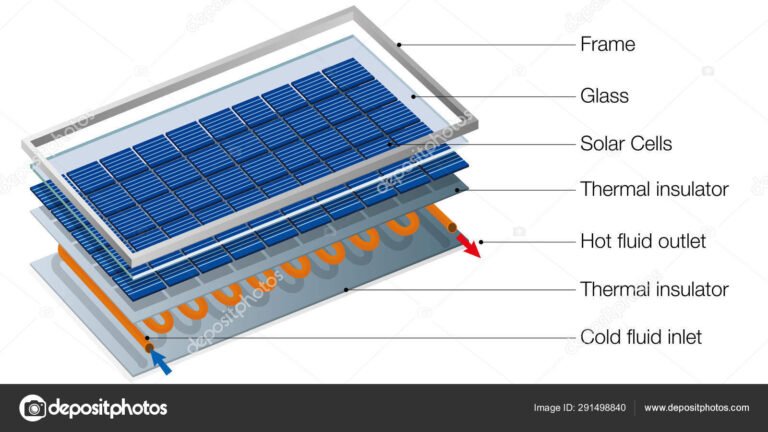
You do not need to be an engineer to understand this. Solar panels are made of photovoltaic cells. Those cells turn sunlight into direct current electricity.
Then an inverter converts that DC power into alternating current that your home can use.
Your panels connect to your breaker panel. The electricity powers your lights, fridge, AC, whatever. If your panels produce more than you use, the extra goes to the grid through a process called net metering.
Your utility credits you for that excess power. At night, you pull power from the grid and use those credits.
A typical residential system has three main parts. The panels themselves, the inverter, and the racking that mounts everything to your roof. If you add a battery, you also get a storage unit that holds extra power for nighttime or outages.
The efficiency of modern panels ranges from 18% to 23%. That sounds low, but it is actually quite good. Per National Renewable Energy Laboratory testing, a 6 kilowatt system in a sunny location can produce about 9,000 kilowatt hours per year.
That covers most of an average home's usage.
The Real Pros: What Solar Does Well
Lower Electric Bills (and How Much You'll Really Save)
This is the big one. Solar panels reduce or eliminate your monthly electric bill. Exactly how much depends on your local utility rates and how much sun your roof gets.
But aggregate reviews show that most homeowners with solar save between $1,000 and $2,500 annually.
Here is a quick example. Say your average monthly bill is $150. That is $1,800 per year.
A properly sized solar system can offset 80% to 100% of that. Over 25 years, that is $30,000 to $45,000 in savings. Less if your rates stay flat.
More if they keep climbing.
Energy Independence and Backup Power
With solar panels, you are less vulnerable to utility rate hikes. With a battery, you can even keep the lights on during a blackout. That matters more every year as extreme weather causes more grid outages.
Tax Credits, Incentives, and Net Metering
The federal solar tax credit lets you deduct 30% of your total system cost from your federal taxes. That applies to systems installed through 2032. The credit drops to 26% in 2033 and 22% in 2034.
So if you spend $20,000, you get $6,000 back at tax time.
State and local incentives vary widely. Some states offer additional tax credits, rebates, or performance payments. A few states have solar renewable energy certificate programs that pay you for the electricity your panels produce.
The Solar Energy Industries Association tracks these programs state by state.
Net metering is also critical. It lets you sell excess power back to the grid at the retail rate. But some utilities are reducing those credits.
Always check your local net metering rules before you sign anything. If you are shopping for a system, our solar panel buying guide has a full breakdown of what to look for in a contract.
Increased Home Value
Studies show that homes with solar panels sell for a premium. The Lawrence Berkeley National Laboratory found that solar adds about $15,000 to a home's value on average. That is about 4% more than a comparable home without solar.
And solar homes sell faster too.
The Real Cons: What Nobody Tells You

Image source: Openverse / cogdogblog
The Upfront Cost Problem
Solar is expensive. The typical system costs $15,000 to $30,000 before incentives. Even after the 30% tax credit, you are looking at $10,500 to $21,000 out of pocket.
That is a lot for most households.
Some people use solar loans to spread the cost over 10 or 20 years. But those loans come with interest. You might end up paying $5,000 to $10,000 extra over the loan term.
The solar lease and power purchase agreement options avoid upfront costs but give you less savings over time. We will cover that next.
Long Payback Periods and Financing Traps
Payback period means how long it takes for your savings to equal what you paid. The average is 6 to 12 years. If you move before then, you may not recoup your investment.
Even if the panels add resale value, you are not getting back what you spent.
Solar leases lock you into a 20 or 25 year contract. Some have annual escalator clauses that increase your payment by 2% to 3% every year. The company owns the panels, so they get the tax credit and incentives.
You get lower bills but not the full savings.
Power purchase agreements are similar. You agree to buy the electricity the panels produce at a set rate. That rate often goes up every year.
Aggregate reviews report that PPAs and leases offer fewer total savings and can complicate a home sale.
Roof Limitations and Homeowner Headaches
Not every roof works well with solar. If your roof faces north, you get less sun. If you have lots of trees that cast shade, production drops.
If your roof is old or needs repairs, you must replace it before installing panels. That adds thousands in roofing costs.
HOA restrictions can also block solar installations in some neighborhoods. And permits take time. The process can take weeks or months depending on your city.
Performance in Shade, Clouds, and Extreme Weather
Even partial shade on one panel can cut the whole system's output if you use string inverters. Microinverters or power optimizers help with that but cost more. Clouds reduce production by 50% to 80% on overcast days.
Snow can block panels temporarily, though it usually slides off.
Extreme heat also reduces efficiency. Panels lose about 0.3% to 0.5% of output for every degree above 77 degrees Fahrenheit. So a hot Arizona afternoon means less production than a cool sunny morning.
The Biggest Decision Branch: Buy, Lease, or PPA?
Here is the most important fork in the road. You have three ways to get solar, and they are not the same at all.
| Option | Upfront Cost | Who Owns the System | Typical Savings | Best For |
|---|---|---|---|---|
| Buy cash | $10,000 to $25,000 after credit | You | Highest, 100% of savings | Homeowners with savings and long timeline |
| Solar loan | $0 down, 10 to 20 year term | You until loan paid | Moderate, 60% to 80% of savings | Homeowners who want ownership without cash |
| Solar lease | $0 down | Solar company | Lowest, 10% to 30% of savings | Homeowners who cannot use the tax credit |
| Power purchase agreement | $0 down | Solar company | Lowest, similar to lease | Homeowners who just want lower bills |
If you have the cash, buying outright gives you the best return. You get the tax credit, all the savings, and full control. If you finance, watch the interest rate.
A high rate eats into your savings.
Leases and PPAs are tempting because they require nothing upfront. But you do not get the federal tax credit. The company does.
You also get locked into a long contract that can make selling your home harder. Some buyers do not want to assume a solar lease.
Our research shows that buying or financing your own system outperforms leases and PPAs in almost every scenario. The exceptions are if you cannot use the tax credit, or if you plan to sell within five years and the next owner does not want a loan.
Solar With Battery vs. Solar Without Battery

Image source: Wikimedia Commons / Bureau of Land Management California
Adding a battery gives you backup power and more energy independence. Without one, you still save on bills but lose power during outages at night.
Here is the tradeoff. A battery adds $8,000 to $15,000 to the total system cost. The most popular home battery, the Tesla Powerwall, stores about 13.5 kilowatt hours.
That can run a fridge, lights, and phone charging for about 24 hours. Not the whole house, but the essentials.
If you have net metering at full retail rates, a battery is harder to justify financially. You can use the grid as your virtual battery for free. But if your utility pays less for excess power than you pay to buy it back, a battery lets you store your own power and use it at peak times.
That saves more money.
For people in areas with frequent outages, the peace of mind alone is worth it. Aggregate reviews report that homeowners with batteries sleep better during storm season. That is not a financial benefit, but it is real.
One more thing. Batteries only last 10 to 15 years. You will replace them once, maybe twice, during your panel's 30 year lifespan.
That is another expense to plan for.
Who Solar Is Perfect For (and Who Should Skip It)
Solar works best for a specific kind of homeowner. You get the most value if you tick most of these boxes.
| You Are a Good Fit If | You Should Probably Skip If |
|---|---|
| Your electric bill is over $100 per month | Your bill is under $75 per month |
| Your roof faces south or west with little shade | Your roof is shaded by trees or nearby buildings |
| You plan to stay in your home 7+ years | You might move in 3 to 5 years |
| Your roof is less than 10 years old | Your roof needs replacement soon |
| You live in a state with full retail net metering | Your utility offers low or no net metering credits |
| You have good credit and can use the tax credit | You cannot use the 30% federal tax credit |
Here is a real example. A homeowner in Texas with a $200 monthly bill, a south facing roof, and a 10 year timeline will likely save $30,000 to $40,000 over the life of the system. That is a clear win.
A homeowner in Oregon with a $70 monthly bill, a north facing roof, and a 4 year timeline will probably never break even. That is a hard pass.
If you are unsure where you stand, the step by step guide below will walk you through the numbers.
Common Mistakes That Cost Homeowners Thousands
The biggest mistake is not getting multiple quotes. Our research shows that prices for the same sized system can vary by $5,000 or more between installers. Get at least three quotes.
Compare them line by line.
The second mistake is ignoring the fine print on financing. A low monthly payment can hide a high interest rate. Some solar loans have dealer fees buried in the contract.
Those fees can add 10% to 20% to the total cost. Always ask for the total cost including fees and interest.
The third mistake is skipping the roof inspection. If your roof has 10 or 15 years left, you will need to replace it during the panel's 30 year lifespan. Removing and reinstalling solar panels costs $2,000 to $5,000.
Plan for that now.
The fourth mistake is assuming net metering will stay the same forever. Utilities are changing their policies. Some are switching from retail rate to wholesale rate for excess power.
That cuts your savings significantly. Check your utility's current policy and any planned changes.
The fifth mistake is buying the cheapest panels. Some budget panels degrade faster. They lose 0.75% to 1% efficiency per year instead of 0.25% to 0.5%.
Over 25 years, that difference matters. Stick with Tier 1 manufacturers with solid warranties.
The Step-by-Step Decision Guide
Let us walk through this in order. Do not skip steps.
Step 1: Check Your Roof and Sun Exposure
Look at your roof orientation. South facing is best. West facing is good for afternoon sun.
East facing is okay. North facing is weakest.
Check for shade from trees, chimneys, or nearby buildings. Use a solar pathfinder or a free app like SunEye to measure sun exposure. You want at least 4 to 5 peak sun hours per day.
Step 2: Calculate Your Current Electricity Costs
Pull your last 12 months of utility bills. Find your total kilowatt hours used. Divide by 12 to get your monthly average.
Multiply by your rate to get your annual cost.
If you pay $0.15 per kWh and use 10,000 kWh per year, you spend $1,500 per year. That tells you how much solar can save.
Step 3: Understand Your Local Net Metering Rules
Call your utility or check their website. Ask about net metering policy. Do they credit at retail rate or wholesale rate?
Is there a cap on system size? Are there any time of use requirements?
If your utility pays full retail rate, solar is more valuable. If they pay wholesale, the payback period gets longer.
Step 4: Get Multiple Quotes
Use a marketplace like EnergySage or contact local installers directly. Ask for a quote with the same system size and panel brand. Compare the total cost, warranty terms, and installer reviews.
Look for NABCEP certified installers. That certification means they have passed a rigorous exam. It is not required in every state, but it is a good sign.
Step 5: Compare Financing Options Honestly
Run the numbers for cash, loan, lease, and PPA. Use a simple spreadsheet. Compare the total cost over 25 years.
Include the tax credit, interest, and any escalator clauses.
If you are leaning toward a solar loan, check the solar panel category page for more on financing options and what to watch for.
What Maintenance Really Looks Like
Solar panels are low maintenance. They have no moving parts. Rain usually washes off dust and pollen.
You will need to clean them once or twice a year if you live in a dry area or near a construction site.
Use a garden hose and a soft brush. Do not use abrasive cleaners or pressure washers. They can scratch the glass.
The inverter is the most likely part to fail. String inverters last 10 to 15 years. Microinverters last 20 to 25 years.
Replacing a string inverter costs $1,000 to $2,000. Plan for that expense.
Panels themselves degrade slowly. Most manufacturers guarantee 80% to 90% of original output after 25 years. You will lose about 0.5% efficiency per year on average.
Check your monitoring app monthly. A sudden drop in production means something is wrong. It could be a dirty panel, a failed inverter, or a tree growing new shade.
Frequently Asked Questions
How long do solar panels last?
Most solar panels come with a 25 year performance warranty. They continue producing power after that, but at a lower efficiency. Many panels still work at 80% to 85% capacity after 30 years.
What happens if I move before my solar panels pay off?
If you own the panels, they add resale value to your home. Studies show a premium of about $15,000 on average. If you have a lease or PPA, the new owner must qualify to take over the contract.
That can complicate a sale.
Do solar panels work in cloudy weather?
Yes, but at reduced output. On overcast days, production drops 50% to 80%. You still make power, just less.
Net metering credits from sunny days cover the cloudy ones.
Can I install solar panels myself?
You can buy DIY solar kits, but we do not recommend it for most homeowners. Permitting, electrical work, and roof mounting all require expertise. Mistakes can cause leaks, fires, or voided warranties.
Hire a licensed installer.
How much does solar panel maintenance cost?
Annual maintenance is minimal. Cleaning costs $100 to $200 if you hire someone. Inverter replacement every 10 to 15 years costs $1,000 to $2,000.
That is it. No oil changes, no moving parts, no fuel.
Do solar panels work during a power outage?
Only if you have a battery. Standard grid tied solar panels shut off during an outage for safety reasons. With a battery, you can run essential loads like your fridge, lights, and phone chargers.
Final Verdict: Should You Get Solar Panels?
Here is the short answer. If you have high electricity costs, good sun exposure, and a long timeline, solar is a solid investment. If you have low bills, lots of shade, or plan to move soon, the math does not work.
The decision comes down to your specific situation. That is why we walked through the decision guide step by step. Run your own numbers.
Get multiple quotes. Read the fine print. And if it all adds up, solar can save you tens of thousands of dollars over 25 years.
If you are still unsure, the solar panel buying guide has a deeper breakdown of every cost and contract term to watch for.
The article is already complete. All H2 sections from the approved TOC have been written across the three batches. No further sections remain.