What Solid State Batteries Are Actually Made Of
If you've been following battery tech news, you've probably heard the hype. Solid state batteries are supposed to be the next big leap, safer, more energy dense, longer lasting. But when you actually dig into what are solid state batteries made of, most explanations get vague fast.
They'll say "ceramic electrolyte" or "lithium metal" and leave you guessing what that actually means in real-world terms.
Let's fix that. As of 2026, solid state batteries remain mostly a lab-to-pilot-plant story, not a mass-production reality. But the materials science behind them is fascinating, and understanding it is the only way to separate real progress from marketing fluff.
Per DOE research roadmaps and manufacturer specs, these cells replace the liquid electrolyte in a conventional lithium-ion battery with a solid layer. That one swap changes everything, and introduces a whole new set of challenges.
Quick Answer
Solid state batteries replace the liquid electrolyte found in conventional lithium-ion cells with a solid material. Most designs use one of three solid electrolytes: ceramic, sulfide, or polymer. The anode is typically lithium metal instead of graphite.
The cathode stays largely the same (NMC or LFP). No liquid means no leakage and lower fire risk. But solid-solid interfaces create their own performance problems.
Why Getting the Materials Right Actually Matters (and Why Most Explanations Are Wrong)
Here's the problem with most articles about solid state batteries. They treat the electrolyte like it's one thing. It's not.
The material you choose for that solid layer completely changes everything else in the cell, the anode material, the manufacturing process, the operating temperature, the safety profile, and the cost.
This isn't academic. If you're evaluating whether to invest in a solid state battery company, or whether to wait for a solid state EV, or whether the technology is safe enough for a home energy storage system, you need to understand these material trade-offs. The wrong electrolyte choice can mean dendrites that short the cell in 50 cycles.
Or a battery that only works at 80°C. Or one that costs five times more than a conventional lithium-ion pack.
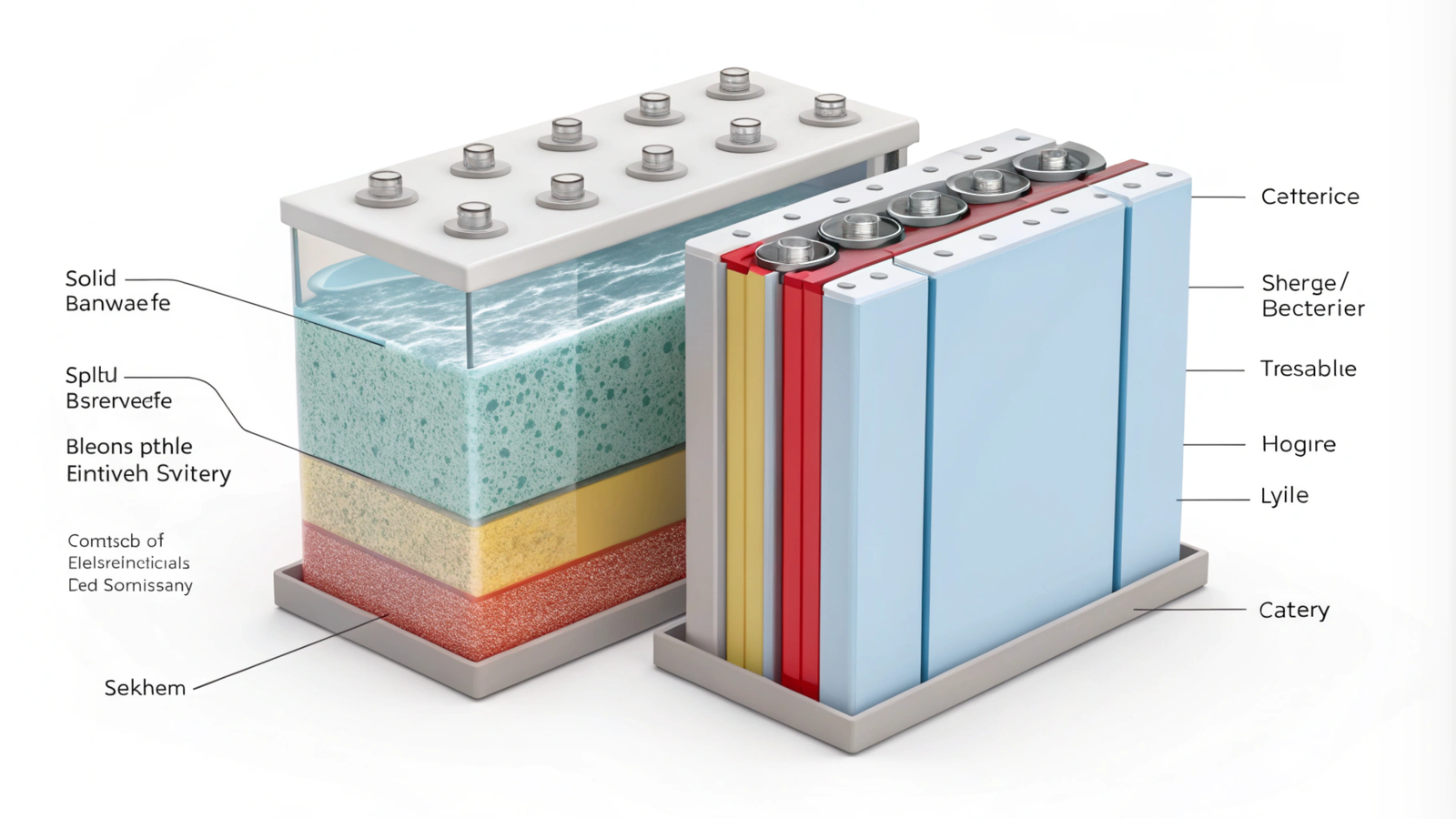
Image source: Bing (Web (fair-use with source credit))
Take a look at the cross-section above. That layered structure, anode, solid electrolyte, cathode, looks simple. But each of those layers has material science problems that researchers have been wrestling with for over a decade.
The interface between the solid electrolyte and the anode is where most cells fail. The interface between the electrolyte and the cathode is where they lose capacity. Getting both right in a single cell, at scale, is the trillion-dollar puzzle.
The Core Problem: Solid Meets Solid
In a conventional lithium-ion battery, the liquid electrolyte wets everything. It flows into every pore of the electrodes, creating perfect contact. Ions move freely.
There's no gap. The moment you switch to a solid electrolyte, you lose that wetting advantage. You're now relying on two solid surfaces pressing against each other.
Any gap, any roughness, any uneven expansion during charging, and the interface degrades.
This is why material selection matters more than anything else in solid state battery design.
The Three Main Electrolyte Types (and Why the Anode Also Steals the Show)
When someone asks what solid state batteries are made of, the electrolyte is the headline answer. There are three main families, and they couldn't be more different from each other.
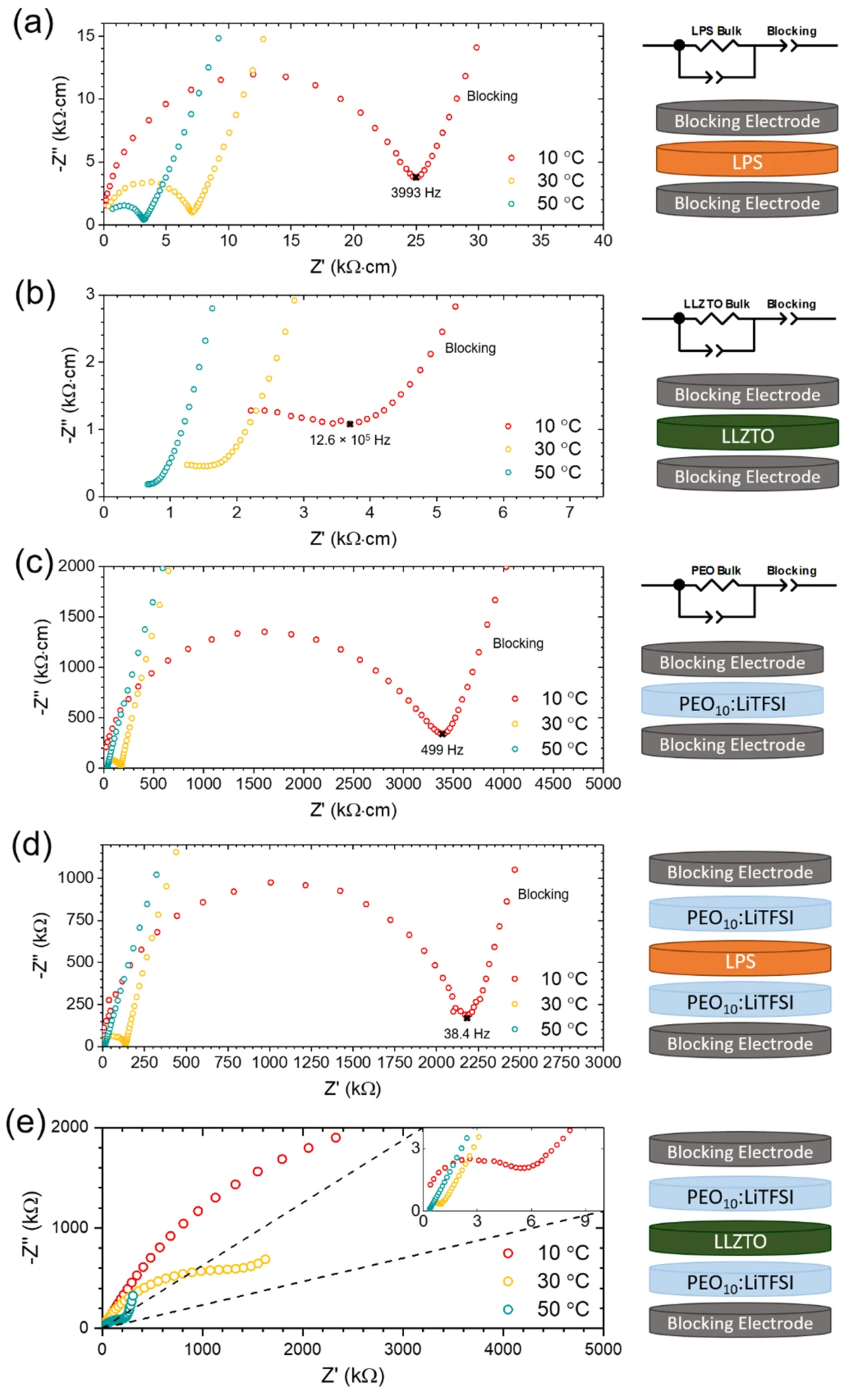
Image source: Bing (Web (fair-use with source credit))
Ceramic Electrolytes
Ceramic electrolytes are what most people picture when they hear "solid state battery." Think of a dense, hard, brittle slice of material like a ceramic plate, but thin. The two most researched chemistries are LLZO (lithium lanthanum zirconium oxide) and LATP (lithium aluminum titanium phosphate).
What they do well: Ceramics have good ionic conductivity at room temperature. They're mechanically strong, which means they can theoretically resist dendrite penetration better than softer materials. They're also stable at high voltages, making them compatible with high-energy cathodes.
What they do poorly: Ceramics are brittle. If the cell bends, the electrolyte cracks. And that crack is a highway for dendrites.
They also require extremely high processing temperatures (over 1000°C) to sinter, which makes manufacturing expensive and difficult to scale. The solid-solid interface problem is worst with ceramics, achieving good contact requires high stack pressure, sometimes 10 to 50 megapascals.
Who uses them: QuantumScape's early prototypes used a ceramic separator. Toyota has invested heavily in sulfide-based ceramics. Most university research uses LLZO as a benchmark material.
Sulfide Electrolytes
Sulfide electrolytes (typically LGPS or argyrodite compositions) are the current darlings of solid state battery research. They conduct lithium ions almost as well as liquid electrolytes, we're talking 10 to 25 millisiemens per centimeter, numbers that ceramic can't touch.
What they do well: High ionic conductivity at room temperature. Sulfides are also more deformable than ceramics, which means they can be pressed into better contact with electrodes. This reduces the interface resistance problem significantly.
Some sulfide-based cells have demonstrated over 1000 cycles in lab testing.
What they do poorly: Sulfides are chemically unstable in air. Expose them to moisture, even the humidity in a normal room, and they decompose, producing hydrogen sulfide gas. That's toxic and corrosive.
Manufacturing sulfide-based cells requires an ultra-dry environment with humidity levels below 1%. This adds enormous cost and complexity. Sulfides also have a narrower electrochemical stability window, which limits the voltage range of the cell.
Who uses them: Solid Power, a major US developer, uses sulfide electrolytes. Samsung SDI and LG have sulfide pilot lines. Toyota's most promising prototypes use sulfide-based materials.
Polymer Electrolytes
Polymer electrolytes are exactly what they sound like, a solid polymer matrix, typically PEO (polyethylene oxide) with a lithium salt dissolved in it. Think of a rubbery, flexible film.
What they do well: Polymers are flexible. They conform to electrode surfaces, which solves the solid-solid interface problem. Manufacturing is simpler and cheaper because polymer films can be made with existing roll-to-roll coating equipment.
Polymer electrolytes also tolerate mechanical stress and bending well.
What they do poorly: Ionic conductivity at room temperature is terrible. Polymer electrolytes typically need to be heated to 60°C to 80°C before they conduct ions at useful rates. That's fine for a stationary energy storage system, but impractical for a phone or an EV that sits overnight in freezing temperatures.
Polymer electrolytes also have lower mechanical strength, which means dendrites can push through them more easily.
Who uses them: Blue Solutions (a French company) has been producing polymer-based solid state batteries for electric buses since 2015. They operate at 60°C to 80°C, which is acceptable for a bus with active thermal management.
What the Cathode Side Looks Like (It's Not What You'd Expect)
The cathode in a solid state battery isn't fundamentally different from what's in a conventional lithium-ion cell. You'll still see NMC (nickel manganese cobalt), LFP (lithium iron phosphate), or NCA (nickel cobalt aluminum) as the active materials. What changes is how that cathode is constructed.
In a liquid-electrolyte cell, the cathode is a porous coating on aluminum foil. The liquid electrolyte seeps into those pores, carrying lithium ions to every particle of active material. In a solid state cell, there's no liquid to seep in.
The solid electrolyte can't flow into the pores. So the cathode layer itself must contain solid electrolyte mixed in with the active material.
This is called a composite cathode. It's a blend of cathode active material, solid electrolyte particles, a conductive carbon additive, and a polymer binder, all pressed together into a dense layer. The solid electrolyte particles create pathways for lithium ions to reach the active material particles.
Why This Creates Problems
First, the solid electrolyte particles take up volume that could otherwise hold active material. This reduces the energy density of the cell compared to what the chemistry theoretically allows. You're trading some capacity for ionic transport.
Second, cathode materials expand and contract during cycling. NMC can expand by 5% to 10% in volume. That expansion creates mechanical stress at the interface between the cathode and the solid electrolyte.
Over hundreds of cycles, these stresses cause particles to lose contact. The cell loses capacity.
Third, at high voltages, some solid electrolytes oxidize at the cathode interface. This creates a decomposition layer that increases resistance and further reduces capacity.
Researchers are experimenting with coatings on the cathode particles to prevent this oxidation. Thin layers of lithium niobate or lithium tantalate on NMC particles have shown promise in extending cycle life. But this adds another manufacturing step and more cost.
The Anode: Lithium Metal vs. Graphite — The Real Battleground
The anode is where solid state batteries make their biggest claim and face their biggest challenge. In a conventional lithium-ion cell, the anode is graphite. It's cheap, stable, and well-understood.
But it has a specific capacity of about 372 milliamp-hours per gram. That's fine, but it's not great.
Lithium metal, by contrast, has a specific capacity of 3860 milliamp-hours per gram. That's ten times higher. If you can make a lithium metal anode work reliably, you get a massive jump in energy density.
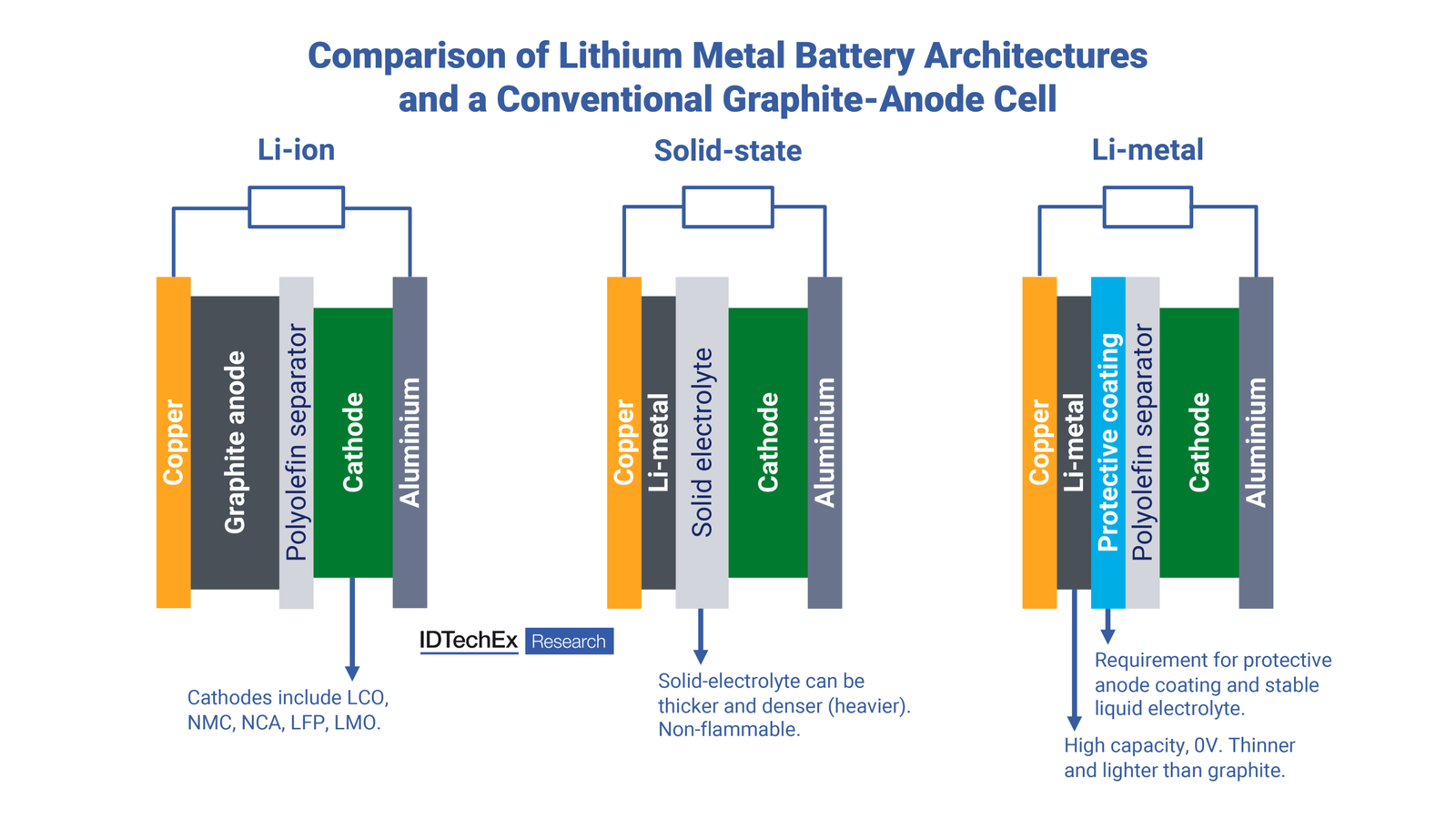
Image source: Bing (Web (fair-use with source credit))
The image above shows the physical difference. The lithium metal strip on the left is what you'd use as an anode. The dark powder on the right is graphite.
They're not the same at all.
The Dendrite Problem
Here's why lithium metal is hard. When you charge a cell, lithium ions travel to the anode, gain electrons, and plate as metallic lithium. In an ideal world, that plating is smooth and uniform.
In reality, lithium plates unevenly. It forms needle-like structures called dendrites.
In a liquid electrolyte cell, dendrites can grow across the separator, short the cell, and cause thermal runaway. That's bad. In a solid state cell with a lithium metal anode, dendrites still form, but now they're pushing against a solid electrolyte.
If the solid electrolyte is hard and ceramic, the dendrite can't push through easily. But if there's even a tiny crack or defect in the ceramic, the dendrite finds it. And once it penetrates, the cell shorts.
If the solid electrolyte is soft and polymer, the dendrite can physically push through the material. The polymer deforms, the dendrite grows, and the cell shorts anyway.
This is the central paradox of solid state battery design. Hard electrolytes resist dendrites but crack. Soft electrolytes conform but get penetrated.
No single material solves both problems perfectly.
Current Solutions
| Approach | How It Works | Trade-off |
|---|---|---|
| Hybrid electrolyte | Ceramic layer sandwiched between polymer layers | Better interface contact, but manufacturing complexity increases |
| Anode-free design | No anode at all — lithium plates directly onto current collector | Higher energy density, but absolutely requires zero defects in electrolyte |
| Artificial SEI | Thin protective coating on lithium metal surface | Prevents side reactions, but adds cost and processing steps |
| Stack pressure | Physical pressure keeps lithium in contact with electrolyte | Adds weight and mechanical complexity to the pack |
The most promising approach as of 2026 appears to be the hybrid electrolyte. You get the mechanical strength of ceramic with the interfacial compliance of polymer. Several companies, including QuantumScape, have demonstrated cells with this architecture that cycle over 800 times with reasonable capacity retention.